Shop by problem
Disclosure: As an Amazon Associate, we earn from qualifying purchases. We may earn a commission when you buy through our partner links. It doesn't affect our recommendations or what you pay. Prices and availability change frequently; editorial ranges are planning estimates, not live quotes. Check the retailer for current prices, pack sizes, and availability. Learn more
Gasket-Lid Bins (IRIS WeatherPro or Sterilite Gasket Box)
Foam-gasket lids with latching clips — for non-textiles; fabric needs to breathe. Best for: Documents, photos, tools, anything moisture-sensitive that isn't fabric.
Moisture Absorbers (DampRid, bulk)
Calcium-chloride tubs plus silica packs — replace both at every 3-month check. Best for: Inside bins, preventing mold for years.
Cedar Blocks (Large Pack)
Natural moth protection for textiles — cedar, not mothballs, which leave a smell that never fully leaves wool. Best for: Wool, silk, natural fiber protection.
Vacuum Storage Bags (Ziploc Space Bag or Spacesaver, jumbo)
Short-term space savers — not for 6+ months, and never for wool, down, or leather (compression sets permanent creases and the fibers need air). Best for: Synthetic comforters and pillows stored for a season, not years.
Breathable Furniture & Mattress Covers
Woven fabric covers, not plastic sheeting — they stop dust without sealing moisture against the finish. Best for: Sofas, chairs, mattresses.
Labels & Inventory (Avery or Brother P-touch)
Number every box, photograph the contents, keep the list in your phone. Best for: Finding one item after two years.
Preparation Timeline
Four weeks is the comfortable runway; two is doable if you already know what's going. The order matters more than the calendar — decluttering has to happen before you size the unit, and cleaning has to happen before anything gets sealed.
4 Weeks Before
This is the decision month, not the packing month. Everything you do now is about storing less: the cheapest storage unit is the one you size down after a real declutter, and every 10x10 you avoid renting is $1,200–3,600 a year you keep.
- ☐Declutter first, before you size anything — sell or donate in this window, because charity pickups book 2–3 weeks out
- ☐Size the unit against what's left: a 5x10 holds roughly one bedroom, a 10x10 holds a 1–2 bedroom home (about 800 cu ft to the ceiling, less the aisle you need to reach the back), and a 10x15 takes a 2–3 bedroom house
- ☐Reserve the unit — climate-controlled 10x10 runs $100–300/month, and most facilities run a first-month promotion worth asking for
- ☐Order supplies: budget 8–10 gasket-lid bins ($15–35 each), one roll of 2 in packing tape per 15–20 boxes, and covers for anything upholstered
- ☐Photograph every valuable item and note serial numbers — facility-offered policies commonly start around $2,000–3,000 of coverage, which is less than most people assume
2 Weeks Before
Packing starts now, and it starts with the things you won't miss. Label as you go — a box you seal without labeling is a box you open twice.
- ☐Pack the obvious non-essentials first: off-season clothes, books, décor, anything you haven't touched in 6 months
- ☐Cap every box at about 40 lb — a 16 x 12 x 12 in book box is already there when it's full, and boxes above that split at the seam
- ☐Clean each item as it's packed, not in a single push at the end
- ☐Disassemble beds, tables, and shelving; hardware into a labeled zip bag taped to the underside of the piece it came off
- ☐Number every box on two sides and the lid, and log the contents in your phone against that number
- ☐Pull deeds, wills, titles, passports, and current tax records into one box that stays with you — those never go to a storage unit
1 Week Before
The drying-out week. Every item that goes in wet — a fridge, a washer hose, a comforter, a patio cushion — is the item that ruins the things next to it. Give fabrics and appliances a full day of air before they're sealed up.
- ☐Deep clean furniture and appliances; vacuum upholstery on both sides, since food residue is what draws pests
- ☐Drain fuel from mowers, trimmers, and generators, or run them dry — facilities prohibit stored fuel, and it's a lease violation as well as a fire risk
- ☐Defrost fridges and freezers a full 24 hours, then hand-dry the door gasket, where the last water always hides
- ☐Wash all fabrics and air-dry them 24–48 hours after washing — anything even slightly damp mildews inside a few weeks
- ☐Apply wood conditioner to wood and conditioner to leather, and let both cure 24 hours before wrapping
Moving Day
Load once, in the right order — heaviest at the back and bottom, a center aisle you can actually walk, and nothing touching the concrete. Rearranging a full unit later means unloading it.
- ☐Final walkthrough against the numbered inventory before anything goes on the truck
- ☐Lay pallets or 2x4s across the unit floor first — everything sits 3–4 in off the concrete, which is where condensation collects
- ☐Heaviest at the back and on the bottom; don't stack above chest height, roughly 4–5 ft, or the bottom bins bow and the top one comes down on you
- ☐Leave a center aisle of 24–30 in — enough to walk in with a box in both hands
- ☐Leave 2–4 in between the stacks and the unit walls so air can move behind them
- ☐Anything you'll want inside a year goes by the door, labels facing out
After Storage
Five minutes of admin now is what makes the unit usable in two years. The photo of the loaded unit and the inventory list are the two things people always wish they had.
- ☐Photograph the loaded unit from the doorway — that one picture is what tells you later whether something moved
- ☐Confirm coverage: homeowners and renters policies commonly cover off-premises property at around 10% of your contents limit, which is often well under the value in the unit. Confirm the figure with your carrier rather than assuming it
- ☐Set a recurring 15-minute calendar event every 3 months, first one dated now
- ☐Put the unit key somewhere you'd find it in two years, and give the gate code to one other person
- ☐Keep the numbered inventory in your phone and in one cloud folder, not on paper in the unit
Checklists by Category
Six categories account for nearly everything that goes into long-term storage, and each fails in its own way — wood warps, electronics corrode, fabric attracts moths, appliances grow mold behind a closed door. Items marked critical are the ones that cause permanent damage if you skip them.
Furniture
- !Vacuum upholstery on both sides and wipe every hard surface — food residue is what draws pests, and a crumb under a cushion feeds them for a season(critical)
- ☐Disassemble beds, tables, and shelving; hardware into a labeled zip bag taped to the underside of the piece
- !Wrap in moving blankets (the standard pad is about 72 x 80 in), never plastic sheeting — plastic seals moisture against the finish(critical)
- ☐Wood conditioner on unfinished, oiled, or antique wood; let it cure 24 hours before wrapping
- ☐Cushions off and stored flat and separately, so nothing compresses in the same spot for two years
- !Up on pallets or 2x4s, 3–4 in off the concrete, and 2–4 in clear of the unit walls(critical)
Electronics
- !Back up every drive twice, to two places, before anything is boxed — storage is where drives go to fail unnoticed(critical)
- !Remove every battery, including remotes and backup cells — alkaline cells commonly leak within a year or two and take the contacts with them(critical)
- ☐Use the original box and foam inserts if you kept them — then put that box on a shelf or inside a bin, never on the floor (the cardboard is only protective as an inner layer)
- ☐Anti-static bags for bare boards and drives; bubble wrap for screens, 2 layers minimum on anything glass
- !Climate-controlled only, 55–80°F — and let anything stored cold sit 24 hours at room temperature before you power it on, or condensation does the damage the unit prevented(critical)
- ☐Coil cords in loose 6–8 in loops with velcro, not zip ties, one labeled bag per device
Clothing & Textiles
- !Wash everything, including items worn once — body oils and food residue are what moths and carpet beetles actually feed on, not the fabric(critical)
- !Air-dry 24–48 hours after washing; anything even slightly damp mildews inside a few weeks and the smell doesn't come out(critical)
- ☐Wardrobe boxes (about 24 x 21 x 46 in) for coats and suits that shouldn't be folded for years
- ☐2–3 cedar blocks per container, sanded lightly once a year to reopen the pores — never mothballs, whose smell never fully leaves wool
- ☐No vacuum bags past a single season, and never for wool, down, or leather: compression sets permanent creases and those fibers need air
- !Breathable cotton or canvas containers, not sealed plastic — this is the one carve-out to the gasket-bin rule, because a sealed bin traps the humidity that was in the air when you closed it(critical)
Documents & Photos
- !Scan first: 300 dpi for documents, 600 dpi for photos and slides. Above a few thousand photos a scanning service costs less than your weekends(critical)
- ☐Acid-free, lignin-free boxes and sleeves; pull out every rubber band and paper clip, which stain and rust into the paper within a year
- !The acid-free box then goes inside a gasket-lid bin — the archival box handles chemistry, the bin handles water(critical)
- !Up on a shelf or pallet like everything else — 3–4 in off the concrete, 2–4 in clear of the walls, and never stacked directly on the floor(critical)
- ☐Fireproof safe at home for the originals — deeds, wills, titles, birth certificates and passports never go in a storage unit at all
- !Climate control required: 55–80°F with humidity held under about 55%. Paper yellows and photo emulsion fuses to its sleeve within a couple of humid summers(critical)
Appliances
- !Clean inside and out, including the crumb tray, the drip pan, and the gasket folds — a teaspoon of residue is a food source for a whole season(critical)
- !Defrost fridges and freezers a full 24 hours, then hand-dry the door gasket, which holds water after everything else looks dry(critical)
- !Door propped 1–2 in open — tape a rolled towel into the gap. A sealed fridge door grows mold in weeks(critical)
- ☐Hoses off, drained, and stored inside the drum where they can't be crushed
- ☐Coil power cords in loose 6–8 in loops and tape them to the back; a kinked cord cracks its insulation over a couple of years
- !Upright, always. A fridge laid on its side lets compressor oil into the refrigerant lines — if one had to travel flat, stand it up 24 hours before it's ever plugged in(critical)
Mattresses & Bedding
- !Vacuum both sides and air it out 24 hours before it's bagged(critical)
- !Breathable mattress bag or cover, not a sealed plastic sleeve — sealed plastic traps body moisture the foam is still holding(critical)
- !Flat on a pallet, never on its side: springs and foam sag permanently within a few months on edge(critical)
- !Nothing stacked on top. A mattress is not a shelf, and a single heavy bin leaves a dent that doesn't recover(critical)
- ☐Pillows and duvets in breathable cotton bags — this is exactly the fabric carve-out, not a vacuum-bag job
- ☐Climate control recommended: memory foam stiffens and yellows in an unconditioned unit that clears 85°F for months at a stretch
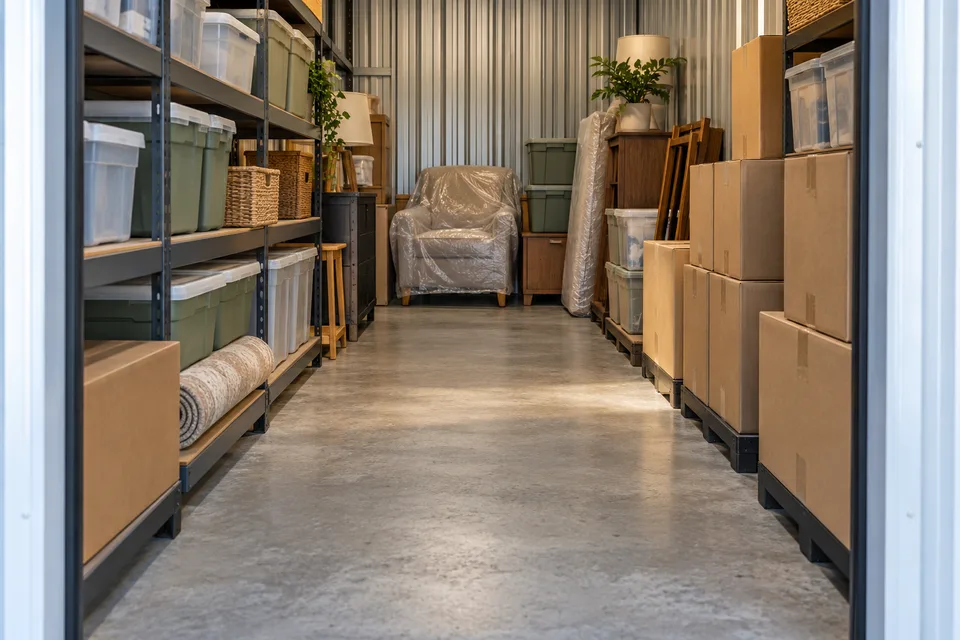
Climate Control, Pests, and the 3-Month Check
Once the boxes are in the unit, three things decide whether they come out intact: the air in the room, whether anything living gets in, and whether you ever look. Climate control handles the first, cleanliness and cedar handle the second, and a quarterly 15-minute visit handles the third.
Climate Control Considerations
Climate control adds 10–30% to the rent (Extra Space publishes about 17%; Public Storage says typically 10–30% more): a 10x10 that goes for roughly $90–230/month without it lands at the $100–300/month this page quotes throughout. What you buy for that premium is a unit held around 55–80°F with humidity kept in check. Read the facility's actual spec before you sign — a unit that only promises to stay under 85°F is not climate control for leather, electronics, or instruments, and some facilities condition temperature but not humidity, which is the half that matters most for paper and wood. Worth the premium for:
- Wood furniture — solid wood moves with humidity; joints loosen and panels cup below about 35% or above about 60% relative humidity
- Electronics — condensation when a cold unit warms up is what corrodes boards; also let anything stored cold sit 24 hours at room temperature before powering it on
- Documents and photos — heat and humidity yellow paper and fuse photo emulsion to sleeves within a couple of summers
- Leather — dries and cracks in dry heat, grows mildew above roughly 60% humidity. There is no safe unconditioned option for it
- Musical instruments — a guitar or piano wants roughly 45–55% relative humidity; outside that, necks bow and soundboards crack
- Anything at all past 6 months in a humid climate, where an unconditioned unit tracks outdoor dew point all summer
Pro Tip: Moisture Absorbers
Even in climate-controlled units, place silica gel packets or moisture absorbers (DampRid) throughout your unit. Replace every 3 months during check-ins. This provides an extra layer of protection, especially in humid regions.
Pest Prevention
Pests come for food and nesting material, and a storage unit supplies both if you let it. Cardboard and crumbs are the two things to eliminate:
- Never store food — not even sealed jars or sealed pet food. A mouse follows the smell and chews the container to reach it
- Clean everything before it goes in — a teaspoon of crumbs in a toaster or a grill tray is a food source for a season
- Cedar or lavender, 2–3 blocks per bin — sand the cedar lightly once a year to reopen the pores; it stops working long before it looks used up
- Avoid cardboard as the outer container past about 6 months — pests eat it and it wicks moisture. Use gasket-lid plastic bins for everything except fabric: clothing, linens, and anything else that needs to breathe goes in breathable cotton or canvas containers instead, because a sealed bin traps whatever humidity was in the air when you closed it. That is the one carve-out, and it is not optional
- Check during visits — droppings, gnaw marks along bin lips, and shredded paper are the three early signs
Quarterly Check-In Routine
Budget 15 minutes every three months. Almost every storage horror story is a problem that was small and fixable for months before anyone opened the door:
- Open the unit and let air circulate for 10–15 minutes before you touch anything
- Check for moisture, mold, and pests — look at the concrete floor and the back wall first, where condensation shows up before anywhere else
- Inspect covers and wrappings for tears, and re-cover anything that has slipped
- Replace the moisture absorbers — a calcium-chloride tub is usually spent inside 3 months, and a full reservoir means the unit is damper than you think
- Verify nothing has shifted or fallen; restack anything above chest height
- Update the inventory list if anything came out or went in
When Long-Term Storage Costs More Than the Stuff
There is one honest test, and it isn't what the contents were worth new. Storage is worth paying for only while the bill stays below what it would cost to replace what's in the unit — secondhand, at today's prices, for the things you'd actually bother replacing. Figures below assume a 10x10 climate-controlled unit at $100–300/month, the range most metros fall in.
The trap is the sunk-cost year. If you've been paying for 18 months and still can't name six things in the unit, the answer isn't a cheaper unit — it's an afternoon spent emptying it.
Doing the whole house?The free 12-week planner takes one room a week, with a printable checklist for each. Get the planner. No email required.
Long-Term Storage FAQ
How long can you store items in a storage unit?+
There's no maximum time limit — many people store for years. The limit is financial, not contractual: a 10x10 climate-controlled unit runs about $100–300 a month, so one year costs $1,200–$3,600 and three years $3,600–$10,800. Storage is worth paying for while that running total stays below what replacing the contents would cost. Visit every 3 months to check for moisture, pests, and anything that has shifted.
Can you store things in cardboard boxes long-term?+
Not as the outer container. Past about 6 months, bare cardboard sags under stacked weight, wicks moisture out of the air, and gives rodents both food and nesting material — use gasket-lid plastic bins ($15–35 each) instead. Two exceptions. An original equipment box with its foam inserts is genuinely protective: keep it, but put it on a shelf or inside a bin, never directly on the concrete floor. And fabric doesn't go in sealed plastic at all — clothing, linens, pillows, and duvets need breathable cotton or canvas containers, because a gasket bin traps whatever humidity was in the air when you closed it.
What should you not put in long-term storage?+
Every facility lease prohibits the same list: food of any kind (including sealed jars and pet food), fuel and propane, paint, solvents, ammunition, plants, and animals. Drain mowers, trimmers, and generators dry before they go in. Beyond the lease, four things belong at home rather than in a unit: deeds, wills, titles, and passports; anything that hasn't been fully dried; batteries left inside electronics, which commonly leak within a year or two; and irreplaceables you haven't insured, since facility-offered policies commonly start around $2,000–3,000 of coverage and a homeowners policy typically covers off-premises property at only about 10% of your contents limit. Confirm both figures with your carrier.
How do you prepare furniture for long-term storage?+
Six steps. Vacuum upholstery on both sides and wipe every hard surface, because food residue is what draws pests. Disassemble beds, tables, and shelving, and tape the hardware in a labeled zip bag to the underside of the piece. Wrap in moving blankets — the standard pad is about 72 x 80 inches — and never in plastic sheeting, which seals moisture against the finish. Apply wood conditioner to unfinished, oiled, or antique wood and let it cure 24 hours before wrapping. Take cushions off and store them flat and separately. Then set everything on pallets or 2x4s, 3–4 inches off the concrete and 2–4 inches clear of the walls, and don't stack above chest height.
Long-Term Storage Protection
Six purchases, $105–220 all in, cover the protection side of a typical unit — roughly one month's rent, once. The four-item core kit is $70–155 of that. Bins and desiccant first: those are what stand between your boxes and the humidity.
Browse storage options aboveFind long-term storage near you
Compare climate-controlled facilities for extended storage.
Find storage near you