Prep by furniture type, at a glance
Almost every piece of furniture ruined in storage was ruined by one of four things: moisture, a plastic cover, a concrete floor, or being folded. This table is the prep for each material and the one mistake that specifically wrecks it.
Tap a row to shop the thing it needs.
Disclosure: As an Amazon Associate, we earn from qualifying purchases. We may earn a commission when you buy through our partner links. It doesn't affect our recommendations or what you pay. Prices and availability change frequently; editorial ranges are planning estimates, not live quotes. Check the retailer for current prices, pack sizes, and availability. Learn more
Shop by problem
Breathable Furniture Covers (Set)
Cotton or non-woven polypropylene covers that stop dust without trapping moisture — not plastic sheeting. Best for: Sofas, armchairs, upholstered pieces.
Moving Blankets (6-Pack)
Standard 72 x 80 in padded blankets — the same thing professional movers use. Best for: Wood furniture, antiques, appliances.
Breathable Mattress Bag
Keeps dust and pests off while still letting the foam breathe. Best for: Mattresses, box springs.
Wood Conditioner (Howard Feed-N-Wax)
Beeswax and orange-oil conditioner for solid wood before a long stay — one coat, buffed off. Best for: Solid wood tables, dressers, antiques.
Leather Conditioner (Lexol or Leather Honey)
Cleans and feeds leather so it doesn't dry out and crack over months in storage. Best for: Leather sofas, chairs, ottomans.
Stretch Wrap Roll
Holds drawers and doors shut in transit — run it over a moving blanket, never against bare wood or leather. Best for: Securing drawers and doors, bundling hardware.
Moisture Absorbers (DampRid)
Calcium chloride tubs that pull humidity out of an enclosed unit — replace every 45-60 days. Best for: Enclosed units, preventing mildew.
Furniture Felt Pads (3M Scotch)
Stick-on felt for legs and feet so pieces don't gouge each other or the unit floor. Best for: Table legs, chair legs, preventing scratches.
Storage Tips by Furniture Type
The table above is the checklist; this is the detail behind it. Each material fails in its own way — wood at the joints, foam by taking a set, leather by drying out, veneer by delaminating — and the fix is different for each.
Wood Furniture
- ✓Solid wood and veneer need different care: solid wood moves with humidity and opens at the joints, while veneer and MDF delaminate and swell — and swollen veneer never goes back
- ✓One coat of a beeswax conditioner (Howard Feed-N-Wax) buffed off before storage; skip silicone sprays, which build a film that has to be stripped later
- ✓Aim for 30-50% relative humidity — the band the EPA recommends for indoor spaces, and comfortably under the 60% where mold starts
- ✓Take the legs off tables and bag the hardware, taped to the underside of the tabletop
- ✓Felt-pad the feet of anything that will stand on a concrete floor, even on a pallet
Upholstered Furniture
- ✓Let it dry 24-48 hours after any wet cleaning — a cushion that feels dry on the surface is not dry in the foam, and that's how a sofa comes out of storage smelling
- ✓Store cushions flat and separately rather than compressed under the frame; foam takes a set within weeks
- ✓A cotton or non-woven polypropylene cover ($20-50 a set) breathes; a plastic sofa bag is a greenhouse
- ✓Don't stack boxes on the seat long-term — the springs and webbing hold a load standing, not sitting under one for months
- ✓Nothing stored under it or against the arms: airflow on all four sides is the whole prevention strategy
Leather Furniture
- ✓Clean and condition before it goes in (Lexol or Leather Honey, $15-30), then again every 6 months if the stay runs long — leather dries out with time, not with use
- ✓Keep it away from vinyl, rubber, and printed cardboard: dye and plasticizer transfer onto pale leather and doesn't come off
- ✓Direct contact with a heated wall or an exterior metal roll-door is the other way leather dries; leave a 2-3 inch gap
- ✓One coat, thin — over-conditioning leaves a tacky surface that attracts dust
- ✓Cover with cotton, and don't fold or crease the cushions; a crease held for months becomes a crack
Mattresses & Bedding
- ✓A breathable mattress bag ($15-30), not a sealed plastic one — foam and fabric have to release moisture
- ✓Store flat when you have the floor space: flat is what protects the springs and foam layers
- ✓Upright on edge is a short-term compromise; months that way let the layers settle sideways and cause permanent sagging
- ✓Never fold a mattress, and don't stack anything heavier than bedding on top of one
- ✓Air it out for a day before you sleep on it again — every mattress out of storage smells like the unit
How to Place Furniture in Storage
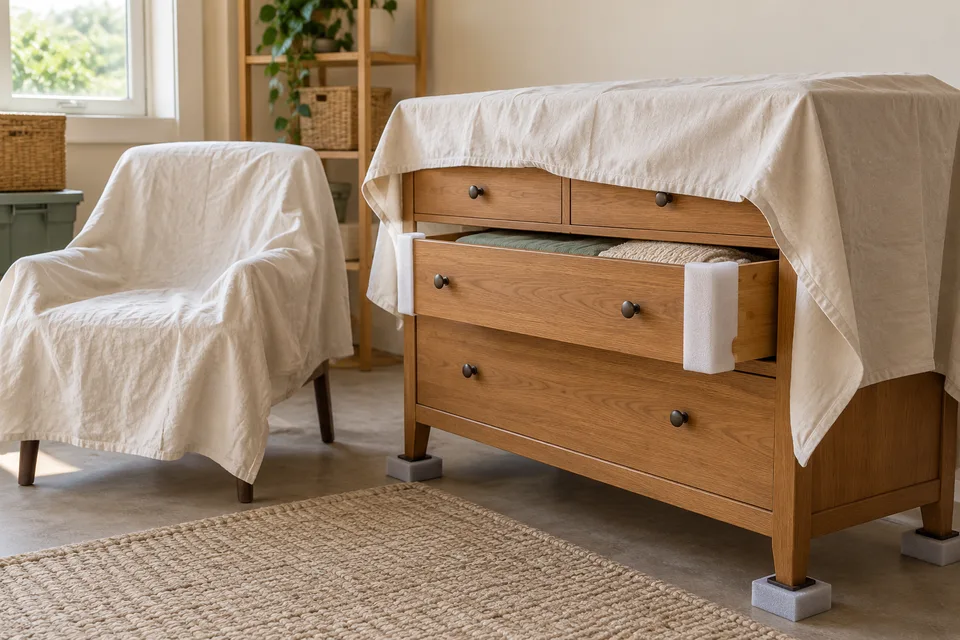
How a unit is loaded decides how much you fit and how much survives. Two numbers carry most of it: 4+ inches off the concrete, and 2-3 inches off the walls. A slab floor wicks moisture upward year-round, and a piece pressed against a metal exterior wall gets that wall's temperature.
The Golden Rules
- Elevate off the floor - Use pallets, boards, or furniture risers
- Leave space around items - 2-3 inches from walls for airflow
- Don't stack anything on furniture - Boxes belong on shelving or on the floor of the unit, not on a sofa seat or a tabletop
- Position strategically - What you'll need first goes nearest the door, and keep a walking aisle to the back wall
Optimal Placement Order
- Large furniture against back/side walls
- Mattresses flat on a pallet or on top of other flat items (upright along a wall only if space forces it)
- Tables on their side with the legs removed and the hardware bagged to the underside
- Chairs can hang on hooks or stack seat-to-seat
- Dressers can store boxed items in drawers
Space-Saving Tip
Store items inside furniture: blankets in dressers, small boxes in entertainment centers, off-season shoes in armoire bottoms. This maximizes your storage unit space.
Storing a Fridge or Freezer: Take the Doors Off
Every appliance instruction on this page says to block the doors ajar so the inside can dry, and that is right — a sealed damp fridge molds. But a propped-open fridge or freezer sitting in a garage, a carport, or a yard is a child-entrapment hazard, and it is the one piece of advice on this page that can kill somebody. The CPSC has documented suffocation deaths of children in stored and discarded appliances, most of them four to seven years old, and recommends completely removing the doors from any appliance being stored or discarded. In many jurisdictions it is illegal to leave one otherwise.
So: if the unit is going into a locked storage unit no child can enter, doors ajar is fine. If it is going anywhere a child could reach it — a garage, a shed, a driveway, the kerb — take the doors off. Dry the interior first either way. CPSC guidance on appliance entrapment.
Ongoing Care
One visit every month or two is enough, and it takes ten minutes. The point is to catch a humidity problem while it's a smell rather than after it's mold — and to swap the moisture absorbers, which are the only part of this that expires.
- Swap moisture absorbers every 45-60 days in a humid unit — a DampRid tub full of liquid has stopped working
- Check the pieces nearest the door first — they see the biggest temperature swings and show problems earliest
- Look for droppings and chewed cardboard, not for the pests themselves
- Leave the door open for ten minutes while you're there; that's the air exchange the unit gets all month
- Re-condition leather at the 6-month mark if the stay runs long
Doing the whole house?The free 12-week planner takes one room a week, with a printable checklist for each. Get the planner. No email required.
Furniture Storage FAQ
How long can furniture stay in storage?+
Indefinitely, if it went in clean and dry and the unit holds roughly 55-80°F and 30-50% relative humidity — the band the EPA recommends for indoor spaces. The EPA advises keeping indoor humidity below 60%, which is the real clock on furniture storage — not time. Visit every couple of months, swap the moisture absorbers (calcium chloride tubs last about 45-60 days in a humid unit), and check the pieces nearest the door, which see the biggest temperature swings.
Should I disassemble furniture for storage?+
Yes, wherever it comes apart without force: table legs, bed frames, shelving units. A disassembled dining table takes about a third of the floor space and can't get racked by something leaning on it. Bag the hardware, label the bag, and tape it to the underside of the piece it came from — not to a box that gets moved. Photograph each joint before you take it apart; reassembly is where the hour goes.
Is climate-controlled storage worth it for furniture?+
For wood, leather, upholstery, mattresses, and anything electronic: yes, and it costs about $30-50/mo more than a standard unit on a 10x10 — so on a three-month stay it's a $90-150 decision. Those materials are the ones that crack, warp, or grow mold when a unit swings from freezing to 100°F. For metal shelving, plastic bins, patio furniture, and tools in a mild climate, a standard unit is fine and the money is better spent on a bigger one.
Can I store a mattress in a storage unit?+
Yes. Use a breathable mattress bag and store it flat if you have the floor space — flat is what protects the internal springs and foam layers. Standing a mattress on its edge for months lets those layers settle sideways, which is what causes permanent sagging. If space forces you to store it upright, treat that as short-term and lay it flat again as soon as you can. Climate control is strongly recommended to prevent mold and mildew in the foam and fabric.
Furniture Storage Supplies
Three of these do most of the work: moving blankets, breathable covers, and moisture absorbers — about $60-135 for a household's worth. The conditioners are worth buying only if you have solid wood or leather going in.
Browse storage options aboveNeed climate-controlled storage?
Find units with first month free deals at facilities near you.
Find storage near you