Best Garage Shelving Systems (2026)

From budget wire racks to premium modular cabinets — find the right shelving for your garage, budget, and storage needs.

Updated: August 202612 min read

If you only read one thing

Skip the research and buy Edsal MuscleRack.

Steel shelving rated 500–1,000 lb per shelf on the boltless Z-BEAM units, ~$80–200 per unit (check the label on yours — ratings assume evenly-distributed weight). A typical unit is 36–48 in wide × 18–24 in deep × 72–78 in tall, so measure the gap to your fully-open car door before you pick a depth — a car door needs about 30 in of swing. Most garages need one or two of these and a FLEXIMOUNTS overhead rack (a 4 × 8 ft platform hanging 22–40 in below the ceiling) for seasonal bulk — that's the entire system. Skip the rest unless you're going premium-cabinet.

Quick Recommendations

Tap any recommendation to jump to the full comparison ↓

Garage Shelving Side-by-Side

Capacities are manufacturer ratings for evenly-distributed weight and vary by model — check the label on the unit you buy. Prices are typical street ranges for the category, and sizes are the configurations each category is commonly sold in.

Read the depth column against your own garage: a car door needs roughly 30 in of clear swing to open wide enough to get out of, so anything 18–24 in deep belongs on the back wall, and the 14–18 in units (or a track system, at 4–12 in) are what fits alongside a parked car.

Tap a row's shelving type to jump straight to the full comparison.

TypeCapacityTypical size (W × D × H)Typical priceInstallBest For
Wire Shelving800 lb/shelf on levelers, 160 on casters36–48 W × 14–18 D × 72 H (in)$40–100EasyGeneral storage
Steel Industrial500–1,000 lb/shelf (Z-BEAM)36–48 W × 18–24 D × 72–78 H (in)$80–200ModerateHeavy tools & parts
Wall Track SystemPer-hook — check each accessory's label48 in rails; hooks project 4–12 in$60–200ModerateBikes, tools, gear
Ceiling Rack750 lb rated (4×8 Classic)4 × 8 ft platform, hangs 22–40 in down$80–250HardSeasonal, bulky items
Modular Cabinets100–200 lb/shelf28–30 W × 18–24 D × 34–35 H (in), base$150–500+ModerateFinished garages
Plastic Shelving50–150 lb/shelf30–36 W × 14–18 D × 60–72 H (in)$30–70EasyLight items only

Garage Shelving Comparison by Type

Six categories, and most garages only need two of them. Read the capacity line first: it's the one spec that decides whether a rack is right, and the gap between plastic (50–150 lb per shelf) and boltless steel (500–1,000 lb) is roughly sevenfold. Then read the size line, because a rack that clears every weight you throw at it is still the wrong rack if it stops the car door opening — depth runs 14–24 in across these categories, and a door wants about 30 in of swing.
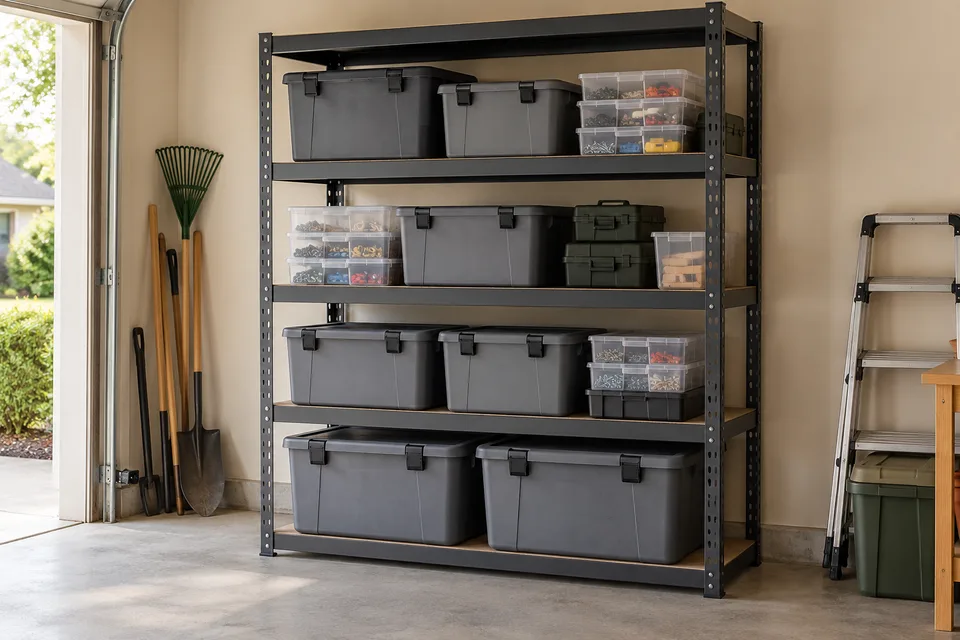
Typical price ranges for the category, not live listings. Amazon prices change frequently — click through for current pricing and availability.

Wire Shelving Units

Chrome or powder-coated wire racks — the affordable workhorse

Top pick:Trinity EcoStorage NSF (800 lb/shelf on levelers) — the Amazon Basics 5-Shelf is the cheaper alternative at 350 lb/shelf

Best for:

General garage storage, pantry overflow, laundry rooms

Price range:

$40–100 per unit

Typical size:

Typically 36–48 in wide × 14–18 in deep × 72 in tall, 4 or 5 shelves. The shallowest freestanding option here, which is why it's the one that usually fits beside a parked car.

✓ Pros

  • $40–100 a unit — the cheapest shelving that still carries real weight
  • Rated 800 lb per shelf on the feet levelers, but only 160 lb on the casters it ships with — swap to levelers before loading it heavily
  • Grooved posts let you move a shelf up or down in roughly 1 in steps, no tools
  • The open weave lets damp gear dry instead of trapping condensation against a solid deck
  • Shelves tap onto the posts with a mallet — one person, 15–30 minutes, no bolts

✗ Cons

  • Anything narrower than the ~1 in wire grid tips or drops through — plan on shelf liners or bins
  • A 72 in unit racks side to side until you bolt the top to a stud
  • Bare chrome pits and rusts at the welds in a damp garage; powder-coated versions hold up longer

Heavy-Duty Steel Shelving

Industrial bolt-together or rivet racks for serious weight

Top pick:Edsal MuscleRack Z-BEAM or Edsal Industrial Boltless Shelving

Best for:

Power tools, car parts, bulk storage, workshops

Price range:

$80–200 per unit

Typical size:

Typically 36–48 in wide × 18–24 in deep × 72–78 in tall, 4 or 5 shelves. At 24 in deep this is the category most likely to crowd an open car door — put it on the back wall.

✓ Pros

  • Boltless Z-BEAM units are rated 500–1,000 lb per shelf (800 lb with particleboard decking) — check the rating label on the exact unit you buy
  • Rivet beams lock into the uprights and carry the load into the corner posts, so the deck doesn't bow the way resin does
  • Beams pop out and reposition anywhere on the punched uprights — no drilling to change a shelf height
  • Most ship with particleboard decks over steel beams; a soaked or split deck is a cheap board, not a new unit

✗ Cons

  • A loaded unit is effectively immovable — decide where it lives before you build it
  • Rubber-mallet assembly runs 45–90 minutes for a 5-shelf unit and is genuinely easier with two people
  • 18–24 in deep: measure the gap to your open car door before you commit to a wall

Wall-Mounted Track Systems

Rails and hooks that keep everything off the floor

Top pick:Gladiator GearTrack or Rubbermaid FastTrack — both are stud-mounted rails with deep accessory lines; choose on which hooks and baskets you want, and compare the per-accessory weight ratings on the label

Best for:

Bikes, ladders, garden tools, sports gear

Price range:

$60–200 per system

Typical size:

Rails are commonly 48 in long and mount horizontally into studs; hooks and baskets project about 4–12 in from the wall. A full track wall costs you under a foot of depth — the only system that fits beside a car door in a tight bay.

✓ Pros

  • Everything hangs, so the floor stays clear for parking, sweeping, and the wet-vac
  • Hooks project only 4–12 in, so a whole wall of storage costs less depth than one shelving unit
  • Accessories slide anywhere along the rail and lock — rearranging costs you no new holes
  • Line-of-sight storage: you see the rake or the drill instead of excavating a bin to find it

✗ Cons

  • Rails have to land on studs (16 or 24 in centers) — drywall anchors alone will not hold a loaded hook
  • Capacity is per hook and per basket, not per rail: check the label on each accessory, not the system's headline number
  • Stud finder, level, and a drill; budget an afternoon for a full wall

Ceiling-Mounted Racks

Overhead platforms for bulky seasonal items

Top pick:FLEXIMOUNTS 4×8 Classic or MonsterRax 4×8 — both are 4 × 8 ft joist-mounted platforms; compare the height-adjustment range and the rating printed on the box

Best for:

Holiday decor, camping gear, luggage, seasonal tires

Price range:

$80–250 per rack

Typical size:

The common size is a 4 × 8 ft platform (48 × 96 in) hanging 22–40 in below the ceiling. Under a standard 8 ft garage ceiling that leaves roughly 4.5–6 ft of headroom underneath — measure your vehicle, including a roof box, before you mount one over a parking bay.

✓ Pros

  • 32 sq ft of platform (4 × 8 ft) in the one part of a garage nothing else competes for
  • Zero floor footprint — the only category on this page that costs you no square feet at all
  • Height adjusts 22–40 in below the ceiling, so you can tune the clearance to what parks underneath
  • The right home for what you touch twice a year: holiday bins, ski gear, a spare set of tires
  • Rated 750 lb when mounted into ceiling joists (4×8 Classic)

✗ Cons

  • Has to land on joists at 16 or 24 in centers — a drywall-only mount is how these fail
  • You need a ladder and usually two hands, so nothing you reach for monthly belongs up there
  • Lag bolts into joists leave holes: this is an owner's upgrade, not a renter's

Modular Cabinet Systems

Enclosed cabinets for a showroom-quality garage

Top pick:Gladiator GarageWorks (best value) or NewAge Pro Series 3.0 (premium 18-gauge)

Best for:

Workshops, chemicals, valuables, finished garages

Price range:

$150–500+ per cabinet

Typical size:

Base cabinets typically run 28–30 in wide × 18–24 in deep × 34–35 in tall — counter height, so a row of them gives you a work surface too. Wall cabinets are shallower, about 12–14 in deep.

✓ Pros

  • Doors close on the mess, which is the only reason to pay this much — it's the one category that changes how a garage looks
  • Lockable doors put solvents, pesticides, and power tools behind a key, away from kids
  • Enclosed backs and doors keep drywall dust and road grit off tools that live in an open bay

✗ Cons

  • $150–500+ per cabinet — a full wall costs more than everything else on this page combined
  • Depth is fixed at 18–24 in and shelves rarely adjust, so measure the car-door swing before you buy the run
  • A steel cabinet is a two-person carry while it's still empty; plan the layout before assembly, not after
  • Garage floors are poured with a slope for drainage, so expect to shim and level a long cabinet run

Budget Plastic Shelving

Lightweight resin shelves for light-duty storage

Top pick:Sterilite 5-Shelf or Plano 4-Shelf (200 lb total)

Best for:

Light items, seasonal decor, garden supplies

Price range:

$30–70 per unit

Typical size:

Typically 30–36 in wide × 14–18 in deep × 60–72 in tall, 4 or 5 shelves. Shelf heights are molded in place, so what you see in the listing is what you get.

✓ Pros

  • $30–70 a unit — the cheapest shelving on this page by a wide margin
  • Resin doesn't rust or rot, so it survives a damp slab and the odd hose-down better than raw steel
  • Snaps together by hand in 10–15 minutes with no fasteners, and one person can reposition it empty

✗ Cons

  • Lower weight capacity than steel — 50–150 lb per shelf on mainstream units
  • Resin creeps under sustained load: a shelf that bows stays bowed, and it won't come back flat
  • Shelf heights are molded in, so you can't reconfigure a bay for a tall item the way you can with steel or wire

How to Choose Garage Shelving

Two measurements decide almost everything: how deep the shelving can be before it blocks a car door, and how heavy your heaviest item is. Here are the working numbers for the first one. Freestanding garage shelving runs 18–24 in deep in steel and cabinets, 14–18 in in wire and plastic, and a car door needs roughly 30 in of clear swing to open far enough to get out of comfortably. A standard single bay is only about 12 ft wide, so park the car, open the door all the way, and measure from the door's edge to the wall — that number, not the product page, is your depth limit. Get those right and the rest is preference. One rule is non-negotiable regardless of what you buy — freestanding units get bolted to wall studs, because a loaded rack that tips is the way this project hurts someone.

  • Measure your garage first: ceiling height, usable wall width, and the gap between your fully-open car door and the wall. Anything deeper than that gap goes on the back wall or above the hood, not beside the driver's door
  • Weigh your heaviest items: Power tools and car parts need steel; holiday decor is fine on wire or plastic
  • Anchor to the wall: Always bolt freestanding shelves to wall studs to prevent tipping
  • Check headroom before an overhead rack: ceiling racks hang 22–40 in below the ceiling, so an 8 ft garage keeps about 4.5–6 ft of clearance underneath — fine over a sedan, tight over an SUV or a roof box
  • Leave floor clear: Wall and ceiling systems keep the floor open for parking and walking
  • Combine systems: the usual pairing is one or two freestanding units on the back wall plus 48 in of track rail beside the car and a 4 × 8 ft rack overhead
  • Consider moisture: In humid climates, choose powder-coated steel or plastic over raw metal

Where the load ratings come from

Every capacity on this page is the manufacturer's published rating for evenly-distributed weight — we have not load-tested these racks ourselves, and no independent lab figure exists for most of them. Confirm the number for your exact model on the maker's spec page or the label in the box before you load it:

  • Edsal — MuscleRack steel shelving manufacturer, official specs and load ratings.
  • Gladiator GarageWorks — GearTrack wall systems and modular cabinets.
  • FLEXIMOUNTS — ceiling-mounted overhead racks with weight ratings and joist-spacing specs.
  • NewAge Products — Pro Series modular cabinet systems.

Best Garage Shelving FAQ

What's the best garage shelving overall?+

Edsal MuscleRack — steel shelving rated 200–1,000 lb per shelf depending on the model — the boltless Z-BEAM units we recommend are rated 500–1,000 lb per shelf (800 lb with particleboard decking), and Edsal's separate welded storage racks go to 2,000 lb. Check the label on the one you buy, and treat every figure as evenly-distributed weight. Budget $80–200 per unit. A typical unit measures 36–48 in wide × 18–24 in deep × 72–78 in tall. Most garages need one or two units along one wall plus a FLEXIMOUNTS overhead rack for seasonal bulk — that's the entire shelving system. Skip the rest unless you're going premium-cabinet.

Wire vs steel garage shelving?+

Steel (Edsal MuscleRack, $80–200 per unit) holds 200–1,000 lb per shelf depending on the model (the Z-BEAM boltless units run 500–1,000 lb; check the label on yours) — doesn't sag, and works for tools, fluids, and bulk garage stock. It's also the deeper of the two at 18–24 in, against 14–18 in for wire, which matters if the wall you're using is the one beside the car. Wire (Trinity EcoStorage NSF, $40–100 per unit) is lighter and cheaper, is rated 800 lb per shelf on the feet levelers but only 160 lb per shelf on the casters it often ships with — swap to levelers before loading it — and works better for items you want airflow around (gear that gets wet, sports equipment). Both are commonly 36–48 in wide and about 72 in tall. For a typical garage, steel is the default; add wire if you have sports gear that needs to dry.

Wall-mounted vs freestanding shelving — which do I need?+

Wall-mounted track systems (Gladiator GearTrack, $60–200 per system depending on how many rails and accessories you buy) for tools and sports gear at eye level — line-of-sight access, doesn't take floor space, items hang individually. Rails are commonly 48 in long and hooks project only 4–12 in from the wall, against 18–24 in for a freestanding steel unit, which is why a track wall is usually what fits beside a parked car. Freestanding shelving (Edsal MuscleRack, $80–200 per unit) along one wall for bins and bulk. Most garages need one of each: wall for tools and active gear, freestanding for storage bins.

How deep can garage shelving be without blocking a car door?+

Measure the gap between your fully-open car door and the wall — that number is your depth limit, not what the product page says. The typical figures to check it against: heavy-duty steel shelving and modular cabinets run 18–24 in deep, wire and plastic units 14–18 in, and a car door needs roughly 30 in of clear swing to open far enough to get out of comfortably. A standard single bay is only about 12 ft wide, so in most garages the deep steel units belong on the back wall, and what fits alongside the car is a shallow wire unit (14 in) or a wall track system, whose hooks project just 4–12 in. Overhead racks avoid the problem entirely: a 4 × 8 ft platform hangs 22–40 in below the ceiling, leaving about 4.5–6 ft of headroom under a standard 8 ft garage ceiling — measure your vehicle's height, roof box included, before mounting one over a parking bay.

How much weight can garage shelving hold?+

Every figure below is the manufacturer's rating for evenly-distributed weight, and it varies by model — always check the label on the exact unit you buy rather than trusting a range. Steel industrial shelving (Edsal MuscleRack): 200–1,000 lb per shelf depending on model — the boltless Z-BEAM line is 500–1,000 lb, and Edsal's welded storage racks are rated higher still, to 2,000 lb. Wire shelving (Trinity EcoStorage NSF): 800 lb per shelf on levelers, 160 lb per shelf on casters — the wheels, not the frame, are the limit. Modular cabinets: 100–200 lb per shelf. Ceiling-mounted overhead racks: 500–800 lb depending on brand and series (FLEXIMOUNTS Classic 4×8 is 750 lb, its Lite series 600, SafeRacks 600, MonsterRax 500) when properly mounted into ceiling joists — never load above a rating on the assumption there's headroom. Plastic shelving: 50–150 lb per shelf (Sterilite and standard Keter units are rated 150 lb; Plano's Standard Duty is 50 lb), and up to 400 lb on metal-reinforced heavy-duty models.

Are ceiling-mounted garage racks safe?+

Yes, if mounted properly into ceiling joists (not drywall alone) with the brand's included hardware. The FLEXIMOUNTS 4×8 Classic is rated for 750 lb — treat that as the ceiling, not a target. Reserve them for seasonal and rarely-accessed items (holiday decor, summer pool gear, ski boots) and don't store anything above the car that you're not willing to drop on it. Use a ladder, not a step stool, to access overhead storage. On sizing: the platform is 4 × 8 ft and hangs 22–40 in below the ceiling, which leaves roughly 4.5–6 ft of headroom under a standard 8 ft garage ceiling — check your vehicle's height, roof box and antenna included, before you mount one over a parking bay.

Disclosure: As an Amazon Associate, we earn from qualifying purchases. We may earn a commission when you buy through our partner links — it doesn't affect our recommendations or what you pay. Prices and availability change frequently; figures shown were accurate at publication and may be different by the time you click through. Learn more

Show us your garage.

Snap a photo and we’ll tell you what’s in your way, what to mount on the wall, and how to get the car back inside.

Analyze My Garage