Useful additions for your space
Shop by problem
Use the best-for notes to find a relevant option. Check dimensions and compatibility before buying.
Disclosure: As an Amazon Associate, we earn from qualifying purchases. We may earn a commission when you buy through our partner links. It doesn't affect our recommendations or what you pay. Prices and availability change frequently; editorial ranges are planning estimates, not live quotes. Check the retailer for current prices, pack sizes, and availability. Learn more
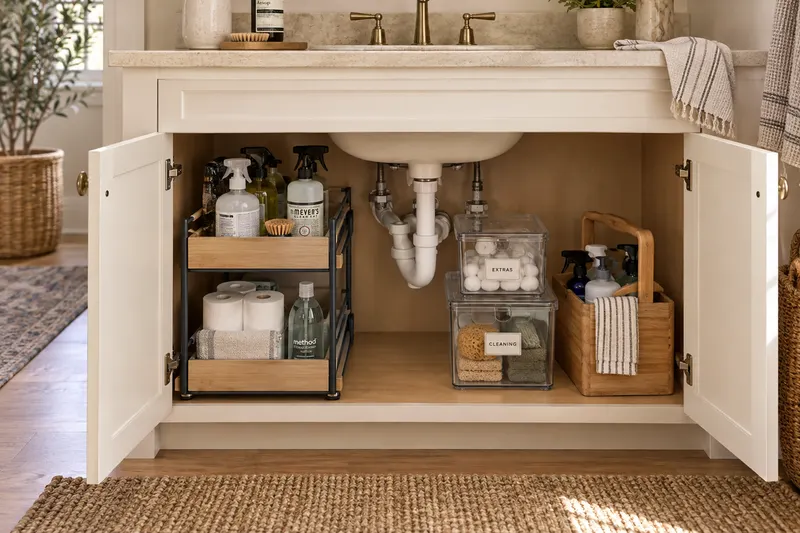
Under-Sink Organizer (2-Tier)
Two sliding tiers built to clear the P-trap. Best for: Cleaning supplies, extra products.
Vanity Drawer Dividers
Spring-loaded dividers for a deep drawer, an interlocking tray set for a shallow one. Best for: Makeup, dental, small tools.
Shower Caddy (Tension Pole)
Floor-to-ceiling pole with 3-4 baskets. Stainless or anodized aluminum survives daily steam, chrome-plated steel does not. Best for: Shampoo, soap, razors.
Over-Toilet Shelf (Étagère)
Freestanding unit that straddles the tank and adds three shelves. One anti-tip screw. Best for: Towels, toilet paper, toiletries.
Over-Door Organizer
Six rows of pockets or wire baskets on a bracket that hooks over a standard 1-3/8 inch door. Best for: Hair tools, brushes, products.
Adhesive Shower Shelves
Stick to smooth tile or glass and hold roughly 5-15 lb depending on the pack rating. The no-drill answer when a tension pole has no flat ceiling to press against. Best for: Shampoo, conditioner, razors.
Medicine Cabinet Organizer
Clear acrylic bins plus a two-step riser so the back row is readable. Best for: Daily skincare, dental, small tools.
Adhesive Towel Hooks (4-Pack)
No-drill hooks. Check the printed weight rating, because a soaked bath towel can run 3 lb or more. Best for: Towels, robes, loofahs.
1. Storage Solutions at a Glance
Ten fixes cover most bathrooms, and only the surface-mount cabinet needs more than one screw. Product names link to Amazon search results.
Budget Smart Start
If you only buy three things, spend about $50-110: an under-sink two-tier organizer ($20-40) + vanity drawer dividers ($7-20) + a tension-pole shower caddy ($25-50). That handles the counter, the drawer and the tub ledge, the three places that fill up first. The over-toilet shelf ($25-60) is the second-phase upgrade, taking this trio to about $75-170.
2. Under-Sink Cabinet Organization
The cabinet under a bathroom sink is a cave with a pipe through the middle, which is why everything ends up in one layer on the floor of it. Three pieces ($37-72) fix it: a two-tier pull-out organizer built around the P-trap ($20-40), a small turntable for the back corner ($10-20), a spring tension rod across the cabinet to hang spray bottles by their triggers ($7-12). Then one clear bin per category.
Measure Three Numbers First
Under-sink returns are almost always a measuring problem, not a product problem. Before you order anything, write down:
- Opening width. Measure at the narrowest point, usually the cabinet frame, not the doors.
- Front-to-back depth. Most vanities give you 16-20 inches of usable depth.
- Height to the bottom of the P-trap. This is the number that kills two-tier units, which typically stand 12-17 inches tall. Note whether the drain is centered or offset while you are in there, because that decides between a U-shaped shelf and two narrow towers.
What to Store Under the Sink
Under-sink space is damp, dark and hard to see into, so it earns bulk and backstock, not anything you reach for twice a day.
- Cleaning supplies, in a caddy you can lift out whole
- Refills and backstock (one bin, and when the bin is full you stop buying)
- Hair tools, in a heat-resistant holder or a metal bin, cord left loose
- Feminine hygiene products, in a lidded bin
- Not medication. See what goes where.
Line the cabinet floor with a waterproof mat or peel-and-stick liner ($8-18). A supply-line drip under a vanity can go unnoticed for weeks, and a liner turns it into a visible puddle instead of a swollen particleboard floor.
Don't Skip the Drawer
The vanity drawer is the other half of the same cabinet and it fails the same way: one layer, everything loose, nothing findable. A set of drawer dividers ($7-20) is the cheapest fix in this section. Adjustable spring-loaded dividers suit a deep drawer, an interlocking tray set suits a shallow one. Measure the drawer's interior depth before you buy. A standard vanity drawer is 2-4 inches deep, so check the tray height against yours.
3. Medicine Cabinet & Mirror Storage
A medicine cabinet is the most humid cabinet in the house, which makes it excellent for the things you use wet and daily, and a poor home for the one category it is named after. Give it your face and teeth routine, contained in $15-30 of clear acrylic bins and a two-step riser so the back row is readable without unpacking the front.
- Set shelf heights to your tallest daily bottle. Most cabinets have adjustable pins, and one tall shelf plus two short ones beats three equal ones.
- Magnetic holder inside the door ($5-15). Tweezers, nail clippers and bobby pins, the items that otherwise migrate to the bottom of a drawer.
- Check the open-jar symbol. The small icon with 6M or 12M on cosmetics is the months-after-opening shelf life. Date the bottom of the bottle with a marker when you open it.
- Move medication out. Steam is the enemy of tablets, capsules and adhesive strips.
No Medicine Cabinet?
If there is no cabinet behind the mirror, the cheapest replacement is a surface-mount cabinet over the sink ($50-200, screwed into studs or hollow-wall anchors) or a mirror with hinged storage behind it. A recessed cabinet looks better and steals no room depth, but it means cutting the wall, which needs an interior wall (recessing into an exterior wall removes the insulation) and a bay with no plumbing or wiring in it. If a stud has to be cut, that is a header and a permit, not a weekend job. Renting? A three-tier wall shelf with a rail ($20-60) mounted beside the mirror does the same job with four screws.
4. Over-Toilet Storage
The wall above the toilet is the single biggest piece of unused storage in most bathrooms, and an étagère claims it for $25-60 without touching the floor plan. Measure your tank at its widest point, including the flush handle and any supply line, before you order. Most over-toilet units are 22-25 inches wide and need 8-10 inches of clear depth behind the legs.
Étagère / Ladder Shelf, $25-60
Three open shelves, no installation. Best all-round pick.
Wall Cabinet, $35-150
Doors hide the clutter, which matters in a guest bath. Needs two studs or toggle anchors and a level.
Floating Shelves, $15-35
Cheapest per linear foot and visually lightest. Hang the lowest shelf at least 8 inches above the tank lid so you can still lift it.
Anchor it. Freestanding étagères are tall, narrow and top-heavy by design. Most ship with a small anti-tip bracket and a screw. Use it, and if yours did not include one, use a furniture anti-tip strap, especially if small children use this bathroom. It takes two minutes and one drywall anchor.
5. Shower & Tub Organization
Everything in a shower is wet, soapy and slowly rusting, so the fix is fewer bottles on surfaces that drain. Two products cover almost every shower: a tension-pole corner caddy ($25-50) if you have a flat ceiling, or adhesive shelves ($8-20) if you don't.
- Tension pole caddy ($25-50). Three or four baskets, no drilling, holds the most. It needs floor-to-ceiling contact on a flat surface.
- Adhesive shelves ($8-20). They stick to smooth tile or glass and hold roughly 5-15 lb depending on the pack rating. Check it, because a full 32 oz shampoo bottle is about 2 lb.
- Suction cups. The cheapest and the least reliable. They fail on textured tile, matte surfaces, and anywhere a grout line runs under the cup.
- Hanging over-showerhead caddy ($15-30). Zero install, but it swings and drips onto the tub edge.
- Materials. 304 stainless or anodized aluminum survives daily steam. Chrome-plated steel rusts at the weld points within a year or two.
Reduce products first. Three to five bottles per person is the target. Every bottle you remove is one less ring to scrub, and it is cheaper than any caddy.
6. Towel Storage Solutions
Roll, don't fold. A rolled bath towel is about 5-7 inches across, so a 12-inch-deep shelf takes two rows deep where a folded stack takes one, and rolls stay neat in open storage while stacks collapse the moment someone pulls from the middle. Store the rotation in the bathroom and the backstock somewhere dry.
- Hooks, one per person ($7-10 for a 4-pack). A towel on a hook dries faster than a towel folded double over a bar, and everyone knows whose is whose. Check the printed weight rating, because a soaked bath towel can run 3 lb or more.
- Bars are for drying, not storage. A standard 24-inch bar holds one bath towel spread flat.
- Étagère or ladder shelf ($25-60). It holds a family's rotation vertically over space the toilet was already occupying.
- Hall linen closet. Backstock linens do not belong in a bathroom.
How Many Towels Do You Need?
Two to three bath towels per person, and one to two more for guests. A four-person household is fine at 9-14 bath towels total. Anything past that is stored laundry, and storing it in the bathroom is what creates the smell.
7. Small Bathroom Strategies
In a bathroom under about 40 square feet, the only free space left is inside the walls and on the back of the door. A standard interior wall framed with 2x4s at 16 inches on center gives you 3.5 inches of depth and roughly 14.5 inches of width between studs, enough for a recessed niche that holds every bottle in the room and projects nothing into the floor plan.
- Over-door organizer ($10-30). Six rows on a bracket that hooks over a standard 1-3/8 inch door, the highest storage-per-dollar item in this guide.
- Recessed niche between studs. 3.5 inches deep, about 14.5 inches wide. Interior walls only, no stud cut, and open the bay carefully, because plumbing and wiring live in there.
- Pedestal sink skirt. A fabric skirt on a tension wire hides two stacked bins under a sink with no cabinet.
- Corner shelves. The one place a 10-inch shelf doesn't collide with anyone.
- Wall-mount the small stuff. Toothbrush holder, soap dispenser, cup. Each one clears roughly a 4-inch circle of counter.
For Renters
Everything above works without drilling, beyond the étagère's one anti-tip anchor, if you swap the mounting method:
- Adhesive hooks and strips ($7-10 per 4-pack). Command is the reference brand. Match the printed rating to the load and remove them by pulling the tab straight down, not out.
- Spring tension rods ($7-12) inside the vanity for spray bottles, and across a corner for a shower curtain that doubles as a screen.
- Freestanding étagère ($25-60) instead of a wall cabinet.
- Over-door organizer ($10-30) instead of shelves.
8. What Goes Where (and What Doesn't)
A bathroom swings to near-saturated humidity every time somebody showers and takes 20-60 minutes to come back down even with the fan running, so "where does this go" is really a question about what tolerates steam. Daily-use, water-resistant items get the prime real estate at eye level. Anything paper, powdered or pharmaceutical belongs in another room.
Browse the storage options above once you know what your space needs.
Doing the whole house?The free 12-week planner takes one room a week, with a printable checklist for each. Get the planner. No email required.
Bathroom Storage FAQ
How do I organize a bathroom with no storage?+
Build storage on the three surfaces every bathroom already has: the wall above the toilet, the back of the door, and the cabinet under the sink. An over-toilet étagère ($25-60) adds three levels in zero floor space, an over-door organizer ($10-30) turns the door into six rows, adhesive shower shelves ($8-20) clear the tub-ledge bottle graveyard, and a two-tier sliding under-sink organizer ($20-40) doubles the cabinet. All four together run about $65-150, and the only hole any of them needs is the single anti-tip anchor that keeps a freestanding étagère from tipping.
How much does it cost to organize a bathroom?+
A full bathroom build with one screw is about $65-150: over-toilet shelf $25-60, under-sink two-tier organizer $20-40, over-door organizer $10-30, adhesive shower shelves $8-20. If you only buy three things, a different basket runs about $50-110: the under-sink organizer ($20-40), a set of vanity drawer dividers ($7-20), and a tension-pole shower caddy ($25-50). A surface-mount medicine cabinet is the one line item that jumps: $50-200 plus installation.
What is the best way to organize under a bathroom sink?+
A two-tier pull-out organizer sized around the P-trap ($20-40) does most of the work, and the cabinet becomes two sliding shelves. Add a small turntable ($10-20) in the back corner for tall bottles, a spring tension rod ($7-12) mounted across the cabinet to hang spray bottles by their triggers, and one clear bin per category (hair, dental, cleaning, backstock). Measure three numbers first: the cabinet opening width, the front-to-back depth, and the height from the cabinet floor to the bottom of the P-trap.
Should medications be stored in the bathroom?+
No. A bathroom is the worst room in the house for medication. Heat and humidity from showers degrade tablets, capsules and adhesives faster than a cool dry cabinet does, and the medicine cabinet sits directly in that steam. Keep daily skincare, dental and grooming items there instead, and move prescriptions and over-the-counter medicine to a bedroom closet shelf or a kitchen cabinet away from the stove and the dishwasher.
How do I store towels in a small bathroom?+
Roll, don't fold. A rolled bath towel is about 5-7 inches across, so a 12-inch-deep shelf takes two rows deep instead of one folded stack. An over-toilet étagère ($25-60) holds a family's rotation vertically in a footprint the toilet was already using. Adhesive hooks ($7-10 for a 4-pack) take the in-use towels: one hook per person dries a towel faster than a shared bar and makes it obvious whose towel is on the floor. Backstock linens shouldn't live in the bathroom at all. Humidity is why the hall closet exists.
See our best storage bins
Clear stackable, fabric, heavy-duty and airtight bins, compared on price, capacity, and what actually fails.
See Top Picks