Shop by problem
Disclosure: As an Amazon Associate, we earn from qualifying purchases. We may earn a commission when you buy through our partner links. It doesn't affect our recommendations or what you pay. Prices and availability change frequently; editorial ranges are planning estimates, not live quotes. Check the retailer for current prices, pack sizes, and availability. Learn more
Wall-Mounted Panel System
Slatwall panels with hooks, baskets and shelves. Price is per 4x8-foot section, DIY installed. Best for: Tools, sports equipment, gardening gear.
Overhead Ceiling Rack
A 4x8-foot deck, typically manufacturer-rated 500-800 lb depending on brand and series, and only when every upright is fastened into solid wood ceiling joists. Check your unit's label. Best for: Seasonal items, bins, rarely-used gear.
Heavy-Duty Shelving Unit
Steel or wire shelving, 18-24 inches deep, rated 250-1,000+ lb per shelf. Edsal, Seville Classics and Trinity are the common ones. Best for: Bins, tools, heavy equipment.
Clear Storage Bins (6-Pack)
Stackable latching bins you can read from across the garage; Sterilite, IRIS and Rubbermaid all make garage-rated versions. Best for: Hardware, seasonal decor, sports gear.
Bike Hooks & Hangers
Wall or ceiling-mounted bike storage; a single screw-in hook must go into a stud or joist, never drywall. Best for: Bikes, scooters, outdoor toys.
Tool Organizer & Holders
Magnetic bars, pegboard hook assortments and yard-tool racks that get long handles off the floor. Best for: Hand tools, power tools, yard tools.
1. Storage Solutions at a Glance
Tap a row to shop the fix on Amazon, or follow the shelving and cabinet rows to our buying guides.
Budget Smart Start
The $115-255 starter kit: a 4x4 pegboard with hooks ($30-60) + one steel or wire shelving unit ($60-150) + a 6-pack of clear bins ($25-45). That is a tool wall, a bin wall and a labeling system. Add a slatwall section and an overhead rack later and you are into the $500-1,500 tier.
2. Assess Your Garage & Set Goals
Before buying anything, settle what the space is for, because parking is what makes every other decision. A standard two-car garage is about 20 x 20 feet (400 square feet) and a one-car is roughly 12 x 22. A typical car is about 6 feet wide and 15 feet long and needs about 30 inches beside it to open a door, which leaves usable wall depth of 18-24 inches on each side and a few feet at the front. Answer these five before you spend:
- Parking cars inside? If yes, cap shelving at 24 inches deep and keep everything else on the walls or overhead. If no, you gain roughly 200 square feet for every car you stop parking
- Workshop area? Budget 6-8 linear feet of bench at 30-36 inches high and 24-30 inches deep, plus outlets within reach of it
- Sports and hobby gear? Bikes, kayaks and long-handled tools want vertical hanging, not shelves. Measure the longest item now
- Seasonal items? Anything used two to four times a year belongs overhead. Count the bins. A 4x8 rack fits six 27-gallon totes in one layer, two rows of three. A real 27-gallon tote runs about 28-30 inches by 20
- Budget? $115-500 does a real DIY reset, $500-1,500 buys a full wall-and-ceiling system, and installed cabinetry starts near $1,500
3. Declutter First
The most expensive garage mistake is buying storage for things you will never use again. That is $300 of shelving to hold $0 of value. Do one pass, four piles, and finish the piles the same weekend. The rule that settles most arguments: if it has not been used in two full seasons and it is replaceable for under about $50, it goes.
- Trash. Broken items, dried-out latex paint, hardware for appliances you no longer own
- Donate. Working items unused for 2+ years. Load them into the car the same day
- Sell. Anything worth more than about $50 and easy to photograph; set a 30-day deadline, then it becomes a donation
- Keep. Used regularly or seasonally. It goes straight into a zone
Dispose properly. Solvent-based paint, pesticides, pool chemicals and old fuel are household hazardous waste and do not belong in a curbside bin. Most municipalities run a collection day or a drop-off site. Car batteries go back to the retailer (usually with a core refund), and propane cylinders go to an exchange cage, never the trash.
4. Create Activity Zones
Zoning is what makes a garage stay organized after week three, because it gives every object a single obvious address. Divide by activity, then use height as the second axis: daily gear between 30 and 60 inches off the floor where you can grab it without a ladder, heavy items low, and anything used a few times a year above 78 inches or overhead.
Parking Zone
About 10 x 20 feet per car, plus 30 inches at the driver's door. Mark it with tape on the floor once and the zone defends itself.
Workshop Zone
6-8 linear feet of bench at 30-36 inches high, with the wall above it at 30-60 inches given to the tools you reach for most.
Sports Zone
One wall, hung not shelved: bikes on hooks or a track, balls in a corner cage, long handles vertical.
Seasonal Zone
Overhead only. Holiday decor and camping gear in matching labeled totes so a 4x8 rack packs tightly.
5. Wall Storage Systems
Walls are the cheapest storage in the garage. Three systems cover almost every case, and the choice comes down to how heavy your gear is and how often you want to move things around. All three screw into studs (16 or 24 inches on center), not into drywall. If you cannot drill (renters, block walls), skip to freestanding steel shelving and a rolling tool chest. They do the same job without a screw.
Pegboard ($30-60)
Best for: hand tools, and the cheapest way to prove the concept before you commit
- Metal pegboard (Wall Control makes the widely sold version) holds far more than hardboard and the holes don't tear out
- Hardboard needs furring strips behind it. The hooks need the gap to seat
- Trace each tool's outline once and put-away becomes automatic
Slatwall Panels ($100-300 per 4x8 section)
Best for: flexible, reconfigurable storage across a whole wall
- $100-300 buys enough panel to cover a 4x8-foot section yourself (about $3-9 per square foot in materials)
- Accepts hundreds of accessory types: hooks, baskets, shelf brackets, cabinets. Proslat, StoreWALL and Gladiator are the systems with the deepest accessory catalogs
- Cleanest look of the three, and the easiest to change, since accessories move without leaving holes
- Panels screw into every stud they cross. The load rating assumes it
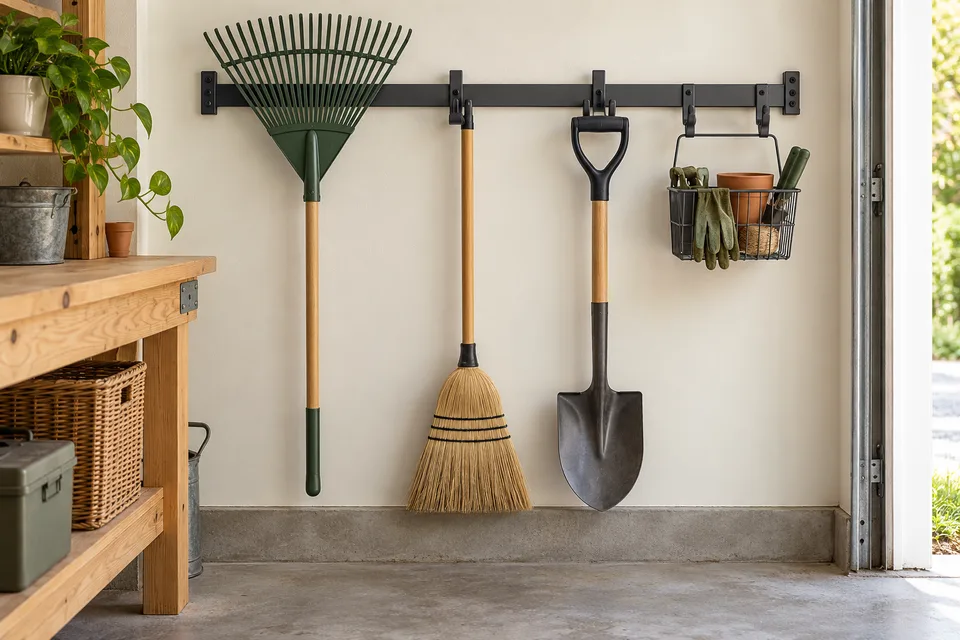
Track Systems ($60-200)
Best for: heavy, awkward items such as bikes, ladders and wheelbarrows
- $60-200 for a starter kit covering roughly 6-10 linear feet of rail plus hooks, about $10-20 per linear foot
- One rail spreads the load across several studs. Rubbermaid FastTrack and Gladiator GearTrack are the two mainstream lines; check the published rating for your rail
- One rail at about 60 inches handles most yard tools. Add a second at 78 inches for ladders
- Less flexible than slatwall. A rail is a line, not a surface
6. Ceiling & Overhead Storage
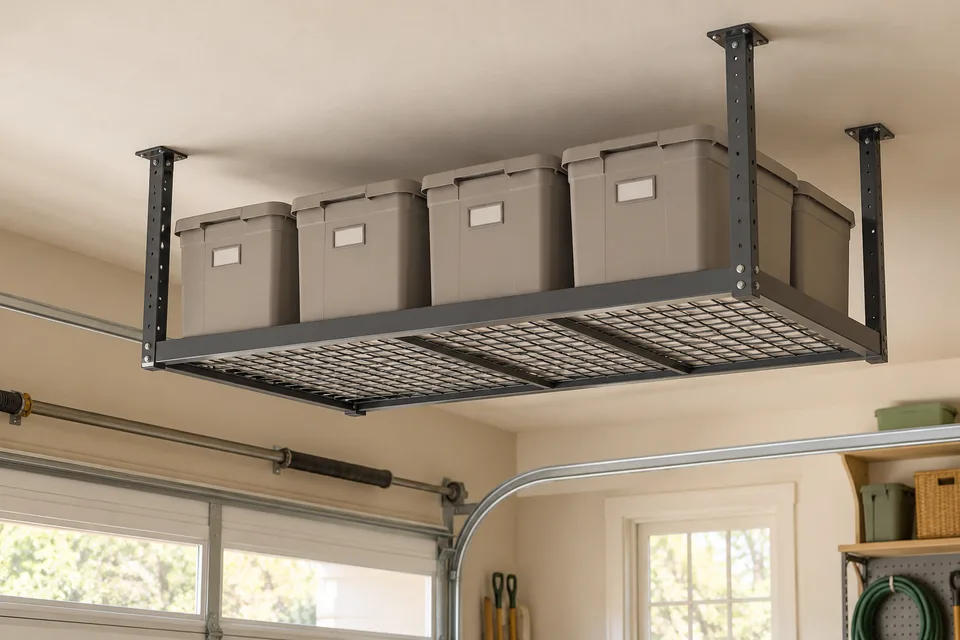
Overhead is where the seasonal bins go, and it is the only part of this guide where getting it wrong drops several hundred pounds onto a car. A standard 4x8-foot rack costs $100-250 and is typically manufacturer-rated at 500-800 lb, but that number is conditional, so read the safety spec below before you buy, not after.
- Overhead rack ($100-250): a 4x8 deck fits six standard 27-gallon totes in a single layer, two rows of three. FLEXIMOUNTS and SafeRacks are the two lines carried nearly everywhere
- Hoist or pulley system ($50-200): the right answer for one heavy awkward object, a kayak, a cargo box, a bike. You never lift it overhead by hand
- Ceiling-mounted rails and racks: for lumber and other long items. Same joist rules
- Leave headroom: measure from the floor to the bottom of the loaded rack, then compare against the roof of the tallest vehicle you park, and against the garage door's open travel, which is the clearance people forget
The rating only holds if you hit joists. That 500-800 lb figure assumes every upright is lagged into ceiling joists with the hardware supplied in the box. Ratings vary by model. Check your unit's label. Find the joists with a stud finder and confirm with the drill; fastening into drywall, or into the diagonal web members of an engineered roof truss, is not a reduced capacity, it is no capacity at all. Load the deck evenly rather than piling everything at one end, and if you plan to hang heavy loads from engineered trusses, ask a structural engineer or your builder first. This is the one job on the list that is genuinely two people and a solid ladder.
7. Floor Storage Solutions
Keep floor storage to the pieces that genuinely need a footprint, and give each one a depth budget: 18-24 inches. Anything deeper becomes two rows, and the back row disappears. Everything down here sits a few inches clear of the slab. Garage floors get wet.
- Steel or wire shelving ($60-150 a unit): 18-24 inches deep, rated 250-1,000+ lb per shelf. Edsal, Seville Classics, Trinity and Husky cover the range. Set the lowest shelf 4-6 inches off the slab
- Steel cabinets ($150-500): doors keep dust off and lock chemicals and power tools away from children. Gladiator and Husky are the mainstream lines
- Workbench: 30-36 inches high, 24-30 inches deep, 6-8 feet long. Put it under a window or the brightest fixture and give it its own outlet
- Rolling tool chest: the one piece worth keeping mobile. It follows the job to the driveway and parks against a wall
- Clear bins ($25-45 for six): stack them on the shelving, not on the floor, and label the short end, which is the face you will see
8. Best Garage Storage Products
These six cover the walls, the ceiling and the floor.
Browse garage storage options aboveComplete Garage Organization Bundle
A full makeover is a 4x8 wall panel section ($100-300) + an overhead rack ($100-250) + a steel shelving unit ($60-150) + a 6-pack of clear bins ($25-45), which comes to $285-745 at the ranges above. That straddles the DIY-reset and full-system tiers; add hooks and a second shelving unit and you are into the $500-1,500 band.
Browse all buying guidesDoing the whole house?The free 12-week planner takes one room a week, with a printable checklist for each. Get the planner. No email required.
Garage Storage FAQ
How much does it cost to organize a garage?+
There are three realistic tiers. A DIY reset runs $115-500: a 4x4-foot pegboard panel with hooks ($30-60), a steel or wire shelving unit ($60-150), and a 6-pack of clear bins ($25-45), scaling up with how many walls you cover. A full wall-and-ceiling system you install yourself runs roughly $500-1,500. That buys two 4x8 slatwall sections ($200-600), an overhead rack ($100-250), two or three shelving units ($120-450), and a track or hook kit ($60-200). Professionally installed cabinetry and custom systems start around $1,500 and run past $5,000. Most two-car garages get most of the benefit at the first tier.
How much weight can an overhead garage storage rack hold?+
500-800 lb for a standard 4x8 rack, and only with every upright lagged into solid wood ceiling joists with the hardware in the box. Drywall, or the diagonal webs of an engineered truss, gives no rating at all. Ratings vary by model, so read your unit's label, load the deck evenly, and ask a structural engineer before hanging heavy loads from engineered trusses.
What is the best way to organize a garage?+
Work in this order: declutter, zone, then buy. Sort everything into trash, donate, sell and keep before you spend anything, because the most common garage mistake is buying storage for items you will never use again. Then divide the space into zones (parking, workshop, sports, seasonal) and match the storage to the zone: wall systems at 30-60 inches off the floor for daily gear, steel shelving for bins and heavy items, and overhead racks for the two-to-four-times-a-year things.
What should not be stored in a garage?+
Propane cylinders first, if the garage is attached. Fire codes prohibit cylinders over 1 lb indoors at a residence, including an attached garage, and a leak pools at floor level near ignition sources. A detached garage or shed is where fire marshals direct them. After that, paint through a freeze-thaw cycle, documents and photographs, food including pet food, and electronics that mind temperature swings. Gasoline belongs in an approved container, and a spare refrigerator or freezer may not hold temperature in an unheated garage in winter, since many models rely on ambient warmth to cycle correctly. Old solvent-based paint, pesticides and car batteries are household hazardous waste. Most municipalities run a collection day, and retailers usually take batteries back.
Building the $115-255 starter kit?
Shelving, wall track, totes and hooks that each land under $100, picked and priced.
See Top Picks