The right container for each seasonal item
Matching container to item is most of the job:
Disclosure: As an Amazon Associate, we earn from qualifying purchases. We may earn a commission when you buy through our partner links. It doesn't affect our recommendations or what you pay. Prices and availability change frequently; editorial ranges are planning estimates, not live quotes. Check the retailer for current prices, pack sizes, and availability. Learn more
Useful additions for your space
Shop by problem
Use the best-for notes to find a relevant option. Check dimensions and compatibility before buying.
Divided Ornament Storage Box (IRIS USA and similar)
Hard-sided box with removable divider trays — typically 48–75 slots. A fabric-sided version won't take a stack on top. Best for: Christmas ornaments, fragile decorations.
Rolling Artificial Tree Bag
Upright bag on casters; heavy woven fabric holds its shape where the original carton collapses. Best for: Artificial trees up to 9 ft.
Wreath Storage Container
Rigid box or hanging bag sized 24–30 inches — the rigid version is the one that survives a stack. Best for: Holiday wreaths, garlands.
Light Storage Reels
Wind each strand on its own reel and tape the plug end down — untangling is most of the setup time. Best for: String lights, extension cords.
Vacuum Storage Bags (Ziploc Space Bag tier)
Compress bulky synthetic bedding and coats for a single season — not for wool, down, or leather. Best for: Synthetic comforters and puffy coats, unpacked within the year.
Cedar Blocks and Rings
Natural moth deterrent; sand them lightly at each seasonal swap to reopen the pores and restore the scent. Best for: Wool sweaters, coats, blankets.
1. Holiday Decoration Storage
Holiday décor is fragile, bulky, and handled twice a year — which is exactly why it gets damaged. Match the container to the item (a $20–40 divided box for ornaments, a $25–50 rolling bag for the tree), label bins by holiday rather than by season, and you cut both the breakage and the hour spent hunting for the wreath.
Christmas & Winter Holidays
Christmas is the biggest seasonal load in most homes — a tree, several bins, and the most breakable things you own. Five categories cover it — the four below plus wreaths, which get their own rigid box ($15–30, sized 24–30 inches) because nothing stacks on a wreath without crushing it:
Artificial Trees
A rolling tree bag beats the original box — the cardboard collapses and soaks up damp. Store upright if possible.
Lights
Cord reels ($10–20) or a wrap of cardboard — not a loose bag, which is how strings tangle and get binned. Test each string before it goes away, not next December.
Ornaments
Ornament storage boxes with dividers. Wrap fragile items in tissue. Egg cartons work for small ornaments.
Wrapping Supplies
Vertical wrapping paper organizer or under-bed container. Keep ribbon and bows separate.
Other Holidays
Everything that isn't Christmas fits in one clear latching bin per holiday ($8–15 each). One bin is also the budget: when a holiday needs a second bin, that's the signal to thin it, not to buy more storage.
- Halloween: One latching bin for décor, costumes in garment bags so they don't crease
- Easter: Small bin for baskets, eggs, and decor
- July 4th/Patriotic: Combine with outdoor party supplies
- Thanksgiving: Often stored with fall decor
Pro tip: Take a photo of your decorated tree/house each year before taking down decorations. It helps you remember what you have and how you arranged it.
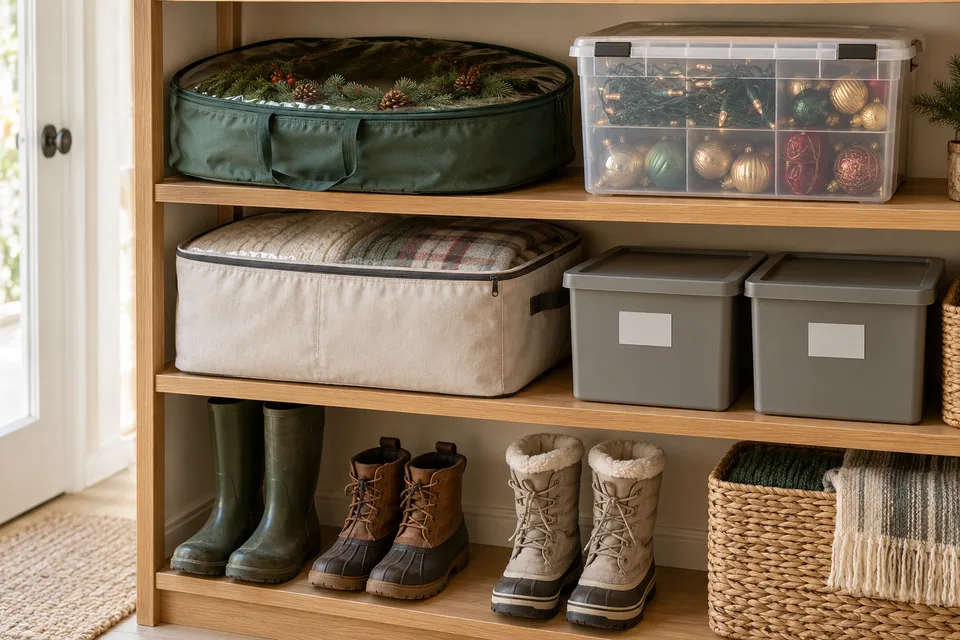
2. Seasonal Clothing Storage
Rotating the off-season half of a wardrobe is the cheapest way to make a closet feel bigger — and the whole outcome is decided before anything goes in a box: wash everything, then pick the container by fiber. Synthetics can be compressed; wool, down, and leather cannot.
Before You Store
Almost every garment ruined in storage was put away dirty. Body oils and invisible food residue are what moths and carpet beetles actually feed on — wool itself is a poor meal — so a clean sweater is a far less attractive target than a worn one. Five minutes each:
- Wash or dry clean everything — stains set over time, body oils attract pests
- Repair any damage — easier now than in 6 months
- Declutter — anything you haven't worn in two full years goes now, not back into a bin. One unworn season is a signal to watch; two is a decision
Best Storage Methods
Four container types cover a wardrobe, and the choice is made by fiber rather than by what's bulkiest:
- Vacuum bags ($20–35 for a multipack, Ziploc Space Bag tier): Synthetics only — fleece, polyester-fill comforters, and synthetic-insulated coats compress to about a third of their loose volume. Not for wool, down, or leather: compression sets permanent creases and those fibers need air. Even with synthetics, unpack within the year; a bag left compressed season after season flattens loft you don't get back.
- Plastic bins with lids ($8–15 each, Sterilite or IRIS USA): Protects from dust, pests, and moisture, and it's the right container for synthetics and décor. For wool, down, and other natural fibers, use the same bin but leave the lid resting rather than latched, or use a canvas bag — a fully sealed bin traps whatever humidity was in the room when you closed it, and those fibers need to breathe.
- Canvas garment bags: For suits, dresses, formal wear (not plastic — it traps moisture). Whitmor and Honey-Can-Do both make breathable canvas versions at $15–30.
- Cedar blocks or lavender sachets ($10–20): Natural moth deterrent. Cedar stops working when the scent fades — sand the blocks lightly each rotation.
What to Rotate
Roughly half a wardrobe is out of season at any moment, and that half is the bulky half — coats and knits eat three to four times the rod space of the shirts replacing them. Rotating is what buys the closet back:
Winter → Storage (Spring)
- • Heavy coats and jackets
- • Sweaters and fleece
- • Boots and heavy shoes
- • Scarves, hats, gloves
- • Thermal underwear
Summer → Storage (Fall)
- • Shorts and tank tops
- • Swimsuits and coverups
- • Sandals and flip-flops
- • Sundresses
- • Linen clothing
3. Sports & Outdoor Gear
Gear fails in storage for three reasons: it went away wet, it went away dirty, or it sat all season under a load it wasn't built to hold. Everything here comes down to clean, dry, and uncompressed — rinse the salt or chlorine off, let it dry fully for a day or two, and store anything with loft (sleeping bags, down, tents) loose rather than in its stuff sack. That single habit is worth more than any rack you can buy.
Winter Sports (Store in Spring)
- Skis/snowboards: Wipe dry, then lay on a thick storage coat of wax over the whole base and the edges — that's what keeps the edges from rusting over 7–8 months. Back the binding DIN down 2 settings so the springs don't take a set. Flat or hanging, somewhere that stays under about 70°F.
- Ice skates: Wipe the blades, then air them 20–30 minutes before anything touches them. Soft absorbent blade covers for storage; the hard plastic guards are for walking to the rink and hold moisture against the steel if you store in them.
- Snow gear: Wash per the label, then a full second tumble-dry cycle on low — a waterproof shell holds water in the seams long after the outside feels dry. Hang or store loose in a breathable bag, never compressed.
Summer Sports (Store in Fall)
- Bikes: Clean and lube the chain, inflate to the pressure printed on the sidewall (tires bleed roughly 1–2 psi a week and a flat tire stored for months flat-spots), then hang from wall hooks or a ceiling hoist so nothing rests on the rubber.
- Kayaks/paddleboards: Rinse the salt or chlorine off and dry fully, then support on a padded rack at 2 points about a third of the way in from each end — on edge or upside-down. Months resting flat on the hull deforms it.
- Camping gear: Tent bone dry before it folds — pitch it in the yard for an afternoon if there's any doubt, because 24 hours damp in a bag is enough to start mildew on the coating. Sleeping bags loose in a large cotton or mesh sack, never in the compression sack.
- Golf clubs: Clean the grooves, wipe the shafts dry, store upright indoors — a car trunk swings past 120°F in summer, which is what softens grip adhesive and head epoxy.
- Pool toys: Deflate, rinse the chlorine off, and dry inside and out for a full day before they go in a bin off the concrete. Residual chlorine left on vinyl is what turns it brittle by spring.
4. Lawn & Garden Equipment
This section is pre-storage prep, not storage: powered equipment is ruined by sitting, not by being used. Three things do the damage — fuel that gums up the carburetor over a few months, water that freezes and cracks whatever it's sitting in, and dirt that holds moisture against bare metal. Twenty minutes per machine in the fall is the whole job.
End of Season Prep
Powered equipment fails in storage for a reason nothing else does: the fuel goes off. Untreated gasoline starts varnishing in about 30 days and gums the carburetor, which is why a mower that ran fine in October won't start in April. Twenty minutes now, per machine:
- Lawn mower: Either run the tank dry or add stabilizer and run the engine 5 minutes so treated fuel reaches the carburetor — untreated gasoline starts varnishing in about 30 days. Scrape the deck, and sharpen or swap the blade now so spring starts with a cut, not a tear.
- String trimmer: Same fuel treatment, then clean the guard and rewind fresh line — nylon that sat wound all winter goes brittle and snaps in the first 10 minutes of use.
- Hoses: Drain completely (walk them downhill, end over end), coil loosely in 2-ft loops, and store indoors above freezing. Water left in a hose expands about 9% when it freezes, which is what splits the liner.
- Patio furniture: Wash, dry, and cover, or stack it in the garage. Cushions always come indoors — under a cover outside they hold damp for 5 months and come out mildewed.
- Grill: Deep clean the grates, empty the grease tray, and disconnect the propane cylinder. The cylinder stays outdoors, upright, on a flat non-combustible surface such as concrete, valve closed — never the garage, shed, or basement, and never anywhere it can pass 120°F.
- Planters: Empty the soil, scrub, and stack. Ceramic and terracotta come indoors; soil left in one holds water, and water that freezes inside a fired pot cracks it.
Snow Equipment (Store in Spring)
Same rules in reverse, plus one that's specific to winter: ice melt draws moisture out of the air and will corrode a concrete floor and any metal near it.
- Snow blower: Drain or stabilize the fuel the same way, clear the auger housing, and check the belts and shear pins — shear pins run a couple of dollars each and are the part that strands you in the first storm.
- Shovels: Rinse the salt off and dry before hanging — a steel edge stood in a puddle of melt rusts through in a single off-season.
- Ice melt: Reseal in an airtight bin, up off the concrete on a shelf or pallet. An open bag pulls enough moisture out of summer air to set into a solid block, and the runoff corrodes both the slab and any metal within a few feet.
5. The Seasonal Rotation System
Two swaps a year — one in spring, one in fall — covers most homes, and each one takes an hour or two. The system that makes it stick is boring on purpose: a calendar reminder, color-coded bins, and a contents list taped to each lid so you never open three bins to find one sweater.
The Swap Calendar
Put the two swaps on a calendar rather than waiting to feel cold, because the weather that prompts you is exactly the week you need the coat already accessible. Each swap is a 60–90 minute job for one person:
Spring (March/April)
- • Store winter clothes
- • Pull out spring/summer clothes
- • Store snow equipment
- • Pull out lawn/garden tools
Fall (September/October)
- • Store summer clothes
- • Pull out fall/winter clothes
- • Winterize lawn equipment
- • Pull out snow equipment
The free whole home organization planner includes a seasonal rotation calendar you can print and keep with the bins.
Labeling System
A label is what decides whether next December costs you five minutes or an hour. The rule that does the most work: label for how the bin gets retrieved, which is different for clothes than for décor.
- Color code the wardrobe, name the holidays: Clothing rotates on a season, so blue bins = winter, yellow = summer, green = spring/fall works there — three colors is the limit, past that you're reading labels anyway. Décor doesn't rotate on a season, it comes out for one date, so those bins get the holiday written on them ("Christmas — tree", "Halloween") rather than a color.
- Detailed labels: "Winter Coats — Mom & Dad", not just "Winter". Label 2 faces, the top and one short side, because on a stacked shelf only one of them is ever facing you.
- Inventory list: Tape a printed contents list to the outside, or photograph the open bin before you lid it and name the photo after the bin number. Either takes about 30 seconds and saves opening three bins in October.
6. Where to Store Seasonal Items
Claim the high, awkward space you never use for anything else — top shelves, overhead garage racks, under beds. The rule that decides most locations: plastic and metal décor tolerates heat, but anything with fabric, wax, glue, or a photograph in it needs somewhere cooler and steadier — archives put photographs below 75°F, and electronics want about 85°F — which rules out an unconditioned attic for months at a stretch. A few items are fussier still and are called out where they appear — ski bases want under about 70°F, and golf clubs don't belong in a car trunk at all.
Good Options
- • Climate-controlled closet — top shelf
- • Conditioned attic (insulated at the roofline)
- • Finished basement (with dehumidifier)
- • Overhead garage storage
- • Climate-controlled storage unit
- • Under-bed storage
Avoid
- • Unconditioned attics (~130°F on a hot day)
- • Damp basements (mold)
- • Outdoor sheds (pests, weather)
- • Garage floor (flooding risk)
A conditioned attic — one insulated at the roofline rather than the floor — behaves like a warm closet and is fine for bins. An ordinary vented attic is not: it runs 20–35°F above the outdoor temperature and sits near 130°F on a hot day under a dark roof. Holiday décor in plastic and metal survives that; candles, photographs, leather, and anything vinyl do not. The attic storage guide has the full survives/doesn't-survive table.
Browse the storage options above once you know what your space needs.
Seasonal Storage FAQ
How do I store Christmas decorations properly?+
Match the container to the item. Ornaments go in a divided ornament box ($20–40, 48–75 slots) — never loose in a bin, where they knock together. Lights go on cord reels ($10–20), not in a bag, because a tangled string is the one you throw away next year. An artificial tree goes in a rolling tree bag ($25–50) rather than its original carton, which collapses and soaks up damp. Wreaths go in a wreath box ($15–30, sized 24–30 inches). Everything else goes in clear latching bins ($8–15 each), labeled by holiday on two faces so you can read them stacked. Keep the lot somewhere that holds a steady temperature — a conditioned attic, a top shelf, or an overhead garage rack. An unconditioned attic runs 20-35°F above the outdoor temperature, roughly 130°F on a hot day, which fades and warps décor and is far past what photographs or candles tolerate.
How should I store winter clothes in summer?+
Wash all items before storing to prevent stains from setting and attracting pests. Use cedar blocks instead of mothballs. Store in breathable containers or garment bags — avoid sealed plastic for wool. Keep in a cool, dry place. Vacuum bags are fine for synthetics you'll unpack within a single season, but not for wool, down, or leather — compression sets permanent creases and those fibers need air. For multi-year storage, everything goes loosely packed and breathing.
Can I store seasonal decorations in the attic?+
Plastic and metal décor, artificial trees, and light strands are fine in an attic — store them in latching bins, never cardboard. Everything else is a judgment call about heat: unconditioned attic air runs 20-35°F above the outdoor temperature and sits around 130°F on a hot day under a dark roof, far past what photographs (below 75°F per the National Archives), candles, or adhesives tolerate. That rules out candles, photographs in décor, leather, vinyl, and anything with adhesive. A conditioned attic insulated at the roofline behaves like a warm closet and takes anything a closet would.
When should I rotate seasonal items?+
Two swaps a year covers most homes — one in spring and one in fall, when the wardrobe and the gear both change over. Four swaps (March, June, September, December) only earns its effort if you have distinct summer and winter sports gear on top of clothing. Set calendar reminders either way. Keep an inventory of what's in storage so you don't buy duplicates. Declutter each time you rotate — donate items unused for 2+ years.
Running out of room?
A climate-controlled storage unit is perfect for seasonal items you don't have space for at home.
Find storage near you