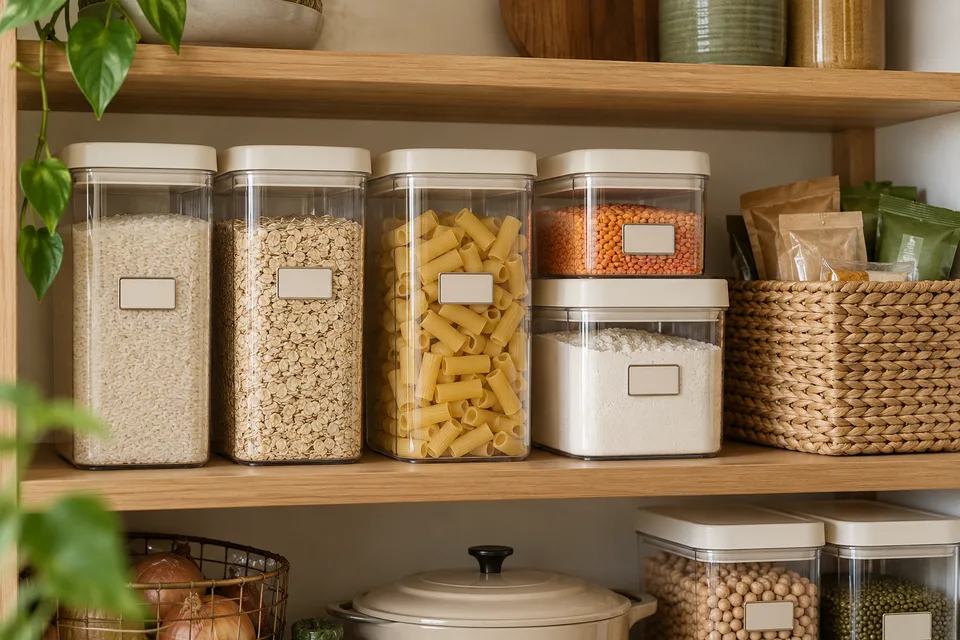
If you only read one thing
Skip the research and buy OXO Good Grips POP 2.0 — $15–25 a container, $55–70 for a 5-piece set.
One-handed push-button lid, sizes designed to sit together without wasted shelf, and a satisfaction guarantee behind it. Buy five for the staples you open daily and stop there. On a tighter budget, a 10–12 piece set at $25–40 does the same job with shorter-lived lids; for open shelving you look at every day, glass at $30–60 a 6-pack is the upgrade worth paying for.
Quick Recommendations
Tap any recommendation to jump to the full comparison ↓
- Best Overall: OXO Good Grips POP 2.0 — $15–25 each, $55–70 for 5
- Best Budget: Vtopmart 10-Piece Airtight Set — $25–40
- Best Glass: Rubbermaid Brilliance Glass (ATK pick) — $30–60 for 6
- Best for Small Pantries: Vtopmart 24-Piece Modular Set — $35–60
- Best for Cereal: A pour-spout dispenser — $15–30 each
Pantry Container Side-by-Side
Tap a row's container type to jump straight to the full comparison.
| Type | Material | Lid & seal | Typical price | Best For |
|---|---|---|---|---|
| Airtight Plastic | BPA-free plastic | Push-button lid, silicone gasket | $15–25 each / $55–70 for 5 | Daily staples: flour, sugar, cereal |
| Glass Jars | Glass (soda-lime or borosilicate) | Clamp or screw-top with gasket | $30–60 for a 6-pack | Open shelving you actually look at |
| Modular Stackable | Plastic, square profile | Four-side latch clamp | $35–60 for 24 pieces | Small pantries, deep shelves |
| Budget Sets | Thinner plastic | Snap-on flip lid; gasket varies | $25–40 for 10–12 pieces | A first full pantry rebuild |
| Cereal Dispensers | Plastic | Push-button lid + pour spout | $15–30 each | Cereal, granola, pet food |
| Spice Jars | Glass jar, plastic cap | Screw cap with shaker insert | $20–45 for 12–24 jars | Spices, herbs, blends |
Pantry Container Comparison by Type
Typical price ranges for the category, not live listings. Amazon prices change frequently — click through for current pricing and availability.
Airtight Plastic Containers
BPA-free containers with gasketed lids that keep food fresh and pests out
Best for:
Flour, sugar, rice, pasta, cereal, baking supplies
Price range:
$15-25 per container; $55-70 for a 5-piece set
✓ Pros
- • Keeps food fresh for months
- • Pest-proof seal
- • Lightweight and stackable
- • See-through for visibility
✗ Cons
- • Can stain from tomato-based foods
- • Plastic may scratch over time
- • Some lids loosen after repeated use
Glass Storage Containers
Glass canisters and jars with clamp, screw-top, or bamboo lids
Best for:
Countertop display, spices, coffee, tea, decorative pantry
Price range:
$30-60 for 6-pack
✓ Pros
- • Won't absorb odors or stains
- • Looks premium on open shelving
- • Dishwasher safe
- • Eco-friendly and long-lasting
✗ Cons
- • Heavy — can break if dropped
- • Roughly double the per-container cost of plastic
- • Not ideal for deep or high pantry shelves
- • Borosilicate vs soda-lime is irrelevant for dry goods — don't pay for it here
Modular Stackable Sets
Uniform square containers designed to interlock and stack
Best for:
Small pantries, deep shelves, bulk dry goods
Price range:
$35-60 for a 24-piece set
✓ Pros
- • Maximizes shelf space (square > round)
- • Uniform look
- • Interlock when stacked
- • Labels included in many sets
✗ Cons
- • Sizes may not match your exact needs
- • Harder to pour from square corners
- • Some sets have weak seals
Budget Containers
Affordable containers that get the job done without breaking the bank
Best for:
First-time pantry organization, large families, bulk buys
Price range:
$25-40 for 10-12 pieces
✓ Pros
- • Very affordable
- • Large sets cover the whole pantry
- • Decent seal quality
- • Good for getting started
✗ Cons
- • Thinner plastic
- • Lids may not seal as tightly
- • Less uniform appearance
Cereal Dispensers
Pour-spout containers designed specifically for cereal and grains
Best for:
Cereal, granola, oats, snack mixes, pet food
Price range:
$15-30 each
✓ Pros
- • Easy one-handed pouring
- • Keeps cereal crunchy longer
- • Kids can serve themselves
- • Clear to see when running low
✗ Cons
- • Single-purpose shape
- • Takes up more depth on shelf
- • Some leak when tilted
Spice Storage
Uniform jars and racks to tame the spice chaos
Best for:
Spices, herbs, seasoning blends, small dry ingredients
Price range:
$20-45 for 12-24 jar set
✓ Pros
- • Uniform size creates clean look
- • Labels make finding spices instant
- • Fits in drawers, racks, or shelves
- • Airtight lids preserve freshness
✗ Cons
- • Transfer time for initial setup
- • Need to relabel if switching spices
- • Small jars need frequent refilling
Tips for Choosing Pantry Containers
Most returned pantry containers are the right product in the wrong size. Six checks that prevent it — the full pantry setup guide covers the layout side.
- Measure your shelves first: Depth, width, and the vertical gap. Reach-in and cabinet pantry shelves usually run 12–16 in deep with 12–18 in of headroom, so a container taller than about 11 in only fits the tall bay
- Size to the bag it replaces: 4–4.5 quarts takes a 5 lb bag of flour or a family cereal box; 2–2.5 quarts takes 4 lb of sugar or a 1 lb box of pasta
- Square beats round: Square containers use shelf space ~25% more efficiently than round ones
- Buy a set, not singles: Matching containers stack better and look cleaner
- Test the seal: Fill with water, close, and turn upside down — no drip means good airtight seal
- Label everything: Even clear containers benefit from labels, especially for similar-looking ingredients
- Save cooking instructions: Cut directions from the original package and tape inside the lid
Where these picks come from
- Wirecutter: The 4 Best Food Storage Containers of 2026 — independent testing, OXO POP among the top picks.
- America’s Test Kitchen food storage container review — Rubbermaid Brilliance Glass is ATK’s glass pick.
- America’s Test Kitchen equipment reviews (index) — broader kitchen equipment testing methodology.
Best Pantry Containers FAQ
What's the best pantry container overall?+
OXO Good Grips POP 2.0 — the push-button lid seals with one hand, the sizes are designed to sit together without gaps, and it carries OXO's satisfaction guarantee. Budget about $15–25 per container, or about $55–70 for a 5-piece starter set. It is the expensive answer; buy it once for the five staples you open daily (flour, sugar, rice, pasta, cereal) and fill the rest of the pantry with a cheaper set.
Are airtight containers actually necessary?+
For flour, sugar, rice, cereal, crackers, and anything you bought in a bag: yes — airtight extends shelf life 2–3× and stops pantry pests cold. For canned goods, jars, and unopened packaging: no, they're already sealed. Buy airtight for the ~30% of pantry items that need it, not all 100. A typical pantry needs 10–15 airtight containers, not 40.
Glass vs plastic for pantry storage?+
Glass looks better, doesn't stain or scratch, and handles oily or tomato-based foods without holding onto the smell — reckon on $30–60 for a 6-pack. Airtight plastic is lighter, survives being dropped, and costs roughly half as much per container. Use glass on open shelving you look at, plastic on deep or high shelves where a dropped container is a real risk. One thing that doesn't matter for dry pantry goods: whether the glass is borosilicate or ordinary soda-lime. That difference shows up in thermal shock (oven to fridge), not in storing flour.
How many pantry containers do I need?+
For a typical 4-shelf pantry: 6–10 large (2–4 quart) for flour, sugar, rice, pasta, and cereal; 8–12 small (1–2 cup) for spices and snacks; 2–3 oversized (5+ quart) for chips, snacks, or pet food. Buy the same brand/size family so they stack cleanly and align visually — that's most of the look.
What's the cheapest pantry container set that actually works?+
A Vtopmart 10-to-12-piece airtight set, $25–40 — clear plastic with snap lids, a decent gasket for the price, and enough visual consistency that a full shelf looks deliberate. The lids won't take a decade of daily opening, but the set covers a typical pantry rebuild for the price of two premium containers. Sensible entry point if you want to find out whether decanting suits you before spending real money.
Which foods should I not decant?+
Anything you'd have to look up: dried beans and specialty grains with cooking ratios on the bag, boxed mixes with instructions, and baking items you use twice a year. Also skip anything already sealed — canned goods, jarred sauces, unopened vacuum packs — since a second container adds nothing. If you want a food out of its box but need the directions, cut the panel out and tape it inside the lid. Roughly 30% of a typical pantry benefits from decanting; the rest is repackaging for its own sake.
Disclosure: As an Amazon Associate, we earn from qualifying purchases. We may earn a commission when you buy through our partner links — it doesn't affect our recommendations or what you pay. Prices and availability change frequently; figures shown were accurate at publication and may be different by the time you click through. Learn more
Show us your kitchen.
Snap a photo and we’ll tell you what’s wasting space, what to put on those shelves, and how the cabinets should actually work.
Analyze My Pantry