Pantry upgrades, ranked
The four essentials — containers, clear bins, risers, labels — total $73–122. All seven upgrades below come to $123–217. Ranked by visibility gained per dollar; tap a row to jump to the how-to, or shop the fix.
Disclosure: As an Amazon Associate, we earn from qualifying purchases. We may earn a commission when you buy through our partner links. It doesn't affect our recommendations or what you pay. Prices and availability change frequently; editorial ranges are planning estimates, not live quotes. Check the retailer for current prices, pack sizes, and availability. Learn more
Useful additions for your space
Shop by problem
Use the best-for notes to find a relevant option. Check dimensions and compatibility before buying.
Airtight Dry Food Containers (Set of 6)
BPA-free, square, with pour spouts. A 4–4.5 quart size takes a 5 lb bag of flour or a family box of cereal; 2–2.5 quart handles sugar, rice, or a 1 lb box of pasta. Best for: Cereal, flour, sugar, rice, pasta.
Pantry Can Organizer Rack
Tiered rack displays cans so you see every label at once — expandable models span roughly 12–20 in of shelf and hold 20–36 standard cans. Best for: Canned vegetables, soups, beans.
Turntables (2-Pack)
Spin to reach the back of a deep shelf. Match the diameter to the shelf: 9–10 in for a 12 in shelf, 12 in for a 16 in shelf. Best for: Oils, vinegars, sauces, spices.
Clear Pantry Bins with Handles (4-Pack)
Pull-out bins group snacks, packets, and small items. Common sizes run about 8 in wide x 12 in deep — stay 1–2 in shallower than the shelf so the handle clears the front edge (so ~10 in on a 12 in shelf). Best for: Snack bags, packets, tea, granola bars.
Shelf Risers (Set of 2)
Create two levels on any shelf. Expandable risers stretch from roughly 12 to 20 in wide and stand about 6 in tall — enough for spice jars or short cans underneath. Best for: Spice jars, small cans, jars.
Over-Door Pantry Rack
Turns the back of the door into 4–6 shallow shelves. Standard units are about 19–21 in wide and 4–5 in deep, so your front shelf edge has to sit at least 5 in back from the closed door. Best for: Spices, oils, packets, small jars.
Chalkboard Labels (120-Pack)
Reusable waterproof labels for containers, bins, and jars. Best for: Labeling everything in your pantry.
1. The Full-Pantry Reset
The most effective way to organize a pantry is to empty it completely first:
- Pull everything out: Place items on a table or counter by category
- Check dates: Toss anything expired, stale, or that you realistically won't eat
- Wipe shelves: Clean all surfaces before restocking
- Take inventory: Note what you have so you stop buying duplicates
- Measure shelves: Write down three numbers per shelf — depth, width, and the vertical gap to the shelf above
The three measurements that decide everything: Most reach-in and cabinet pantry shelves are 12–16 in deep; walk-in shelving is often 16–24 in. Vertical gaps usually run 12–18 in. Leave about 2 in of headroom above your tallest container so you can lift it out without tipping it, and subtract 1–2 in from shelf depth so bin handles clear the front edge.
2. Create Pantry Zones
Group by how you cook, not by what the food is: a typical four-shelf pantry becomes four zones — baking, breakfast, snacks, dinner staples — and each zone gets its own shelf or labelled bin so a whole category pulls out in one motion. Height does the second half of the sorting. The band roughly 48–60 in off the floor is the only part of the pantry you genuinely see without crouching or reaching, so daily items live there; heavy cans and bulk bags go below knee height where a dropped item can't hurt you, and backstock goes up top. Done properly you stop hunting — and you stop buying a third jar of cumin because the first two were behind the cereal.
Baking Zone
Flour, sugar, baking soda, vanilla, chocolate chips, sprinkles
Breakfast Zone
Cereal, oatmeal, pancake mix, coffee, tea, honey
Snack Zone
Crackers, chips, nuts, dried fruit, granola bars, popcorn
Dinner Staples
Pasta, rice, canned tomatoes, broth, sauces, oils
- Eye level: Most-used daily items (snacks, cooking staples)
- Lower shelves: Heavy items (canned goods, bulk bags, beverages)
- Upper shelves: Rarely used items (specialty ingredients, holiday baking)
- Kid level: If you have children, place their snacks where they can reach
3. Container & Labeling Systems
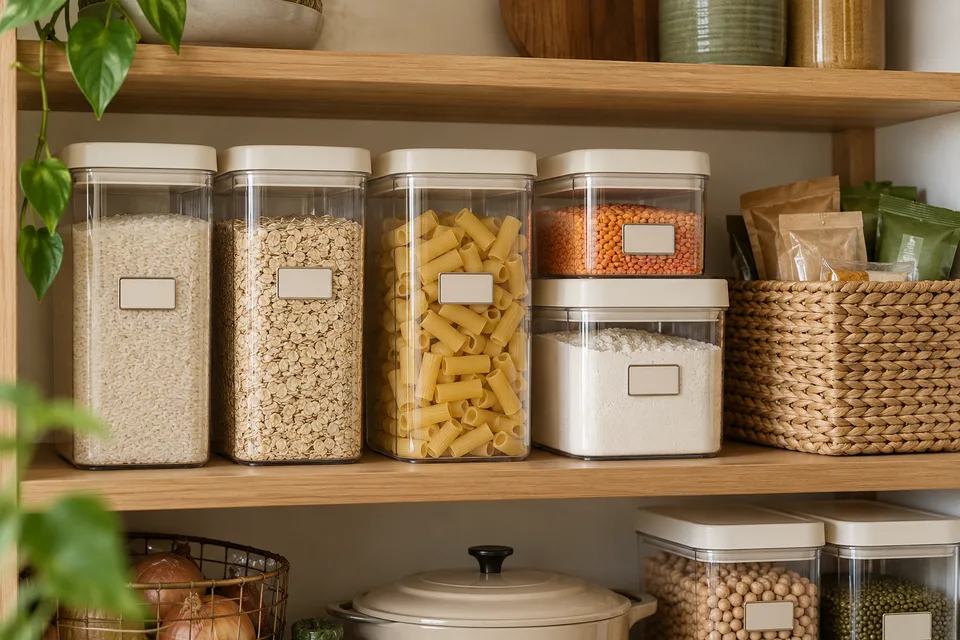
Uniform containers are the single biggest upgrade you can make:
- Square over round: a shelf is a rectangle, so round containers leave a wedge of dead space at every corner and between every pair. Square ones butt up against each other and the back wall
- Clear is key: See quantities at a glance — no more surprise empty containers
- Airtight seals: Keep flour, sugar, cereal, and pasta fresh longer and pest-free
- Label everything: Include contents and expiration date
- Graduated sizes: A 4–4.5 quart container takes a 5 lb bag of flour or a family-size cereal box; 2–2.5 quart holds 4 lb of sugar, 2 lb of rice, or a 1 lb box of pasta; 1 quart and under is for nuts, seeds, and baking add-ins
- How many: A typical four-shelf pantry runs on about 6–10 large containers and 8–12 small ones — not 40. Buy airtight only for what arrives in a bag or box; cans and jars are already sealed
OXO Good Grips POP and Rubbermaid Brilliance are the two airtight lines you will see everywhere; both are square, both stack, and both come in the 4–4.5 quart and 2–2.5 quart sizes that do most of the work above. For a head-to-head on specific brands and set sizes, see our best pantry containers comparison.
Pro tip: Cut the cooking instructions from the original package and tape them inside the container lid. You get clean storage without losing the recipe.
The container-first workflow
Container-first describes the destination, not the shopping order. Decanting is the organizing world's word for pouring dry goods out of their store packaging into uniform containers, and it sits near the end of the sequence, not the start:
- Purge before you buy: containers get sized to what survived the full-pantry reset, never to the pile. If the purge itself is the sticking point, the decluttering method guide handles that half of the job.
- Zone on paper first: every category has a shelf assignment from your zone plan before anything gets poured, so a filled container never sits homeless.
- Wash and fully dry each container: whatever moisture is inside when an airtight lid closes stays in there with the food.
- Decant in one pass: flour, sugar, rice, cereal, and pasta in a single session. The working amount goes in the container; clip the overflow bag shut and park it in one labeled backstock bin on a high shelf.
- Label as you pour: contents and the expiration date off the bag, before the next bag distracts you.
The decanting itself is an afternoon for a typical four-shelf pantry, and the container counts above are the whole container shopping list — the system runs on 6–10 large and 8–12 small, not a wall of matching acrylic.
4. Shelf Optimization
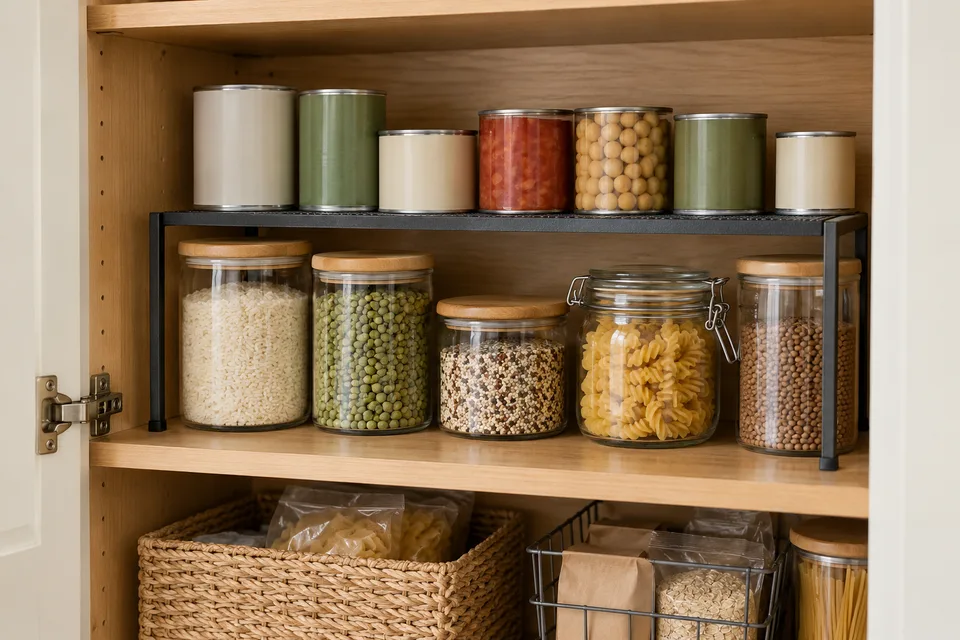
The waste in most pantries is vertical: a 12–18 in gap between shelves holding one row of 4 in spice jars is roughly two-thirds empty air you are paying for. Four cheap parts reclaim it, and together they cost less than one container set. A $15–25 pair of expandable risers (12–20 in wide, about 6 in tall) turns one shelf into two levels; a $15–25 turntable makes the back of a 12–16 in deep shelf reachable; a $15–30 tiered can rack puts 20–36 cans where you can read every label; and under-shelf baskets take back the 4–5 in of dead air below a shelf. Then set your adjustable shelves to your tallest item plus 2 in and the gaps stop being storage you bought and never used.
- Shelf risers: Expandable models stretch from about 12 to 20 in wide and stand roughly 6 in tall — enough clearance for spice jars or short cans underneath
- Turntables (lazy Susans): Size to the shelf — 9–10 in diameter on a 12 in shelf, 12 in on a 16 in shelf. Larger than the shelf is deep and it fouls the frame
- Tiered can racks: Display cans like stadium seating; expandable racks span 12–20 in and hold roughly 20–36 standard cans
- Under-shelf baskets: Clip onto a shelf lip up to about 1 in thick and reclaim the 4–5 in of dead air beneath
- Adjustable shelving: Set gaps to your tallest item plus 2 in — usually one 18 in bay for cereal and appliances, the rest at 12–14 in
5. Door & Wall Storage
A pantry door is about 19–21 in of usable width that costs you no shelf space at all, and a $20–40 over-door rack converts it into 4–6 shallow shelves — exactly the right home for spices, oils, and packets that vanish behind cereal boxes on a 12–16 in deep shelf. One measurement decides whether you can have it: standard racks sit 4–5 in proud of the door, so your front shelf edge must sit at least 5 in back from the closed door or the door will not shut. Measure that gap before you order anything on this list.
- Over-door rack: Multi-tier racks for spices, oils, and small jars. Standard units are about 19–21 in wide and 4–5 in deep, so check that your shelves sit at least 5 in back from the closed door before ordering
- Command hooks: Hang measuring cups, aprons, or reusable bags
- Magnetic spice rack: Mount on the door or wall for easy access
- Chalkboard or whiteboard: Track your grocery list right on the door
- Tension rods: Create mini shelves between narrow pantry walls
6. By Pantry Type
The zones and containers above are the same everywhere; what changes is where the wasted space hides. Walk-ins waste walls and floor, reach-ins waste the door and the back of the shelf, and a cabinet pantry wastes the vertical gap between shelves.
Walk-In Pantry
- Use all three walls with adjustable shelving
- Add a light with a motion sensor so you always see what you have
- Designate floor space for bulk items and small appliances
- Keep a step stool inside for high shelves
Reach-In Pantry
- Maximize the door with an over-door organizer
- Use pull-out bins so nothing gets lost in the back
- Stack containers vertically and label the front
Cabinet Pantry (No Dedicated Pantry)
- Dedicate 2–3 cabinets exclusively to pantry items
- Use a rolling cart, a bookshelf or a freestanding pantry cabinet as an overflow pantry
- Prioritize — keep only a week's worth of staples in the kitchen
- Store bulk backstock in a dry basement or garage that stays cool year-round
7. Maintenance & Rotation
A pantry reset holds for about a month on its own, so build three habits on three different clocks: a two-minute weekly scan for what's about to turn, a monthly pass to toss expired items and refill containers, and a full empty-and-wipe every 3–6 months. The one that does the most work is FIFO: new groceries go behind the old ones, never in front, because that single habit is what stops the third jar of cumin from appearing. Spices are the shelf to watch — most are past their potency at 1–3 years, and nothing about them looks expired.
- First in, first out (FIFO): Place new items behind older ones
- Weekly scan: Check for items that need to be used soon
- Monthly audit: Toss expired items, wipe shelves, restock containers
- Grocery list at the door: Write down items as they run low
- Seasonal deep clean: Full reset every 3–6 months
Browse the storage options above once you know what your space needs.
Doing the whole house?The free 12-week planner takes one room a week, with a printable checklist for each. Get the planner. No email required.
Pantry Organization FAQ
How do I organize a small pantry with limited shelf space?+
Use shelf risers to double each level — an expandable riser about 6 in tall creates a second tier for spice jars and short cans. Add a door-mounted rack (roughly 19–21 in wide, 4–5 in deep) for spices and packets, and clear bins to group categories so a whole zone pulls out at once. A 9–10 in turntable makes a 12 in deep shelf fully reachable. Keep the items you touch daily at eye level — roughly 48–60 in off the floor — and push backstock above and below that band.
What size pantry containers should I buy?+
Match the container to the bag it replaces. A 4–4.5 quart container swallows a 5 lb bag of flour or a family-size cereal box; a 2–2.5 quart takes 4 lb of sugar, a 2 lb bag of rice, or a 1 lb box of pasta; 1 quart and under is for nuts, seeds, and baking add-ins. A typical four-shelf pantry needs about 6–10 large and 8–12 small. Measure shelf depth before you order: most reach-in and cabinet pantry shelves run 12–16 in deep, and the container should sit 1–2 in shallower than the shelf so lids and handles clear the front edge — about 10–11 in deep on a 12 in shelf, up to 14–15 in on a 16 in shelf.
Should I transfer food to containers or keep original packaging?+
Transfer dry goods like flour, sugar, rice, cereal, and pasta to airtight containers. This keeps food fresher, prevents pests, creates a uniform look, and makes quantities visible. Keep original packaging for items with cooking instructions you reference often.
How often should I clean out my pantry?+
Do a quick scan monthly to check expiration dates and toss stale items. Deep clean shelves every 3–6 months — pull everything out, wipe down shelves, check dates, and reorganize. Most spices lose potency after 1–3 years, so that shelf is where the monthly pass earns its time.
See our best pantry containers
Airtight containers, shelf risers, and decanting systems — compared and ranked.
See Top Picks