The four-box method
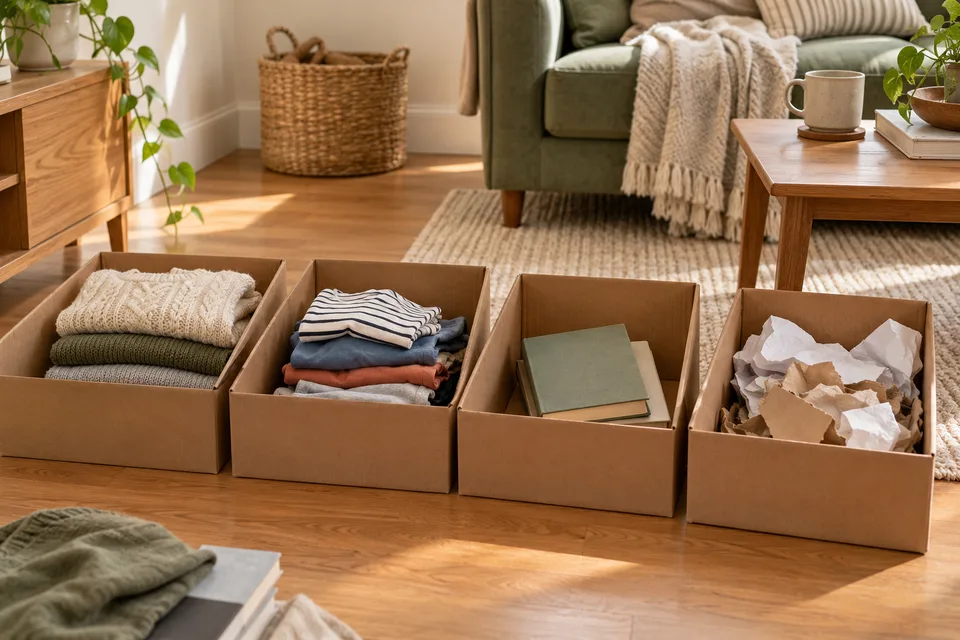
Bring four boxes (or bags, or corners of the room) into the room you're working and give every single item exactly one of four verdicts. The point of the method is banning the fifth verdict. "I'll deal with this later" is the verdict that created the clutter.
- Keep — stays in this room, and gets a specific home in it before the session ends.
- Donate — usable, but not by you. The box goes to the car trunk the same day.
- Sell — genuinely worth someone's money. Be stingy with this box; it has a 30-day deadline (rules below).
- Trash / recycle — broken, expired, stained, or unusable. Out with the next collection.
Add one cheat: a relocate basket for things that belong in a different room. Carry it around once, at the end of the session, not every time you find a stray coffee mug. Leaving the room mid-decision is how declutter sessions quietly turn into snack breaks.
Room order: momentum before sentiment
Every room you finish makes the next one easier, so sequence rooms by emotional difficulty, not by which one bothers you most. The bathroom is close to decision-free (expired products have made their own case). Photos, keepsakes, and inherited things come last, after you've made a few hundred easier calls and know your own standards.
To track the order on paper, print the free whole home organization planner. It has a room-by-room assessment, a 12-week timeline and a declutter tracker.
Moving or downsizing on a deadline? You work by what the truck needs, not by sentiment. That version is its own guide: downsizing without regret.
The four decision rules
The four boxes handle most items on autopilot. These rules handle the ones you stand there holding:
- The 12-month rule. Haven't used it in a year, through all four seasons, and it isn't sentimental or legal paper? It goes. Season-specific gear gets judged against its season, not the calendar year.
- The duplicate rule. Keep the best one, donate the backups. Three can openers is two donations. The exception is genuine consumables you rotate through, like batteries or zip bags.
- "Would I buy this again today?" Not "did this cost money once" — the money is spent either way. If you wouldn't spend $30 on it today, keeping it doesn't refund the $30 you spent then.
- The cheap-replacement test. If it could be replaced for under about $20 in under 20 minutes and you haven't needed it in a year, let it go. The realistic worst case is a small errand, and for most items the errand never comes.
For sentimental items, keep the best representative, not the whole set. One bin per person; when it's full, adding something means choosing what it replaces. Photograph the rest before it goes; the photo keeps the memory without keeping the object.
Get the piles out of the house — 48-hour rule
A declutter isn't done when the room looks better; it's done when the boxes have left the building. Every pile that lingers gets quietly reopened and re-argued. Two days is the deadline for all four:
- Donate: into the trunk the same day, dropped off within 48 hours. For furniture, book a free charity pickup before the session ends (Habitat ReStore and Salvation Army both do this, ZIP depending).
- Sell: one platform (Facebook Marketplace is the usual first choice), listed within 48 hours, and a 30-day deadline. Whatever hasn't sold becomes a donation. An unscheduled garage sale is not a plan; it's a storage category.
- Trash and recycling: out with the next collection. For big purges a bagster-style dumpster bag or one bulk-pickup appointment beats twenty trips.
- Hazardous and e-waste: paint, batteries, chemicals, and electronics go to your municipality's hazardous-waste or e-waste drop-off, not the bin. Many run periodic drop-off days or a permanent facility; check the town site once and calendar it.
Now contain what stays
Buying organizers before decluttering is the expensive mistake. Bins sized to the pile you have just repackage it, and the receipts feel like progress. After the room is decided, measure what remains and buy for that. The list will be shorter than the one you'd have written on day one. When you get there, the storage bins guide covers sizes and which lids actually seal, and the closet guide handles the room most people declutter twice.
Keeping it decluttered
The sessions bought you a decluttered house. Three small habits keep it that way, none over fifteen minutes:
- One in, one out. New sweater in, one sweater out — same category, same day. It converts every purchase into a decision.
- The quarterly sweep. Fifteen minutes per room, four times a year, with a single donate bag. Maintenance at this dose never becomes a project again. The room order above is short enough to rerun as the sweep itself.
- One landing basket per room. Miscellaneous stuff accumulates there instead of on surfaces; when the basket fills, you reset the basket, not the room. If executive function is the real obstacle, the ADHD organizing guide is built around exactly that problem.
And when a room stops working again, don't shop for a system. Run one four-box session first. A system that stopped working often starts again once it holds less, and you'll know before spending anything.
Decluttering FAQ
How long does it take to declutter an entire house?+
Plan on 6–10 sessions for a typical 3-bedroom home, spread over a month or two. Most rooms take 1–4 hours; a garage, basement, or attic can run half a day. A weekend blitz covers 2–3 rooms before decision quality drops. A few hours in, most people start keeping everything. One room per session, and no more than one hard room (closet, garage, paper) per weekend.
Should I buy storage bins before or after decluttering?+
After — always. Bins bought first get sized to the pile you have, which preserves the clutter in tidier packaging. Declutter the room, measure what actually stays, then buy containers for that. It's the reason this guide has no shopping list at the top.
What's the fastest way to start when I'm overwhelmed?+
Shrink the unit of work until it stops being scary: one drawer, 15 minutes, four boxes. Finish it completely, including carrying the trash out. A finished drawer builds more momentum than a half-finished room, and momentum is the only resource that matters in week one. Start in the bathroom. It has the fewest sentimental items in the house, so the decisions are nearly automatic.
What should I never throw out when decluttering?+
IDs and passports, deeds and titles, current insurance policies, warranties for things you still own, and recent tax records. When you're not sure about a paper, don't decide mid-declutter: drop it in a single documents box and sort that box separately with fresh attention. Paper is the one category where a wrong discard is genuinely expensive.
What about things too good to trash but not worth selling?+
Donate them the same week. Charities like Habitat for Humanity ReStore and the Salvation Army schedule free pickups for furniture in sellable condition in most areas, and local buy-nothing groups move smaller items in a day or two. Get an itemized receipt if you plan to claim a deduction.