Basement protection, ranked by value
Moisture is the enemy. Tap a row to jump to the how-to, or shop the fix:
Disclosure: As an Amazon Associate, we earn from qualifying purchases. We may earn a commission when you buy through our partner links. It doesn't affect our recommendations or what you pay. Prices and availability change frequently; editorial ranges are planning estimates, not live quotes. Check the retailer for current prices, pack sizes, and availability. Learn more
The 10-second triage rule
If it's paper, powered, leather, or irreplaceable, an unfinished basement is the wrong room — those four categories cover almost everything people regret storing down there. Everything else is fine in a sealed bin on a shelf. The full keep/move list is in section 7.
Useful additions for your space
Shop by problem
Use the best-for notes to find a relevant option. Check dimensions and compatibility before buying.
Steel Shelving (Edsal MuscleRack or Seville Classics UltraDurable)
Boltless steel racks rated 250+ lb per shelf on most models — check the label on the unit you buy. Best for: Bins, tools, heavy items off the floor.
Gasket-Lid Bins (IRIS WeatherPro or Sterilite Gasket Box)
Foam-gasket lids and latching clips — the seal is what keeps damp air out. Best for: Decorations, camping gear, anything paper-adjacent.
Dehumidifier, 30–50 Pint (Frigidaire, Midea, or hOmeLabs)
Pick one with a hose port so it drains to the floor drain instead of a bucket you forget. Best for: Any basement reading above 55% humidity.
Plastic Pallets or Bin Risers
Get shelving and loose bins 4–6 in off the concrete. Best for: Under shelves, flood protection.
Moisture Absorbers (DampRid)
Passive calcium-chloride tubs for closets, corners, and inside bins. Best for: Enclosed spots a dehumidifier can't reach.
Label Maker (Brother P-touch or DYMO)
Laminated labels survive damp air; masking tape and marker don't. Best for: Organizing and finding items quickly.
1. Controlling Moisture & Humidity
Moisture is the #1 enemy of basement storage. Even a basement that feels dry often sits at 60–70% humidity. Two numbers matter and they are not the same number: 60% is the failure line — sustained humidity above it is where mold, mildew, and musty smells take hold — and 45–50% is the target, because you want margin under the failure line, not to sit on it. The whole job is getting the reading down to 50 and keeping it there.
Dehumidifier Basics
One appliance does 80% of basement moisture control. Buy on capacity and drainage, not features:
- Target humidity: set it to 45–50% — 60% is where mold starts, so don't aim for it
- Size matters: 30-pint for a small, mildly damp basement; 50-pint for 1,500+ sq ft or any basement that smells musty
- Auto-drain: get a model with a hose port and run it to the floor drain or sump — a bucket you forget to empty is a dehumidifier that stops working
- Cost: $150–250 for a 30–50 pint unit ( Frigidaire, Midea, and hOmeLabs all sell in this band), plus roughly $10–25 a month in electricity while it's actually running
Other Moisture Control
A dehumidifier fights water that's already inside. These four keep it from getting in, and they matter more in a basement with a history of damp:
- Fix foundation cracks: Seal with hydraulic cement
- Improve drainage: Gutters, downspout extensions, grading
- Vapor barrier: Plastic sheeting on floor/walls
- Ventilation: Exhaust fan or open windows when weather permits
Pro tip: Get a hygrometer — a ThermoPro or Govee reads humidity for $10–20 — and check it weekly through your first year. Basements swing seasonally, and an August reading tells you nothing about February.
2. Shelving & Storage Systems
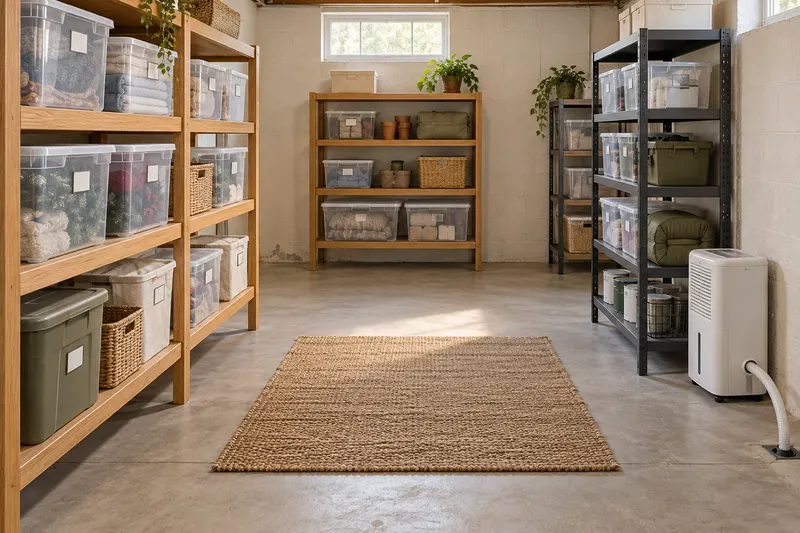
Nothing goes directly on a basement floor — a burst supply line or one bad storm puts an inch of water across the slab, and concrete wicks moisture upward even when it looks dry. Shelving is what buys you 4–6 in of clearance, and in a damp room the material of the shelf matters as much as its capacity.
Best Shelving Options
Steel Shelving — the default
Boltless steel like Edsal MuscleRack or Seville Classics UltraDurable. Strongest option, adjustable, rated 250+ lb per shelf on most models — check the label on yours. $60–150 per unit.
Wire Shelving
Chrome or powder-coated (Trinity, Amazon Basics). Open shelves let air move around bins, which matters in a humid room. $50–150 per unit.
Plastic Shelving
Sterilite or IRIS resin units. Won't rust or rot and shrugs off standing water, but light-duty — keep it to totes of decorations. $30–80 per unit.
Wall-Mounted Systems
Keeps the floor completely clear, which is the point in a basement that has flooded before. Needs studs or masonry anchors. $50–200.
Avoid Wood Shelving
Wood absorbs moisture, warps, and can harbor mold. If you must use wood, seal it thoroughly and keep it away from walls.
3. Choosing the Right Containers
In a basement the container is the last line of defense, so it gets the strictest rule on this page: hard plastic with a lid, always. A gasket lid ($15–35 a bin) buys real protection for anything you care about; a plain snap-lid tote ($8–15) is fine for holiday decorations and camping gear.
Best Containers for Basements
- Gasket/weathertight bins ($15–35 each): IRIS WeatherPro or Sterilite Gasket Box — the foam seal is what keeps damp air out. Use these for anything paper-adjacent.
- Clear snap-lid totes ($8–15 each): Sterilite or Rubbermaid. See contents at a glance, stack well, good enough for decor and gear.
- Original product boxes: Only if the cardboard itself goes inside a plastic bin.
- Textiles are the exception: a basement is the wrong room for wool, down, or leather at all. If seasonal clothes must live down there, wash and fully dry them, use a gasket bin with a DampRid or silica packet, and skip vacuum bags for natural fibers — compression sets permanent creases and those fibers need air.
Never Use in Basements
Three container types fail predictably in a damp room, and the failure is usually total — you open the box a year later and everything in it is gone:
- Cardboard boxes: Absorb moisture, collapse, and mice chew through one overnight
- Fabric bins: Mold from the outside in
- Paper bags: Zero protection against anything
4. Creating Storage Zones
Zone a basement by access frequency, not by category — the single biggest time-waster down there is walking past six bins to reach the one you need every month. Put the things you touch often within a few steps of the stairs and push the archive to the back wall. Four zones cover most basements:
Frequent Access
Near stairs: tools, sports gear, seasonal decorations
Seasonal Access
Middle zone: holiday decor, camping gear, seasonal clothes
Long-Term Storage
Back of basement: keepsakes, archives, rarely-used items
Workshop Zone
If applicable: workbench, power tools, hardware
5. Pest Prevention
Mice, spiders, and silverfish come to a basement for the same three things: a way in, something to eat, and somewhere to hide. Remove all three and you rarely need traps at all.
- Seal entry points: Cracks in foundation, gaps around pipes — a mouse fits through a quarter-inch hole
- No open food: Sealed metal cans are fine; bags, boxes, and paper packaging are an invitation. See what to store.
- Plastic bins only: Mice can chew through cardboard overnight
- Cedar blocks: Natural repellent for moths and some insects
- Traps: Set preventively, check monthly
- Reduce clutter: Pests love hiding spots
6. Flood Protection
Even a basement that has never flooded can take water from a failed water heater, a frozen pipe, or one storm that overwhelms the drainage. Flood protection is cheap relative to what it saves: the two items below cost under $200 combined and both work while you're asleep or away.
- Sump pump: Essential if you have any water history. Battery backup recommended.
- Water-leak alarm ($15–30): Sits on the slab next to the heater or washer and shrieks the moment it gets wet
- Elevate everything: At least 4–6 inches off the floor
- Nothing on floor: Use pallets under shelving units
- Insurance: Standard homeowners doesn't cover flooding—consider flood insurance
Inventory tip: Photograph valuable items stored in your basement for insurance purposes. Keep the photos in cloud storage, not in the basement!
7. What to Store (and What Not To)
Sort by what the material does in damp air, not by what room the item came from. Anything inert — plastic, metal, sealed glass, hard goods — is happy in a basement bin for years. Anything that absorbs, corrodes, or can't be replaced needs a drier room.
Good for Basement Storage
- Holiday and seasonal decorations (in plastic bins)
- Sports and camping equipment
- Tools and hardware
- Luggage and travel gear
- Extra furniture (covered)
- Sealed metal cans only — canned food is genuinely fine in a dry basement: rotate yearly and keep cans off the concrete so they don't rust from the bottom. Bagged, boxed, or paper-wrapped food is not, because that's what draws mice
- Exercise equipment
Store Elsewhere
- Important documents: Safe deposit box or fireproof safe upstairs
- Photographs: Digitize and store in climate-controlled space
- Electronics: Humidity destroys circuits
- Leather goods: Mold and mildew risk
- Wine: Unless you have proper climate control
- Musical instruments: Wood and humidity don't mix
- Artwork: Consider climate-controlled storage unit
Browse the storage options above once you know what your space needs.
Doing the whole house?The free 12-week planner takes one room a week, with a printable checklist for each. Get the planner. No email required.
Basement Storage FAQ
How do I keep my basement dry for storage?+
Aim for 45–50% relative humidity, measured with a $10–20 hygrometer, not by feel. Mold needs sustained humidity above roughly 60%, so treat 60% as the failure line and 50% as the target that gives you margin. A 30–50 pint dehumidifier ($150–250) plumbed to a floor drain does most of the work; seal foundation cracks with hydraulic cement, extend downspouts away from the house, and check the floor after heavy rain.
Can you store canned food in a basement?+
Sealed metal cans are fine in a dry basement — rotate them yearly and keep them off the concrete, since cans rust from the bottom up. What doesn't belong down there is food a mouse can open in a night: bagged rice and pet food, cereal boxes, flour, anything in paper or thin plastic. If it isn't in a metal can or a hard airtight container, it belongs upstairs.
What should not be stored in a basement?+
The rule of thumb: if it's paper, powered, leather, or irreplaceable, an unfinished basement is the wrong room. That means documents, photos, artwork, electronics, leather goods, musical instruments, and wine without real climate control. Also keep firewood outside — it brings insects in with it.
How do I organize a basement storage area?+
Create zones by category (holiday, sports, tools) and place them by how often you need them: frequent-access near the stairs, long-term at the back. Use steel shelving ($60–150 per unit) to keep everything off the floor, put heavy bins on the lower shelves, label every bin, and leave a few inches between shelving and the wall so air can move behind it.
Need climate-controlled storage?
For items that can't handle basement conditions, a climate-controlled storage unit is the safest option.
Find storage near you