Useful additions for your space
Shop by problem
Use the best-for notes to find a relevant option. Check dimensions and compatibility before buying.
Disclosure: As an Amazon Associate, we earn from qualifying purchases. We may earn a commission when you buy through our partner links. It doesn't affect our recommendations or what you pay. Prices and availability change frequently; editorial ranges are planning estimates, not live quotes. Check the retailer for current prices, pack sizes, and availability. Learn more
Under-Bed Storage Containers
Wheeled bins about 6 inches tall — Sterilite Ultra and IRIS Under-Bed are the two carried nearly everywhere. Best for: Off-season clothes, extra bedding, shoes.
Vacuum Storage Bags
Compress bulky bedding to roughly a third of its packed volume — not for down, leather, or anything stored for years. Best for: Seasonal items, blankets, pillows.
Bed Risers (Set of 4)
3-5 inch sets run $15-30; 5-8 inch sets $25-50. Check the stated per-riser load rating against your bed plus occupants. Best for: Creating more under-bed storage space.
Floating Shelves (Set of 3)
Wall-mounted shelves for display and storage; brackets need studs, typically at 16 inches on center though 24 is also common — find them with a stud finder, not drywall anchors alone. Best for: Books, plants, photos, decor.
Drawer Dividers
Adjustable spring-tension or honeycomb inserts that hold filed clothes upright instead of letting them slump. Best for: Socks, underwear, accessories.
Over-Door Organizer
A 24-pocket organizer holds 12 pairs of flats, or split the pockets between accessories and small bags. Best for: Shoes, accessories, bags, jewelry.
1. Under-Bed Storage Solutions
Under-bed capacity is arithmetic, not guesswork: footprint times clearance. Most frames sit 6-13 inches off the floor (platform beds are often only 3-7), and every one of those inches is worth real volume. Find your bed in the table, then decide whether risers are worth it.
Those are raw clearance figures. Bins have walls and need room to slide, so plan on using 70-80 percent of the number in your row.
Bed Risers
Risers are the cheapest cubic feet in the house — on a queen, five inches of lift buys about 14 cubic feet for the price of dinner. Two sizes cover almost everyone:
- 3-5 inch risers — $15-30 a set of 4: the safe default; the bed still looks normal and the mattress height stays comfortable to sit on
- 5-8 inch risers — $25-50 a set of 4: maximum volume, but check that the mattress top stays below about 30 inches or getting in becomes a climb
- Check the load rating: risers state a per-riser capacity. Add mattress, frame and the heaviest two people who will ever sit on the edge, then compare
- Skip USB and outlet risers unless you actually need the port — they cost more and lock you into one height
Under-Bed Containers
Pick the container for the floor you have, not the photo you like. Wheels are excellent on hardwood and useless in thick carpet.
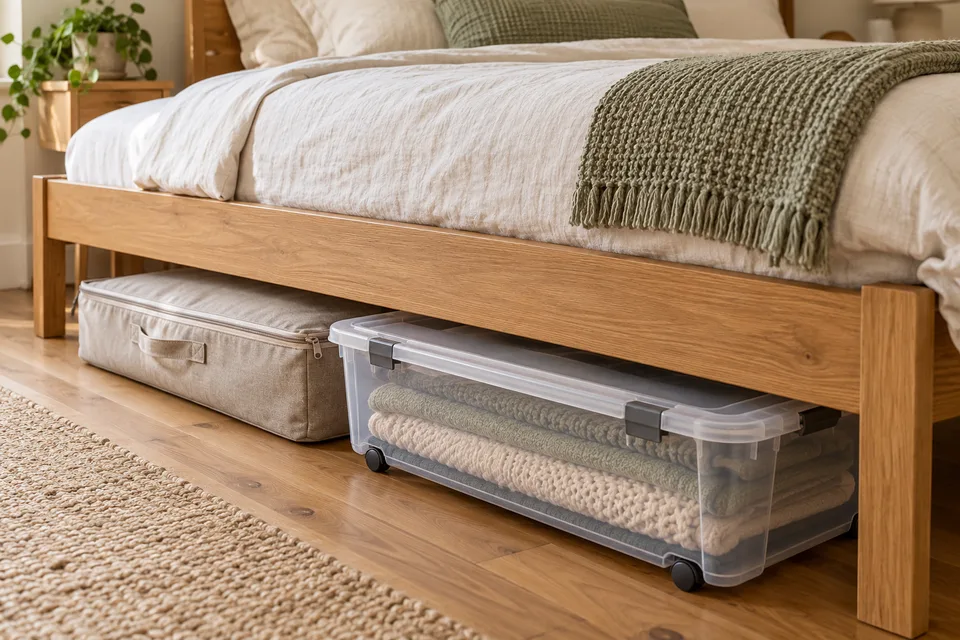
- Wheeled bins ($25-50 a pair): about 6 inches tall, roll out one-handed. Sterilite Ultra and IRIS Under-Bed are the two stocked nearly everywhere
- Canvas bags with handles: the carpet answer — they slide where a caster digs in, and they collapse flat when empty
- Vacuum bags ($20-35 a pack): roughly a third of the packed volume for bedding and knits. Not for down, leather, or anything staying compressed for years
- Drawer units on runners: most furniture-like option, most expensive, and they need a frame with an open rail
Pro tip: Measure clearance at the lowest point (usually a centre support leg), then subtract 1-2 inches. A bin sized to the exact gap stops sliding the first time the frame settles or the rug bunches.
What to Store Under the Bed
Under-bed space is dark, dusty and awkward to reach, so it earns things you need two to four times a year — never daily items, and nothing that minds a temperature swing.
- Off-season clothing and shoes
- Extra bedding and linens (in a closed bin, not open bags — dust)
- Luggage, which is itself storage: pack the off-season inside it
- Gift wrap and craft supplies
- Photo albums and paper keepsakes, in a lidded bin off a concrete floor
2. Nightstand & Bedside Organization
A nightstand top is about two square feet, which is why it collects everything: it is the nearest flat surface to a tired person. Two rules fix it — the top surface should sit within a couple of inches of mattress height so you can reach it lying down, and everything on it should belong to bedtime or morning, not to the rest of the house.
- One tray, about 6 x 9 inches ($10-20): glasses, jewellery, lip balm. A defined edge is what stops the spread
- Drawer, not an open shelf: open bedside shelves are visual clutter you look at every night; a drawer with a small divider hides the same items
- One charging point: a single multi-port charger replaces three bricks and one of the two cables permanently on the floor
- Wall-mounted shelf instead: in a room under about 10 x 10 feet, a 10-inch floating shelf beside the bed does the nightstand's job and gives back a two-square-foot footprint
- Empty it weekly: the nightstand is the room's inbox — if nothing leaves, nothing else fits
3. Dresser & Drawer Organization
The problem with a dresser drawer is not capacity, it is visibility: in a stack, you only ever see the top item, so the bottom third of every drawer is dead. Filing clothes upright and adding $15-25 of dividers fixes both — every item is a spine on a shelf.
File, Don't Stack
Fold each garment into a rectangle roughly the height of the drawer's interior, then stand them in rows front to back. Be honest about what this does and doesn't buy you:
- You see every item without unstacking, so the back of the drawer stops being a graveyard
- Pulling one item doesn't collapse the rest, which is what makes a stacked drawer degrade within a week
- It does not magically double capacity — how much extra fits depends entirely on the garment. Thin t-shirts gain a lot; sweatshirts gain almost nothing
- It needs dividers to work. Without them the rows slump the moment the drawer is half empty
Drawer Dividers ($15-25 a set)
- Spring-tension dividers: adjustable width, no tools, work in any drawer over about 10 inches wide
- Honeycomb inserts: one cell per pair — the best answer for socks and underwear specifically
- Small open boxes: cheapest option; shoe boxes cut to drawer depth work until you replace them
Drawer Assignment Strategy
Assign drawers by how often you open them, heaviest at the bottom — a top-heavy dresser is both harder to open and easier to tip.
Top Drawers
Daily and small: underwear, socks, accessories. This is the drawer that needs dividers most.
Middle Drawers
Casual wear: t-shirts, shorts, loungewear — the best candidates for filing upright.
Bottom Drawers
Bulky and heavy: sweaters, jeans, sweatshirts. Weight low keeps the whole unit stable.
Dresser Top
Keep clear, or one tray plus a lamp. A dresser top with three categories on it becomes six within a month.
Anchor the dresser. Clothing storage units tip when a loaded top drawer is opened and a child pulls or climbs. Any clothing storage unit at least 27 inches tall that was made after September 2023 is required by federal rule to ship with an anti-tip device (16 CFR 1261, adopting ASTM F2057-23 under the STURDY Act); older units often didn't, and a kit is about $10. If yours didn't come with one, an anti-tip kit costs about $10.
4. Vertical Storage Ideas
Wall storage is the only kind that costs no floor space, and in a bedroom the walls are almost always empty above 48 inches. Three 24-inch floating shelves ($25-50 a set) add six linear feet of storage; an over-door organizer ($15-30) adds 24 pockets. Both need the same thing to be safe: fasteners into studs, which sit at 16 inches on center in most homes.
- Floating shelves ($25-50 for three): hang the lowest 18-24 inches above the dresser so the surface below stays usable, and span two studs where you can
- Over-door organizer ($15-30): a 24-pocket panel holds 12 pairs of flats, or split it between accessories, small bags and scarves
- Tall over wide: a 5-drawer tallboy and a 6-drawer double dresser hold similar volume, but the tallboy takes roughly half the floor
- Hooks at 60-66 inches: bags, robes, and tomorrow's outfit — the single cheapest way to stop the chair becoming a wardrobe
- Corner shelving: the one place a 10-inch-deep shelf collides with nobody
- Above the door: the 12-18 inches over a bedroom door frame holds a shelf of boxed, rarely-touched items and is invisible from the bed
5. Small Bedroom Strategies
In a bedroom around 10 x 10 feet, a queen bed and one dresser already claim most of the floor, so the rule is simple: nothing gets floor space unless it stores something. Every item below does two jobs at once.
- Storage bed frame: drawers in the base or a hydraulic lift platform. A lift bed uses the whole 33 cubic feet under a queen, but it needs clear floor on one side to open
- Headboard with cubbies: replaces two nightstands and their combined four square feet of floor
- Wall-mounted nightstands: same surface, no legs, and the floor underneath still vacuums
- Ottoman or trunk at the foot of the bed: seating plus a bin's worth of blankets in a space that is otherwise circulation
- Behind the door: hooks or a mirror with a jewellery cabinet behind it — a surface no furniture can compete for
- Fewer things: the honest one. In a small room, storage products delay the problem; the closet edit solves it
6. Kids' Bedroom Storage
A kid's room only stays organized if the child can operate it, and the constraint is height: as a rule of thumb, anything above about 36 inches is out of independent reach for a preschooler. Put their daily things below that line and your storage above it.
- Open bins below 36 inches: lids are the step where put-away fails. A cube unit with fabric bins is the standard answer for a reason
- Picture labels for pre-readers: photograph the actual contents and tape it to the bin — a drawing of a generic truck doesn't match their truck
- Lower the closet rod to about 40 inches for everyday clothes; a $15-30 hanging double rod does it without touching the closet
- Loft bed: needs roughly 40 inches of clear height under the deck for a desk (desk surfaces are 29-30 inches) — measure your ceiling before ordering
- Rolling cart ($30-60): art supplies and LEGO that move to the kitchen table and back
- Anchor everything tall, including bookcases and dressers — see the anti-tip note in section 3
7. Seasonal Clothing Rotation
Rotation is the cheapest way to make a small closet bigger, because the bulkiest things you own — coats, boots, heavy knits — are the ones you wear for about four months of the year. Move those to under-bed bins and the closet gets back both rod length and shelf depth without you buying a single organizer.
How to Rotate
- At the season change, pull every off-season item out of the closet and dresser at once
- Wash or dry clean everything first — body oils and food residue are what attract moths and set as stains over six months
- Fold into bins or vacuum bags. Skip the vacuum bag for down coats, leather and anything with structure
- Store under the bed or on the closet's top shelf; a lidded bin, never an open basket
- Label by season and contents, not by year — you will read this label in a hurry
What to Rotate
Rotate by bulk, not by category. If it is thick and you wear it in one season only, it goes:
- Winter coats and heavy jackets (the single biggest volume win)
- Sweaters and fleece
- Boots and sandals — boots especially, since a pair takes three times a shoe's shelf space
- Shorts and swimwear
- Seasonal accessories: scarves, hats, gloves, in one labelled bin together
8. Storage Solutions at a Glance
Every price here matches the product cards below and the figures used throughout this guide. Tap a row to shop the fix or jump to the how-to.
Budget Smart Start
A $55-105 bedroom refresh: under-bed bins ($25-50) + over-door organizer ($15-30) + drawer dividers ($15-25). Those three hit the three places bedroom clutter actually lives — the floor, the back of the door, and the drawer nobody can see into. Bed risers are the next $15-30, and they buy more volume per dollar than anything else on this page.
Browse the storage options above once you know what your space needs.
Doing the whole house?The free 12-week planner takes one room a week, with a printable checklist for each. Get the planner. No email required.
Bedroom Storage FAQ
How much storage is actually under a bed?+
Multiply the bed's footprint by the clearance. A queen (60 x 80 inches) covers 33 square feet, so every inch of clearance under it is 2.8 cubic feet: a typical 7-inch gap is about 19 cubic feet, and 5-inch risers take it to roughly 33. A twin covers about 20 square feet — 12 cubic feet at 7 inches, 20 at 12. A king covers 42 square feet and gives about 25 and 42. That is raw clearance volume; bins with walls and slide room use about 70-80 percent of it.
What is the best under-bed storage solution?+
Wheeled plastic bins about 6 inches tall ($25-50 a pair, Sterilite Ultra and IRIS Under-Bed are the common ones) for anything you touch more than twice a year, because they roll out with one hand. Vacuum bags ($20-35 a pack) for off-season bedding and bulky knits, but not for down, leather, or anything staying compressed for years — long compression flattens loft permanently. On thick carpet, skip wheels: a canvas bag with handles slides where a caster digs in. Measure your clearance and subtract 1-2 inches so the bin still slides when the bed shifts.
How do I maximize storage in a small bedroom?+
Take the walls before you take the floor. Three floating shelves ($25-50) above the dresser or headboard add roughly six linear feet of storage with a zero-inch footprint, an over-door organizer ($15-30) turns the back of the door into 24 pockets, and hooks handle bags, robes and tomorrow's outfit. Then buy floor furniture that does two jobs: a storage ottoman, a bed with drawers, a nightstand with a drawer instead of an open shelf. A $55-105 kit — under-bed bins, over-door organizer, drawer dividers — covers most of it.
How do I organize a bedroom with no closet?+
Replace the closet's three functions separately: hanging, folded, and out-of-season. An open garment rack ($60-150) or a freestanding wardrobe with doors ($150-300) covers hanging; a dresser with drawer dividers ($15-25 a set) covers folded; under-bed bins ($25-50 a pair) cover out-of-season. Anchor any tall wardrobe or dresser to a stud with an anti-tip kit — a freestanding unit holding a full wardrobe is top-heavy, and the kit usually ships in the box.
See our best storage bins
Under-bed bins, closet organizers, and bedroom storage solutions — compared and ranked.
See Top Picks