Useful additions for your space
Shop by problem
Use the best-for notes to find a relevant option. Check dimensions and compatibility before buying.
Disclosure: As an Amazon Associate, we earn from qualifying purchases. We may earn a commission when you buy through our partner links. It doesn't affect our recommendations or what you pay. Prices and availability change frequently; editorial ranges are planning estimates, not live quotes. Check the retailer for current prices, pack sizes, and availability. Learn more
Vacuum Storage Bags (variety pack)
Compress textiles to roughly a third of their loose volume with any vacuum hose. A jumbo bag takes a queen comforter. The seal only holds on bone-dry fabric. Best for: Seasonal clothes, blankets, pillows.
Under-Bed Storage Bags (2-pack)
Low-profile zip bags, typically around 40 x 18 x 6 in. They slide under the 7 in of clearance a typical bed frame leaves, where rigid bins need 6-8 in. Best for: Off-season clothes, bedding, shoes.
Over-Door Organizer
Hooks over a standard 1-3/8 in interior door and uses the roughly 21 x 60 in of vertical surface behind it. Best for: Shoes, toiletries, cleaning supplies.
Floating Shelves (3-pack)
Hidden-bracket shelves, usually 16-24 in long and 6-8 in deep, with no floor footprint at all. Hit a stud and check the shelf's own rating. Most list 20-30 lb each. Best for: Books, plants, decor, kitchen overflow.
Storage Ottoman
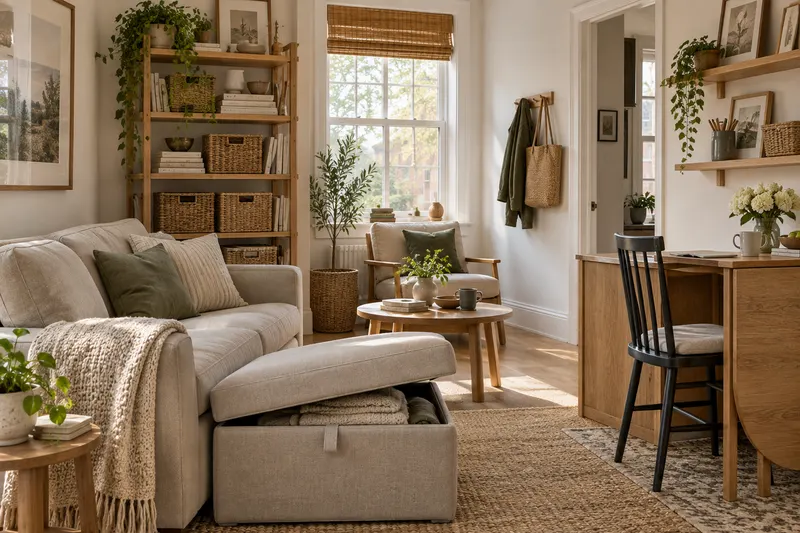
Folding fabric ottoman with a lift-off lid. Common sizes run 30-43 in long x 15 in deep x 15 in tall, roughly 3-5 cu ft inside and a coffee table on top. Best for: Blankets, pillows, board games, remotes.
Stackable Clear Bins (6-pack)
Latching clear boxes that stack three to four high. Buy one product family, because they run 6 qt to 100+ qt and the footprints line up instead of wobbling. Best for: Closets, pantry, any tight space.
1. The Biggest Space Wins, Ranked
Ranked by storage gained per dollar spent. Product names link to Amazon search results.
Budget Smart Start
The four starter buys run $50-110: vacuum bags ($12-25) + under-bed bags ($10-25) + an over-door organizer ($8-20) + a set of floating shelves ($20-40). They cost no floor at all. The tall shelving unit ($35-100) is the next purchase.
2. The Small Space Mindset
One rule decides most purchases in a small home: judge storage by cubic feet gained per square foot of floor given up. A 2 x 3 ft shelving tower scores 20-40 cu ft on 6 sq ft of floor. A dresser on the same footprint gives you maybe 10.
- Free space beats bought space. Under the bed, the back of every door, and the wall above eye level cost nothing in floor area. Spend there first.
- Every item needs one home. In 400 sq ft, an object without a designated spot is visible clutter within a day.
3. Vertical Storage Solutions
Tall Bookshelves
A 72-84 in unit on a 2 x 3 ft footprint holds 20-40 cu ft on 6 sq ft of floor. Bolt it to a stud. That is the price of going this tall.
Wall Hooks & Pegboards
A 2 x 4 ft pegboard ($20-50) holds 20-30 tools or pans on 8 sq ft of wall that was doing nothing. Bikes and bags come off the floor entirely.
Over-Door Organizers
The back of every interior door gives an over-door organizer about 21 x 60 in to work with. A 24-pocket organizer ($8-20) takes shoes, toiletries, or cleaning supplies.
Ceiling Storage
Hoists and overhead racks claim the 12-24 in above head height. Bikes, luggage, the Christmas bins.
Floating Shelves
16-24 in long, 6-8 in deep, zero floor footprint. Stagger the heights, hit a stud, and respect the 20-30 lb most are rated for.
Tension Rods
A second tension rod at about 40 in off the floor, under the main rod, doubles hanging space for shirts. One under the sink hangs spray bottles.
4. Multi-Functional Furniture
A piece that only does one thing is paying rent twice. Full comparisons are in our space-saving furniture guide.
- Storage bed ($100-250 with drawers, $150-350 lift-up). A lift-up platform captures the full 15-30 cu ft under the mattress, where drawers reach only what their boxes enclose.
- Storage ottoman ($30-60). Seats one, holds 3-5 cu ft, and is the cheapest hidden storage in the room.
- Bench with storage ($40-120). Entry seating plus shoes and bags, in about 6 sq ft. Pairs with hooks to replace a coat closet.
- Fold-down or wall-mounted desk ($60-150). Returns 6-9 sq ft of floor whenever you aren't working, and is the one piece worth mounting into studs.
- Headboard with shelves. A shelved headboard replaces two nightstands and the roughly 4 sq ft they occupy.
5. Hidden Storage Opportunities
Each spot below is decided by a single measurement, so take the tape measure with you.
- Under the bed. 15-30 cu ft under a queen: about 15-20 at a typical 7 in of clearance, closer to 30 once 5 in risers take it to 12 in. Measure before buying. Flat zip bags slide under about 6 in, rigid bins run 6-8 in tall, so at 7 in only the shallow bins fit.
- Above cabinets. The gap between wall cabinets and an 8 ft ceiling is usually 12-18 in, room for lidded bins of platters, appliances, and anything you reach for twice a year.
- Staircase. A tread is 10-11 in deep and a riser 7-8 in tall, so step drawers hold shoes and flat items only. It's a build-out, not a weekend project.
- Behind doors. An over-door rack sits 4-5 in proud of the door, so check the door swings clear of whatever it faces before ordering.
- Inside cabinet doors. The gap between a closed door and the shelf edge is typically 2-3 in, enough for a spice rack, a lid holder, or a wrap dispenser, nothing deeper.
- Corner spaces. A 9-12 in turntable makes the back of a corner cabinet reachable. A corner shelving unit claims the 2 x 2 ft of floor most rooms waste.
- Window sills. Sills deeper than about 5 in hold plants and books without blocking the sash.
- Bathtub surround. Shelving recessed between studs gains 3.5 in of depth without taking any floor, and the same trick works on any interior wall where no stud has to be cut. Check for plumbing and wiring before you open the bay. A wet wall carries supply lines, and a stud finder with AC detection finds live wires, not pipes.
6. No Closets? Storage for Homes Without Built-Ins
Every substitute below installs without renovation.
- No bedroom closet. A garment rack ($20-60) or a freestanding wardrobe ($30-200), with vacuum bags handling off-season overflow.
- No entry closet. Wall hooks plus a storage bench ($40-120) do the same job in 6 sq ft.
- No linen closet. Under-bed bags for spare bedding, and an over-door rack in the bathroom for towels.
- No pantry. A rolling cart ($20-50) or a freestanding cabinet ($80-250) turns a free kitchen wall into one. The pantry cabinet roundup compares seven.
- No garage or basement. Ceiling-height shelving in a hallway or laundry nook, or a small off-site unit (section 9).
What the whole kit costs. Priced from the ranges above (garment rack, a bench, under-bed bags at $10-25, and a rolling cart), a full no-closet setup runs about $90-255. Swap in a freestanding wardrobe and a pantry cabinet and the top end reaches about $600.
7. Room-by-Room Tips
- Kitchen. Get the knives and pots onto the wall. A magnetic strip plus a wall or ceiling pot rack frees 2-3 linear feet of counter and usually a whole base cabinet.
- Bedroom. Raise the bed. 5 in risers take clearance from about 7 in to 12 in, roughly 15 cu ft gained under a queen.
- Bathroom. Build over the toilet. An over-toilet étagère adds three shelves on a footprint you already walk around, and needs one anti-tip screw.
- Living room. One storage ottoman ($30-60) replaces the coffee table and hides 3-5 cu ft.
8. Decluttering for Small Spaces
In a small home, decluttering is storage. Set a number before you start (one bag out per room, or 15 minutes a day for a week), because "declutter the apartment" is not a task you can finish. The 90/90 rule settles most arguments: if you haven't used it in the last 90 days and won't in the next 90, it goes. For the items that survive that, three questions.
- Do I own something else that does this job?
- Would I buy it again at today's price?
- Is the "someday" I'm keeping it for on a calendar?
The One-In-One-Out Rule
For every new item that enters your home, one leaves. A drift of ten items a month is 120 items a year, which in 400 sq ft is roughly a closet's worth of stuff you don't have a closet for. One decluttering session fixes today. This rule is what makes it hold.
9. When to Use Off-Site Storage
Rent a unit when what you're storing costs less per year than the floor it occupies at home. A 5 x 5 unit runs $50-75 a month, which is $600-900 a year for about 25 sq ft of floor and roughly 200 cu ft of space, or the contents of a small closet. That's a bad trade for anything you touch monthly.
- Seasonal items. Holiday decor, ski or beach gear, camping kit, luggage, anything with a 3-9 month dead period.
- Sentimental items. Boxes you won't open but won't part with. Put a cap on it: one or two bins, not a room's worth.
- Future needs. Baby gear between kids. Worth storing across a 1-3 year gap. Past that, resale usually beats 36 months of rent.
- Work inventory. Small-business stock. A 5 x 5 to 5 x 10 unit ($50-125 a month) is cheaper than losing a bedroom to boxes.
Browse the storage options above once you know what your space needs.
Doing the whole house?The free 12-week planner takes one room a week, with a printable checklist for each. Get the planner. No email required.
Small Space Storage FAQ
How do you store things in a house with no closets?+
Work in order of volume, because clothing is the bulk of what a closet was holding. Start in the bedroom with a garment rack ($20-60) or a freestanding wardrobe ($30-200), and put off-season clothes in vacuum bags so the rack only carries the current season. Next the entry: four to six wall hooks and a storage bench ($40-120) cover coats, bags, and shoes in about 6 sq ft. Then bedding into under-bed bags ($10-25 a 2-pack), and food onto a rolling cart ($20-50) or a freestanding pantry cabinet ($80-250) against any kitchen wall. Priced from those ranges, a full no-closet kit runs about $90-255 with the rack and the cart. Choose the wardrobe and the cabinet and the top end reaches about $600. Everything on that list installs with a screwdriver or nothing at all, which matters if you're renting, though a wardrobe or pantry cabinet still needs an anti-tip strap screwed into the wall.
How do I maximize storage in a small apartment?+
Buy storage with the smallest floor footprint per cubic foot stored: a tall shelving unit on a 2 x 3 ft footprint holds 20-40 cu ft, which beats any dresser occupying the same floor. Then take the free space you already own. Under a queen bed there are 15-30 cu ft (about 15-20 at the 7 in of clearance a typical frame leaves, closer to 30 once 5 in risers take it to 12 in), behind every door there is roughly 21 x 60 in of surface, and above eye level there is wall. Choose furniture that stores things. A storage ottoman hides 3-5 cu ft, and a bed with drawers or a lift-up platform replaces a dresser. Then declutter on a schedule, because in a small space the cheapest storage is owning less.
What furniture is best for small spaces?+
Pieces that store something. A storage ottoman ($30-60) hides 3-5 cu ft and doubles as a coffee table. An entry bench with storage ($40-120) covers shoes and bags in about 6 sq ft. A storage bed ($100-250 with drawers, $150-350 lift-up) captures the space under a queen, and the lift-up gets all 15-30 cu ft of it where drawers reach less. A wall-mounted or fold-down desk ($60-150) returns 6-9 sq ft of floor whenever you're not working. Beyond storage, furniture on visible legs and clear acrylic pieces make a room read larger because you can see floor underneath them.
How do I declutter a small space?+
Set a number before you start, because "declutter the apartment" is not a task you can finish: one bag out per room, or 15 minutes a day for a week. Then apply the 90/90 rule (if you haven't used it in the last 90 days and won't in the next 90, it goes) and the one-in-one-out rule after that, so nothing drifts back in. For seasonal or sentimental items you genuinely can't part with, a 5 x 5 storage unit runs $50-75 a month (about 25 sq ft of floor and roughly 200 cu ft), which is worth it only for things you touch a few times a year.
See our best storage bins
Under-bed, vertical, and multi-purpose storage for tight spaces, compared and ranked.
See Top Picks