1. What it costs, by route
There are only three ways to get a wall bed, separated by thousands of dollars.
Those ranges are Fixr's, from its January 2025 breakdown. Angi reports the same national average of about $3,000 and adds two costs that quotes often omit: delivery at $100–400, and labor at either $50–150 an hour or a flat $300–800. Fixr puts a simple prefab handyman install lower, at $100–200. Ask which of those your quote already includes.
2. Cost by size and orientation
Size does what you would expect. Orientation moves the price as much as size does. A horizontal bed drops sideways, needs less floor projection, and costs more in every tier.
By orientation, Fixr puts vertical models at $1,500–5,000 prefab and $3,000–8,000 custom, against horizontal at $2,000–6,000 and $4,000–15,000. Choose orientation on the room rather than the price, though. Vertical suits a normal ceiling and a short wall; horizontal suits a low ceiling and a long one, and it is the only option that works under a slope.
3. The DIY route
The mechanism alone is cheap. Rockler sells the Create-A-Bed Adjustable Deluxe hardware kit at $349.99 for twin, full and queen, and $489 for king, in both vertical and horizontal. What the box contains is the lift mechanism, swing-down legs and mounting hardware. What it does not contain, in Rockler's own words, is the mattress and the lumber.
That is the whole catch. You are buying the engineered part and supplying the cabinet, which is a plywood build that has to be square, flat and strong enough to carry a mattress swinging on a spring. Angi rates it a complicated project needing advanced carpentry, and recommends a kit specifically because kits carry components rated for the load and pistons that lower under control. A mattress on a loaded spring is not the place to improvise the hardware.
Price the DIY route as the kit plus sheet goods plus a mattress before comparing it against a prefab unit that arrives finished. Sheet goods swing enough with the lumber market that quoting a figure here would go stale faster than the rest of this page, so price the plywood locally on the day.
4. What moves the price
Four decisions account for most of the distance between a $1,500 bed and a $15,000 one.
- Prefab or built-in. The single biggest lever, worth several thousand. Custom earns it in awkward rooms, sloped ceilings and walls you want matched to existing trim. In a plain rectangular room it mostly buys finish.
- What is bolted to the sides. Fixr prices a desk addition at $300–500 and a sofa at $750–900. Both are small next to the bed. Shelving is the line that runs away at $1,000–8,000, with a TV stand combination at $1,400–3,000. A fully shelved surround can cost more than the bed it frames.
- Size, then orientation. A king prefab runs $3,500–6,000 against a twin's $1,500–2,000. Horizontal moves you up a tier again.
- Removing what is there. Taking out an old unit runs $200–500 by Fixr's figures, which quotes for a replacement sometimes leave out.
5. Is it worth it?
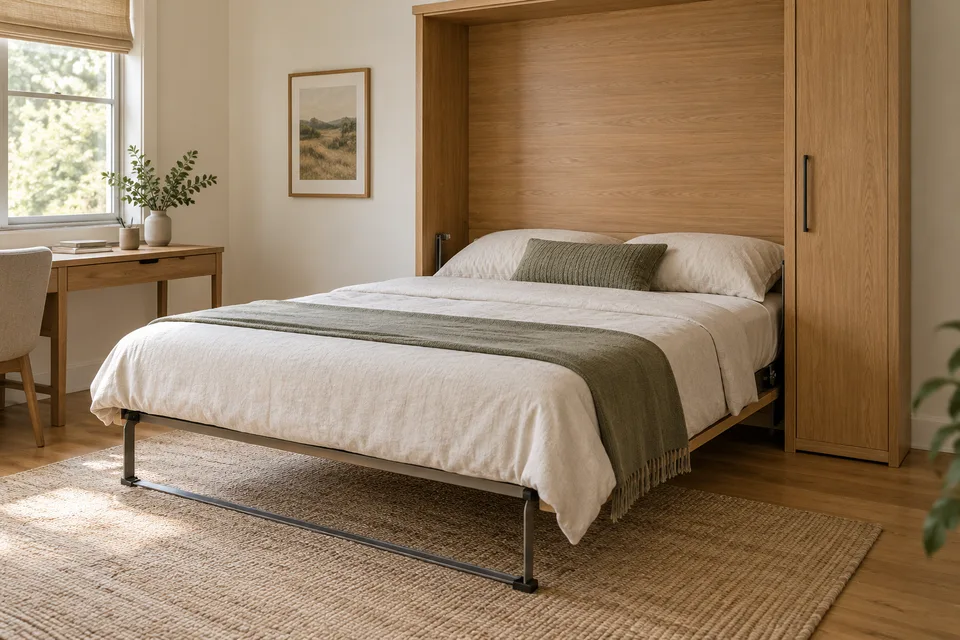
The case is strongest when a room has to do two jobs every day. A home office that hosts guests twice a year does not need one; a studio where the bed occupies a third of the floor at all times does. The test is how often you would actually fold it away, because a wall bed that stays down is an expensive ordinary bed.
What the extra money buys over a sofa bed is a real mattress and a floor that clears. If you are weighing this as part of making a small home work, the small-space guide covers the cheaper moves that come first, and the space-saving furniture guide covers storage beds and ottomans that solve part of the same problem for hundreds rather than thousands.
6. Where to save
The savings come from what you leave off the quote.
- Skip the side cabinets first. Fixr puts shelving at $1,000–8,000 against a $2,900 queen prefab. They are also the easiest thing to add later.
- Take vertical if the room allows. It is cheaper in every tier, and the only reason to pay for horizontal is a ceiling or a slope that forces it.
- Size to the guest, not the aspiration. A double costs roughly a thousand less than a queen prefab and sleeps two adults.
- Get the quote itemized. Delivery runs $100–400 by Angi's figures, a flat install $300–800, and removing an old unit $200–500.
Murphy Bed Cost FAQ
Is a Murphy bed cheaper than adding a guest room?+
Almost always, and it is not close. A Murphy bed converts a room you already have, while a bedroom addition is a foundation, framing, roofing and permitting project. The honest comparison is against the alternatives that also cost nothing structural: a sofa bed, a daybed, or an air mattress in a home office. Against those the Murphy bed costs several thousand dollars more and buys a real mattress, a floor that clears daily, and no nightly setup.
Do Murphy beds need to be attached to the wall?+
Most do, and that is the safety-critical part of the job. The cabinet is anchored into studs so the mechanism cannot tip forward when the bed swings down, which is why the load rating on the hardware and the quality of the anchoring matter more than the finish. Freestanding models exist and avoid wall attachment, which suits renters, but they are heavier and take more floor depth. Check your lease before drilling.
What size room does a Murphy bed actually need?+
The floor clearance matters more than the wall. A vertical queen needs roughly the mattress length clear in front of the cabinet when it is down, so plan on about 7 feet of projection plus room to walk past. Horizontal models drop sideways and need less depth but more wall, which is why they suit low-ceilinged rooms and long walls. Measure the swing before choosing the orientation, because orientation moves the price as much as the size does.
Are there ongoing costs after installation?+
Very little. The mechanism is springs or gas pistons, and pistons are the part that eventually weakens on heavily used beds. Replacement is a hardware cost rather than a new bed. When the mattress itself wears out, replace it with one 10 to 12 inches deep, because a thicker one will not let the bed latch closed.
Can a Murphy bed be moved to another house?+
A prefab or freestanding unit can, though it is a two-person disassembly and the wall anchors leave repairs behind. A built-in custom unit generally stays, and is best thought of as part of the house rather than furniture you own. If you expect to move within a few years, that difference is worth more than the price gap between prefab and custom.