Laundry room upgrades, ranked
Most laundry rooms are fixed for under $175, and the order matters: the shelf and the sorter between them solve the two problems every laundry room has (detergent on the machine tops, clothes on the floor). Ranked by impact:
Upgrade names open Amazon. Each row also links its how-to.
Disclosure: As an Amazon Associate, we earn from qualifying purchases. We may earn a commission when you buy through our partner links. It doesn't affect our recommendations or what you pay. Prices and availability change frequently; editorial ranges are planning estimates, not live quotes. Check the retailer for current prices, pack sizes, and availability. Learn more
Useful additions for your space
Shop by problem
Use the best-for notes to find a relevant option. Check dimensions and compatibility before buying.
Over-Washer Storage Shelf
Freestanding or wall-mounted shelf unit that fits above a washer/dryer. Best for: Detergent, softener, dryer sheets, cleaning supplies.
3-Bag Laundry Sorter Cart
Rolling cart with removable bags for lights, darks, and delicates. Best for: Sorting laundry before wash day.
Retractable Clothesline
Wall-mounted line spans an 8-15 foot room and retracts flat when not in use. Best for: Air-drying delicates and hand-wash items.
Slim Rolling Cart
5-7 inches wide, so it fits the gap between washer and dryer or beside the machines. Best for: Stain removers, brushes, lint rollers, dryer sheets.
Wall-Mounted Ironing Board
Folds flat against the wall when not in use. Best for: Saving floor space in small laundry rooms.
Washer Drip Pan
Catches a hose or seal failure before it reaches the ceiling below. Best for: Second-floor or upstairs laundry.
Lint Bin with Lid
Small countertop bin with a lid. Best for: Lint, coins, receipts, pocket items.
1. Laundry Room Layout Zones
A side-by-side washer and dryer eats about 54-56 inches of wall and 30-34 inches of depth once the doors are counted, which leaves most laundry rooms with one usable wall and the air above the machines. Assigning that leftover space to four zones (sort, wash, dry, fold) is what stops the machine tops from becoming the shelf, the counter, and the folding table all at once.
Sorting Zone
A 3-bag sorter ($30-50) inside the door, or stacked hampers where floor width is under 24 inches
Washing Zone
Detergent and stain remover within arm's reach of the machine door, on a slim cart or the lowest shelf, nothing higher
Drying Zone
A retractable line ($15-30) or fold-flat wall rack ($30-50) on the wall the dryer door doesn't swing into
Folding Zone
36 inches off the floor is standard counter height; a board across front-loaders gets you there for under $40
2. Above the Washer & Dryer
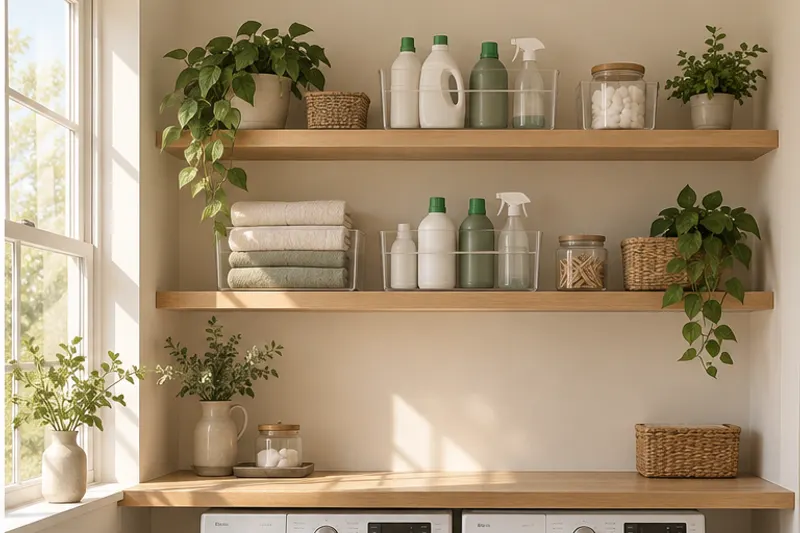
The wall above the machines is the only square footage a laundry room gives you for free, and one shelf there ($30-60 in wire or melamine) clears more clutter than anything else you can buy for the room. The number that matters is the mounting height: leave 16-18 inches above a front-loader so a detergent jug stands up, and 20+ inches above a top-loader so the lid can swing all the way open.
- Wire or melamine shelving, 12 inches deep: $30-60 for a DIY run above the machines. Twelve inches holds jugs and bins without you knocking your head; 16-inch shelving belongs on a pantry wall, not here.
- Anchor into studs: studs sit 16 inches on center. A shelf holding six detergent jugs is carrying 40-60 lbs, and drywall anchors alone won't hold that above a machine that vibrates.
- Freestanding over-the-washer shelf: straddles both machines on four legs and drills nothing. The one for renters.
- Hanging rod between shelf brackets: $10-15 of closet rod hangs shirts straight out of the dryer, before they wrinkle.
- Command hooks (rated 3-5 lbs each, about $10 for six): lint rollers, mesh wash bags, and a brush, on the wall beside the machine rather than on top of it.
3. Sorting & Hamper Systems
Sorting at undress, not on wash day, is the single change that stops laundry piling on the floor, and a full compartment becomes the signal to run a load. A 3-bag rolling sorter ($30-50) is the standard answer, sized so each bag takes about one machine load, which is roughly 10-20 lbs of clothes.
- 3-bag rolling sorter ($30-50): lights, darks, delicates. Typically 30-35 inches wide and 15-18 inches deep, so measure the door swing before you buy the 4-bag version.
- Don't overload the bags: the bags fail before the frame does. Seams and drawstring loops give out first. Wet towels are what kills them.
- Stacked hampers instead: under 24 inches of floor width, three stacking bins get the same sort in half the footprint.
- One sorter bag per person in a shared house: labeled by name beats labeled by color once more than two people use the room.
- A mesh lingerie bag per person for socks: $10 for a set of five, and the sock problem is permanently solved.
Pro tip: Put the sorter on the bedroom side of the door, not the laundry side. Sorting only happens where people undress. A sorter three rooms away only collects what someone already carried there.
4. Detergent & Supply Storage
Half-empty jugs are most of what makes a laundry room look chaotic, and decanting is the cheapest fix: pods into one gasketed jar ($15-30), liquid into a pump or spigot dispenser. Everything you touch every wash belongs within arm's reach of the machine door. A slim rolling cart 5-7 inches wide ($20-35, SPACEKEEPER) fits the gap between the machines and holds all of it.
- Decant pods into one clear jar ($15-30): a gasketed canister keeps them from fusing in humidity, and one jar replaces three torn bags.
- Liquid into a dispenser: a spigot jar or pump bottle pours clean and ends the crusted cap. Keep the original bottle's dosing cap. You still need it.
- Slim cart in the gap ($20-35): stain sticks, brushes, lint rollers, dryer sheets. Measure the gap first. Most carts are 5, 6, or 7 inches wide and the difference matters.
- Everything on a tray: a $10 tray means you lift one thing to wipe the shelf instead of nine.
- One spare of each consumable, no more: backstock beyond that lives in the pantry or garage. A laundry room is not a warehouse.
- A shelf riser ($15-20) turns one detergent shelf into two working levels; a tension rod under it hangs spray bottles by their triggers.
5. Drying & Folding Stations
Every laundry room needs somewhere to put the things that can't go in the dryer, and a floor rack in the walkway is the answer that fails. Wall-mounted solutions cost $15-50, take about 4 inches of depth when folded, and put the hang-dry pile where it isn't in the way, on the wall the dryer door doesn't swing into.
- Retractable clothesline ($15-30): Line that pulls across an 8-15 foot room and disappears into a housing the size of a fist.
- Fold-flat wall drying rack ($30-50): accordion or bar-style, roughly 4 inches deep folded, 20-24 inches out when open. Better than a line for sweaters, which need to lie flat.
- A folding surface at 36 inches: standard counter height. Over front-loaders, a $30-40 laminate board spanning both machines does it; over top-loaders it can't be done, so use a wall-mounted drop-leaf instead.
- Wall-mounted ironing board ($40-70): drops down for use and folds to about 5 inches deep. Nothing freestanding survives a small room.
- A rod, not a rack, for shirts: hanging straight out of the dryer while still warm prevents the ironing.
6. Small Laundry Closet Solutions
A laundry closet is a different problem from a small laundry room: the constraint isn't storage, it's the door and the depth. Stacked machines need about 30-32 inches of closet depth and 27-30 inches of width, plus 4-6 inches behind them for the vent duct and hoses, and that clearance is not optional space you can fill with bins.
- Leave the 4-6 inches behind the dryer alone: crushing a flexible vent duct against the back wall restricts airflow. Loads dry slower and lint collects where it can ignite. Rigid or semi-rigid duct with a periscope fitting buys back a couple of those inches properly.
- Swap the swing door for bi-fold or a curtain: a 30-inch swing door claims about 5 square feet of the room in front of the closet. Bi-folds reclaim it for $60-120; a curtain rod does it for $25.
- Stack, don't line up: a stacking kit ($30-60 from the machine's own manufacturer, not a universal part) turns 56 inches of wall into 27. Without it there is no closet laundry.
- The door is the storage: an over-door organizer ($15-30) is the only place left once the machines are in. Sprays, wash bags, clothespins, and stain sticks.
- Nothing on top of the machines: in a closet you can't see the tops, so anything set there vibrates off behind the machines and stays there.
7. Extras That Make a Difference
Three of these are maintenance, not organizing, and they matter more than any bin you buy. A clogged dryer vent is the most common cause of dryer fires, and it announces itself as loads that suddenly need two cycles.
- Clean the lint trap every load, the duct every year: a $15 vent brush kit is the whole tool. If drying times have crept up, that's the reason.
- Lint bin with a lid ($10-15): lives on the machine top or a shelf so the trap gets emptied instead of “later.”
- A drip pan under a second-floor washer ($25-40): a supply hose failure on an upper floor is a five-figure claim. Steel-braided hoses ($20 a pair, replaced every 5 years) are the other half of that insurance.
- Smart plug or a phone timer ($10-25): wet clothes left in the drum overnight get rewashed. Nobody counts that load.
Browse the storage options above once you know what your space needs.
Doing the whole house?The free 12-week planner takes one room a week, with a printable checklist for each. Get the planner. No email required.
Laundry Room Storage FAQ
How do I organize a small laundry room or closet?+
Work the vertical: a wire shelf or two above the machines ($30-60 installed DIY) holds detergent and bins, a slim rolling cart 5-7 inches wide ($20-35, SPACEKEEPER) fills the gap between side-by-side machines, and an over-door organizer ($15-30) takes lint rollers, wash bags, and clothespins. For air-drying without a floor rack in the walkway, a retractable clothesline ($15-30) or a fold-flat wall drying rack ($30-50) does the job in about 4 inches of depth.
What is the best way to sort laundry?+
A 3-compartment rolling sorter ($30-50): lights, darks, delicates, sorted at undress rather than on wash day. Each bag holds roughly one machine load, so a full compartment is your signal to run it. Label the compartments; shared households only keep a system when the system explains itself. If the room is too tight for a sorter, three collapsible bins on a shelf sort the same way in half the depth.
How can I reduce laundry room clutter?+
Decant: pods into one clear gasketed jar ($15-30), powder into a dispenser. The half-empty jugs are most of the visual chaos. One spare of each consumable is backstock; more is a warehouse, and it moves to the pantry. A shelf riser ($15-20) splits the detergent shelf into two working levels, a tension rod under it hangs spray bottles, and six Command hooks ($10) catch hang-dry items straight out of the dryer.
How much weight can a laundry sorter hold?+
Far less than the frame suggests. Plan on about one machine load per bag, which is roughly 10-20 lbs of clothes, and treat wet towels as the thing that breaks sorters. The bags are the weak point, not the tubing: seams and drawstring loops give out first. If you routinely pile a week of towels into one compartment, skip the 3-bag sorter and use two rigid rolling hampers instead.
See our best storage bins
Bins and baskets for the shelf above the machines, compared and ranked.
See Top Picks