What survives attic heat — and what doesn't
Attic air swings from below freezing to roughly 130°F on a hot day; the material that fails first decides what can go up there. Tap an item to jump to the detail, or a fix to shop it.
Disclosure: As an Amazon Associate, we earn from qualifying purchases. We may earn a commission when you buy through our partner links. It doesn't affect our recommendations or what you pay. Prices and availability change frequently; editorial ranges are planning estimates, not live quotes. Check the retailer for current prices, pack sizes, and availability. Learn more
Attic Safety First
Two things hurt people in attics: stepping between joists, and assuming the floor up there is a floor. Five rules cover the rest.
- • Walk only on joists or installed flooring—never step between them
- • Treat an unfinished attic as roughly a 10 lb/sq ft space, not the 30+ lb/sq ft of a living-space floor — get a structural engineer or your building department to confirm before heavy loads
- • Watch for nails protruding from roof
- • Use proper lighting (headlamp or work lights)
- • Don't block soffit vents or cover insulation
Useful additions for your space
Shop by problem
Use the best-for notes to find a relevant option. Check dimensions and compatibility before buying.
Raised Attic Flooring Panels
Interlocking 2x2-ft panels that deck over joists without crushing the insulation below — a 4-pack covers 16 sq ft. Best for: Creating a stable storage platform over joists.
Gasket-Lid Totes (IRIS WEATHERTIGHT, Sterilite Gasket Box)
Latching lids with a rubber gasket — the seal is what keeps dust, damp air, and insects out. Best for: Décor, camping gear, anything staying up there past one season.
Pull-Down Attic Ladder (Werner, Louisville Ladder)
Folding ladder with an insulated door panel; sold by rough opening size and ceiling height. Best for: Replacing a scuttle hole you have to balance a step ladder under.
Battery LED Motion Light (Mr. Beams tier)
Puck light that switches on when you come through the hatch — no wiring, no switch to find in the dark. Best for: Lighting a decked storage aisle.
Insulated Attic Hatch Cover (“attic tent”)
Zippered insulated tent over the hatch — stops conditioned air escaping the house through the opening. Best for: Sealing a leaky pull-down stair opening.
Label Maker (Brother P-touch, DYMO)
Laminated labels survive heat and don't peel like tape and marker. Best for: Reading bin contents from the top of the ladder.
1. Assessing Your Attic
Not every attic can be a storage space — and finding out after you've hauled bins up the ladder is the expensive way to learn. Seven things determine whether yours qualifies, and the load rating is the one people skip:
Check These First
- Flooring: Are there floor boards or just exposed joists? You need a solid walking surface.
- Load rating: Code minimums (IRC Table R301.5) are 10 lb per square foot for an attic with 42 in or less of clear height and 20 lb per square foot once it carries limited storage — against 30–40 for a living-space floor. Use the 20 figure if you can stand up in there. Engineered roof trusses are the tightest case of all, because their bottom chords are sized to hold a ceiling up, not your bins.
- Access: Pull-down stairs, scuttle hole, or walk-in? This affects what you can store.
- Height: Can you stand? Crouch? Crawl only? Measure clearance.
- Insulation: Is it on the floor (common) or roof (finished attic)? Don't compress floor insulation.
- Ventilation: Are soffit vents and ridge vents clear? Blocking them causes moisture problems.
- Leaks: Look for water stains on rafters or sheathing. Fix any leaks before storing.
How Much Weight Can It Take?
Use 10 lb/sq ft as a planning assumption, not a promise. In practice that means a 4x8 decked platform — 32 sq ft — is carrying its limit at roughly 320 lb spread evenly: sixteen full 20-lb bins, and that's the ceiling rather than a target. Books, hand tools, and spare tile pass that in one trip; holiday décor and luggage almost never do. Anything heavier than the rule of thumb, or any plan to permanently floor the attic, is a question for a structural engineer or your local building department — joist size, span, and spacing all change the answer, and yours may be rated higher or lower.
Temperature Reality
Attic air runs about 20–35°F above the outdoor temperature — roughly 130°F on a 95°F day under a dark shingle roof — and drops below freezing in winter, and the thresholds differ by material — paper and photographs want to stay below 75°F, electronics about 85°F. That gap is the whole storage rule: your attic is above the damage threshold for months at a time. Insulating at the roofline instead of the floor turns the attic into conditioned space and moderates it — but floor insulation, the usual setup, does nothing for the attic's own temperature. It protects the rooms below.
2. Preparing Your Attic for Storage
Two jobs make an attic usable, and both are half-day projects: deck a defined platform so you aren't balancing on joists, and put light in it so you can read a label without a flashlight in your teeth. Budget $100–250 for both if you do the work yourself.
Install Flooring
Deck an area you've actually planned — an 8-foot aisle from the hatch with bins on one side beats floorboarding the whole attic and filling it. Three options, cheapest first:
- OSB (oriented strand board): Cheapest sheet good, works fine for storage. Cut sheets down at the store — a full 4x8 will not turn the corner of a pull-down opening.
- Plywood sheets: 1/2" or 3/4" across the joists. The standard DIY deck, stiffer underfoot than OSB.
- Raised attic flooring panels: $40–80 per 4-pack of 2x2-ft panels — 16 sq ft covered, so about $2.50–5.00/sq ft. They sit on legs above the joists so deep insulation stays uncompressed — the only option that doesn't trade R-value for shelf space.
Whichever you use, decking spreads a load; it does not raise the joists' rating. The 10 lb/sq ft rule of thumb still applies to what you set on top.
Add Lighting
One fixture at the hatch and one over the storage aisle is enough. Pick by how much wiring you're willing to do:
- Battery LED motion pucks ($20–40): No wiring, switch on as you come through the hatch. Swap batteries at the same time you rotate the holiday bins.
- Pull-chain bulb fixture: Cheap and permanent, but you have to find the chain in the dark — tie a length of bright cord to it.
- LED shop lights: Brightest option and they run cool, which matters in a space that can sit above 120°F all afternoon.
3. What to Store in Attics
Rule of thumb: if it survives a hot car in summer and a cold garage in winter, it survives the attic. The table above gives the verdicts — what follows is how to prep each attic-safe category so it comes back down in the condition it went up.
- Holiday décor: Plastic and metal only — pull candles, chocolate, and anything scented out first, because they melt and then they leak into everything else in the bin. Ornaments go in a divided box, lights on reels, never loose.
- Luggage: Store empty with the latches and zippers open. A closed case that went up with a trace of damp inside comes down smelling of mildew, and the lining is what holds it.
- Camping and sports gear: Everything bone dry before it goes up. Tents and sleeping bags stored loose in a mesh sack, not stuffed in their compression sacks — long compression flattens loft permanently. Pull the batteries out of headlamps and lanterns; heat makes them leak.
- Seasonal clothing and bedding: Washed, fully dry, in gasket-lid totes with a cedar block. Vacuum bags suit synthetics for a single season; wool, down, and leather shouldn't be up there at all.
- Books: Only in sealed totes, only if you accept some yellowing. Paper is stable in the heat but not in the humidity swing, and anything you'd be upset to lose belongs in the house.
- Containers themselves: Gasket-lid totes (IRIS WEATHERTIGHT, Sterilite Gasket Box) at $15–30 each for anything staying past one season; a plain latching tote like Rubbermaid Roughneck is fine for a few months but doesn't seal against damp air. Cardboard is not a container up here — it wicks moisture and pests nest in it.
4. What NOT to Store — and Where It Should Go
Most of what follows degrades well below the temperature an attic holds for months at a stretch. Wood furniture and instruments are the exception — they fail on the humidity swing rather than the peak temperature — and paint, aerosols, and propane are safety items that don't belong up there at any temperature. The useful part isn't the ban — it's knowing where each one goes instead.
- Photos, documents, artwork: Interior closet on an upper shelf, or a fireproof box for originals. Scan first; a digital copy is the only version that survives a roof leak.
- Electronics and batteries: Inside the house. Heat degrades lithium cells and softens the solder and adhesives holding screens in. Lithium batteries in particular can vent or swell.
- Wood furniture and musical instruments: A conditioned room or a climate-controlled unit. It's the humidity swing that opens glue joints and cracks soundboards, not the peak temperature — which is why these are a “no” even in an attic that never got especially hot.
- Leather, wine, cosmetics, candles, vinyl: Interior closet or basement — anywhere that holds a steady temperature. Wine is the fussiest of the five and starts to suffer around 70°F; wax and vinyl take more heat but deform under a long hot spell.
- Food: Nowhere in the attic, in any container. It brings rodents into your roof structure, and that's a wiring problem, not a storage problem.
- Paint: Cool, dry, and indoors but unheated — a basement shelf or an interior closet floor. Latex paint is ruined by a freeze as surely as by attic heat, so an unheated garage in a cold climate is out too. Seal the lid and store the can upright.
- Aerosols: Same cool, dry indoor spot, away from any heat source and out of direct sun. The can is pressurized, and manufacturers rate them well below the temperature an attic reaches in July.
- Propane cylinders: Outdoors only — upright, on a flat non-combustible surface such as concrete, and out of direct sun. Never a shed, garage, attic, or basement: a leak pools at floor level and only needs a pilot light or a water heater to find. Cylinders you're done with go to an exchange cage, not into storage.
5. Organization Systems
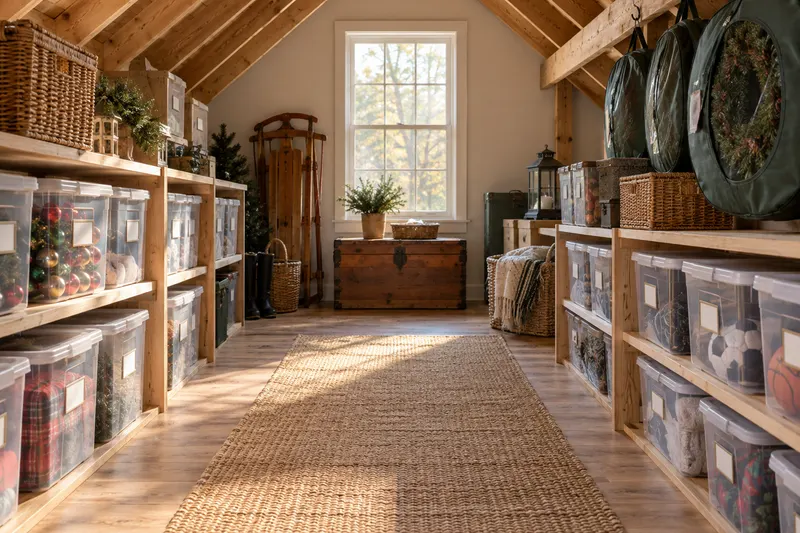
An attic system only has to solve one problem: finding a thing without unstacking everything while balanced on a ladder. Pick one bin size, label two faces, and leave an aisle.
Container Strategy
Buy one model in one size and stick with it — mixed bins don't stack square and you lose a third of the usable height.
- One bin, bought in quantity: A gasket-lid tote (IRIS WEATHERTIGHT, Sterilite Gasket Box) at $15–30 each for long-term contents; Rubbermaid Roughneck for bulky, un-fussy things you touch every year.
- Clear bodies where you can: Seeing the contents saves an unstack, and a clear bin still needs a label because the top one is all you can read.
- Label two faces: Top and one side, printed — a laminated label maker strip survives the heat where marker on tape curls off.
- Weight down low, and light: Keep bins near 20 lb so one person can lift them from a ladder, and stack the heaviest at the bottom nearest the hatch.
- Current season at the front: The bin you'll open in six weeks should never be behind the one you open in six months.
Layout Tips
Lay the attic out like a tiny warehouse: one aisle, categories in zones, nothing blocking the mechanicals.
- Run a main aisle from the hatch — 24 inches is enough to turn with a bin
- Group by category (holiday, sports, seasonal) so one trip gets one job done
- Keep frequently accessed items within arm's reach of the opening
- Stack no higher than shoulder height — nothing you have to pull down blind
- Leave clearance around vents, flues, and HVAC equipment; blocking soffit vents traps the moisture that ruins everything up there
6. Improving Attic Access
Bad access is why attics fill with things nobody ever retrieves. If you go up more than twice a year, fixing the ladder is worth more than any bin you could buy.
Pull-Down Stairs
$150-300 for the unit (Werner, Louisville Ladder), plus about the same again for installation. The most common fix. Buy the insulated-door version.
Attic Lift
$500-2000. Motorized platform lifts heavy items. Great for frequent use.
Wider Opening
Consider enlarging a small scuttle hole for easier access to larger items.
Permanent Stairs
$2000+. If you use attic daily, consider fixed staircase (requires space below).
Browse the storage options above once you know what your space needs.
Doing the whole house?The free 12-week planner takes one room a week, with a printable checklist for each. Get the planner. No email required.
Attic Storage FAQ
How hot is too hot to store things in an attic?+
There isn't one number — different materials fail at very different temperatures, and the strictest item decides. Paper, photographs and film are the tightest: the National Archives puts family papers and photographs below 75°F, and the Library of Congress puts colour photographs and negatives at 40°F or below. Batteries and electronics tolerate roughly 85°F. Wax, vinyl and adhesives survive past 100°F but soften and deform under sustained heat. Attic air runs roughly 20-35°F above the outdoor temperature depending on roof colour and ventilation — about 130°F on a 95°F day under a dark shingle roof with poor venting — then drops below freezing in winter. The swing is as damaging as the peak: it's what warps wood and cracks leather. If you can't condition the attic, store only durable goods up there — plastic and metal décor, luggage, camping and sports gear.
What should not be stored in an attic?+
Anything heat- or humidity-sensitive, and the thresholds differ by material: photos, documents, vinyl records, electronics, batteries, candles, cosmetics, leather, wine, musical instruments, and solid-wood furniture — wood and instruments fail on the humidity swing rather than the peak temperature, so they're a no even in a mild attic. Paint and aerosols don't go up there either; they belong somewhere cool, dry, and indoors but unheated, since latex paint is ruined by freezing too. Propane cylinders belong outdoors only — upright, on a flat non-combustible surface such as concrete, out of direct sun and away from anything over 120°F, and never in a shed, garage, attic, or basement, because a leak pools at floor level and finds an ignition source. Skip cardboard as a container too; it collapses in humidity swings and draws pests. Gasket-lid totes (IRIS WEATHERTIGHT, Sterilite Gasket Box) are the attic container that actually works.
How much weight can an attic floor hold?+
Building code (IRC Table R301.5) sets two minimums for attics: 10 lb per square foot for an uninhabitable attic without storage — one with 42 inches or less of clear height — and 20 lb per square foot once it has limited storage, against 30 to 40 for a living-space floor. If your attic has the headroom to walk in and deck a platform, the 20 figure is the one that applies to you. That is still not much: 20 lb/sq ft over a 4x8 platform is about 640 lb spread evenly, and books, tools, and tile blow past it fast. Engineered roof trusses are the tightest case, since their bottom chords are sized to hold up a ceiling, not your storage. Treat these as planning minimums rather than a guarantee — local amendments vary, so have a structural engineer or your building department confirm before you load heavy items or add a floor.
How do I make my attic safe for storage?+
Deck a defined area over the joists — 1/2-inch plywood, OSB, or raised panels at $40-80 per 4-pack — and walk only on it, never between joists. Add light; a battery motion light runs $20-40 and needs no wiring. Keep soffit and ridge vents clear and don't compress the floor insulation, because moisture ruins stored goods faster than heat does. Fix roof leaks before anything goes up. One correction worth knowing: floor insulation protects the rooms below, it does not cool the attic. The only thing that moderates attic temperature is insulating at the roofline so the attic becomes conditioned space — a contractor-scale project, not a storage tip.
Need climate-controlled storage?
For items that can't handle attic temperatures, find a storage unit nearby.
Find storage near you