Where downsized items should go
The fastest route out for each category, and what it typically returns:
Useful additions for your space
Shop by problem
Use the best-for notes to find a relevant option. Check dimensions and compatibility before buying.
Disclosure: As an Amazon Associate, we earn from qualifying purchases. We may earn a commission when you buy through our partner links. It doesn't affect our recommendations or what you pay. Prices and availability change frequently; editorial ranges are planning estimates, not live quotes. Check the retailer for current prices, pack sizes, and availability. Learn more
Color-Coding Dot Stickers (Avery)
The tool that actually moves a downsize along: green keep, yellow sell, red go. You decide an item in a second and nothing has to be carried anywhere until the whole room is tagged. Best for: Tagging a whole room before you lift a single box.
Small Moving Boxes (12-Pack)
Book-size boxes keep loads under about 40 lb — the size that stops a downsize turning into a back injury. Best for: Books, papers, kitchen items, anything dense.
3-Mil Contractor Trash Bags (Husky, Glad)
Thick enough to hold broken glass, curtain rods, and 30 years of garage debris without splitting on the driveway. Best for: The discard pile and the final cleanout.
Clear Latching Bins, 6-Pack (Sterilite, IRIS USA)
What the keepers travel in. Clear sides mean you can find the coffee maker on night one without opening six boxes. Best for: Keepers, and anything going into temporary storage.
Laser Distance Measure (Bosch GLM tier)
Measures a room in seconds from one spot — you can plan the new floor plan in a single walkthrough instead of wrestling a tape alone. Best for: Checking what furniture actually fits before moving day.
Flatbed Photo Scanner (Epson Perfection tier)
Digitize photos and documents before the originals go. A scanning service is the better call above a few thousand photos. Best for: Albums, slides, and paperwork you don't need in physical form.
1. The Space Math: How Much Has to Go
Start with the subtraction, because it sets the size of the whole job. Divide the new square footage by the old: a 2,400 sq ft house into a 1,200 sq ft condo is a 50% cut, which means roughly half of what you own is not coming. Deciding that on day one is what keeps the last week from becoming a panic.
Then run the same math on storage space alone, because it almost never shrinks in proportion — it collapses. A two-car garage on its own is about 400–600 sq ft. Add an unfinished basement, which is usually the full footprint of the house, and a floored attic on top of that, and the storage-only space in a family home routinely runs 1,000–2,000 sq ft. A condo or an independent-living apartment often replaces all three with one hall closet and a 5x8 storage cage — 40 sq ft, a cut of 95% or more. That 40 sq ft is where the holiday décor, the tools, the luggage, and the camping gear have to fit.
Three numbers to get before you sort anything:
- The floor plan with dimensions. Ask the builder, agent, or community for it. Every wall you can put furniture against, measured.
- Closet linear feet, old versus new. Measure the hanging rod in each closet you have now and each one you're getting. Wardrobes get cut by the same ratio, and no organizer product changes that.
- What's already built in. Many apartments include a washer/dryer, some include shelving, some prohibit personal appliances entirely. That decides whether your machines are worth moving.
Sanity check: a standard 3-seat sofa is about 84 inches and a queen bed with clearance needs roughly 10x10 ft of floor. If the new living room wall measures 8 ft, the sofa question is answered before you get emotional about it — sell it there, buy a smaller one here, and don't pay to move a thing that won't fit.
2. Downsizing Timeline
Rule of thumb: Allow 1 month of sorting for every 10 years you've lived in your home. A 30-year home = 3 months minimum.
6 Months Before Move
- Walk through new space, measure rooms and closets
- Create floor plan showing what furniture can fit
- Start with obvious items: broken things, duplicates, expired items
- Begin selling valuable items (furniture, collectibles)
3 Months Before
- Tackle one room per week
- Sort sentimental items (photos, heirlooms)
- Schedule donation pickups
- Consider temporary storage for undecided items
1 Month Before
- Final decisions on remaining items
- Pack what you're keeping
- Schedule junk removal for final cleanout
- Cancel/transfer utilities and subscriptions
For a printable version of this plan, the free whole home organization planner has a room-by-room assessment and a week-by-week checklist.
3. Making Keep/Go Decisions
The Decision Framework
Five questions, in order. The fourth one is the one people skip, and it's the only one with a dollar figure attached — run it before the sentimental one.
- Does it fit in the new space? If no, it goes (unless irreplaceable).
- Have I used it in 2 years? If no, it goes — that's the rule, not a suggestion. Clothing is the single exception and it runs tighter: one year, because anything you skipped for a full year has already been passed over in every season it was made for.
- Would I buy this today? If no, let it go.
- Is it worth the cost to move or store? Long-distance movers charge by weight, so a heavy dresser can easily cost $100–200 just to ship, and storage adds $50–75 every month it stays undecided. If replacement costs less than transport, that's your answer.
- Does it bring me joy or serve a purpose? Keep only what matters.
What Each Route Costs
"Moving costs add up" is useless without figures. Here are the ones that decide most keep-or-go calls — editorial ranges for planning, not quotes:
The Four Piles
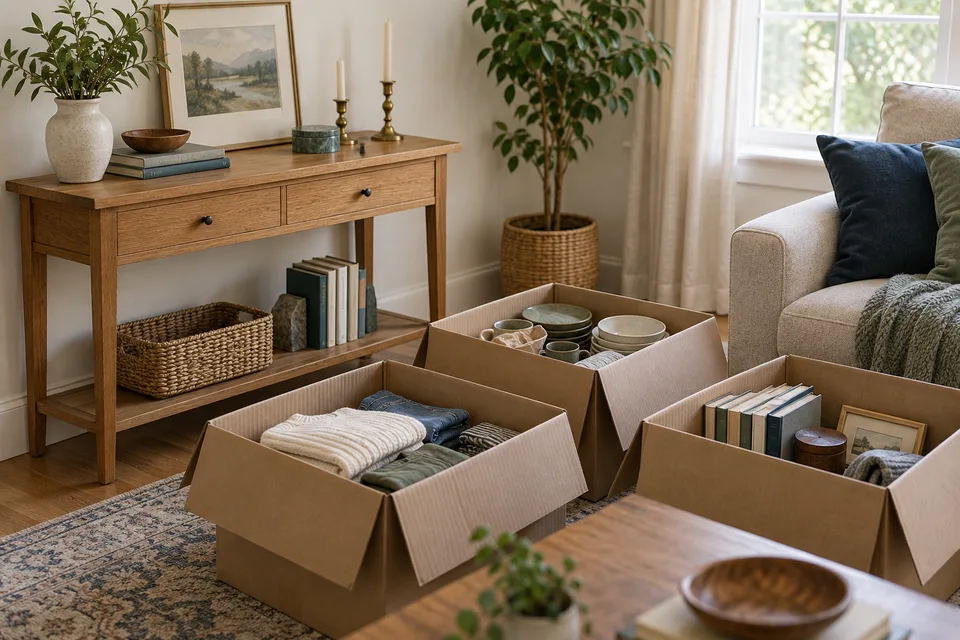
4. Room-by-Room Strategy
Do the rooms in this order: storage spaces first at 6 months out, closets next, the kitchen last. That's volume first and emotion last, and it means you keep cooking out of a working kitchen until the final month.
Garage, Basement, and Attic — Start Here, 6 Months Out
This is the 1,000–2,000 sq ft from Section 1 collapsing into roughly 40. It's the biggest volume in the house and the least emotional, which makes it the right place to practise deciding. Budget two or three weekends and expect one or two junk-removal truckloads at $150–600 each.
- Holiday décor: one bin per holiday you actually host. Thirty years of accumulation is commonly 8–12 totes. Budget 4–6 in a 5x8 cage that also has to swallow the luggage, the tools, and the camping gear.
- Sports equipment for sports you haven't played in 2 years: gone, and it sells locally in a weekend if you list it in spring or fall rather than the week you move.
- Tools: a condo kit is six items. Drill, screwdriver set, hammer, pliers, tape measure, small level. The table saw, the extension ladder, the workbench, and every piece of lawn equipment stay behind — there is nowhere to put them and nothing to use them on.
- Paint, solvents, fuel, propane, old fluorescent tubes: none of it moves, and none of it is allowed in a storage unit either. Book a household hazardous-waste drop-off 3–4 weeks out; most counties run them on a handful of dates a year.
- The 5-year test on anything boxed. A carton you haven't opened in five years can go unopened. Opening it converts a 10-second decision into an afternoon.
Bedrooms and Closets — Measured in Linear Feet
Closets are the fastest room in the house: about 2 hours each, and the rule is arithmetic rather than willpower. Measure the hanging rod you have and the hanging rod you're getting. A shirt takes roughly 1–1.5 inches of rod and a winter coat 2–3, so 12 feet of rod down to 6 means half the wardrobe stays behind — and no organizer product changes that number.
- Clothing is the one-year exception to the 2-year rule used everywhere else on this page. Hasn't been worn in a full year, or doesn't fit today? Donate it.
- Linens: one set on each bed plus one spare per bed. Two bath towels per person, plus two guest sets. A linen closet in a downsized home is commonly a single 24-inch cabinet, so count against that, not against what you own.
- Furniture against the floor plan, not against the memory. A standard 3-seat sofa is about 84 inches and a queen bed with clearance wants roughly 10x10 ft of floor — check both against the dimensioned plan from Section 1 before you pay a mover to carry them.
- Dressers are the classic mistake. They're heavy, they price by weight on a long-distance move at $100–200 a piece, and most downsized bedrooms have built-in closet drawers that make them redundant. Sell locally for 20–40% of retail.
Kitchen — Last, and Against a Tape Measure
The kitchen holds more duplicates than any other room, and it's the one you use until the last week — so it goes in the final month. Measure the new cabinet run before you sort a single drawer: a family kitchen commonly has 20–30 linear feet of cabinetry, an apartment or condo kitchen 10–15. That ratio is your keep list, decided before anything sentimental comes up.
- One set of everyday dishes, service for 6–8. The second set goes, and so does the formal china if nobody claimed it in the heirloom conversation — it typically brings 10–20% of what it cost.
- Cookware: 2 saucepans, 1 stockpot, 1 skillet, 1 sheet pan per oven rack. That covers essentially all home cooking. Count what you own against those six pieces and the answer is usually obvious.
- Single-use appliances that ran once in the last 12 months: bread machine, turkey roaster, fondue set, second slow cooker. Each one occupies a cubic foot you no longer have.
- Utensils: one drawer. If it won't close in the new kitchen, it didn't fit — and a drawer is a much faster test than a debate about the melon baller.
- Pantry and spices go by date, not by feel. Nothing expired moves, and nothing frozen does either. Food banks take unopened, in-date shelf goods; book that drop-off in the final two weeks.
5. How to Let Go
Sort the exit routes by speed, not by price. Anything you're still holding two weeks before the move has stopped being an asset and started being a problem — at that point a free charity pickup beats a listing that might sell.
Selling Options
- Facebook Marketplace: Best for furniture, local pickup. Fastest route for anything bulky, and the buyer carries it out.
- eBay: Best for collectibles and niche items where the buyer isn't local. Not worth the packing time on anything heavy.
- Consignment: The shop keeps a cut and pays you 40–60% of whatever it finally sells for. Note that the sale price is already well under retail, which is why the same item shows up in the table above as returning roughly 15–30% of what you originally paid. Both numbers are true; they measure different things.
- Estate sale: For large volumes. The company prices, staffs, and runs it for a 30–50% commission, and most want a full house rather than a dozen pieces.
- Garage sale: Quick but labor-intensive, and expect dimes on the dollar. Best used as a deadline-forcing event two weekends before the move.
Donation Options
Book pickups 2–3 weeks ahead — charity trucks fill up, and every one of these will decline stained upholstery, cribs, and older mattresses:
- Goodwill/Salvation Army: Accept most items, will pick up
- Habitat ReStore: Furniture, appliances, building materials, cabinets
- Local shelters: Clothing, bedding, toiletries
- Buy Nothing groups: Free to neighbors via Facebook — the fastest disposal route in existence for small items
- Keep the receipt: Itemized donation receipts are worth real money at tax time; ask your accountant what documentation your deduction needs.
6. Using Storage During Downsizing
Pro tip: A storage unit can be a "halfway house" for items you can't decide on. Store them for 6 months — if you don't miss them, donate them.
When Storage Makes Sense
Storage during a downsize is a decision-delay tool, and it's worth paying for in exactly four situations. Outside them, a unit is just a monthly bill attached to things you already decided about:
- Seasonal items: Holiday decor, sports equipment you'll use
- Sentimental items: Can't let go yet, but no room
- Transition period: Moving in stages, or closing dates that don't line up
- Family heirlooms: Committed to a specific person, waiting on their move or their space
Storage Size for Downsizing
Most downsizers need less unit than they think. Size it to the 6-month pile, not to everything you feel unsure about:
- 5x5 ($50–75/mo): Boxes, seasonal items, small furniture pieces — the right size for a can't-decide pile
- 5x10 ($75–125/mo): Contents of a small bedroom or large closet
- 10x10 ($100–200/mo): Half a house worth of furniture + boxes
Do the multiplication before you sign: 6 months in a 5x5 is $300–450, and a year is $600–900. Put the empty-out date in the calendar the same day you rent the unit, and give a copy of that date to whoever is helping you.
7. The Emotional Side
Downsizing isn't just physical — it's emotional, and the emotional part has a mechanical cause. Every object is a decision, and decisions run out long before daylight does. Almost every downsize that stalls stalls in the same place: a box of photographs, opened at hour three of a Saturday. Three techniques handle most of it — a hard session limit, a photograph-then-release routine, and one memory box per person with the lid as the limit.
Tips for the Hard Parts
- Cap sessions at 90 minutes to 2 hours, 2–3 times a week. Decision quality falls off well before energy does; past about two hours people stop making calls and start making piles, which is how a room ends up sorted twice. Set a timer and stop when it goes off, even mid-shelf.
- Never open the sentimental categories first. Start in the garage or a linen closet, where the calls come in seconds, and save photos, letters, and children's things for the third or fourth session — once deciding has become a habit rather than an event.
- Photograph, then release the same day. Plain surface, daylight, one shot of the object and one of any inscription or maker's mark. Record a 20-second voice memo while you shoot: what it was, whose it was, why it mattered. The story is the thing you actually wanted; the object was only holding it. Then it leaves that day — a photographed item left sitting in the room gets re-litigated next weekend.
- One memory box per person, and the box is the limit. Decide the container before you start: a banker's box or a single 27-gallon tote, per person, adults and children alike. Once it's full, something has to come out for something new to go in. That constraint does more work than any amount of resolve, and it survives the move — the box is still the limit in the new place.
- One item per memory, not ten. A trip produces one keepsake, not the whole shelf. Twelve pieces of a collection become one representative piece plus eleven photographs — the same arithmetic the heirloom conversation in Section 8 runs on.
- Hand things over now, while you're there to see them used. A grandchild who gets the sideboard while you're already paying movers costs almost nothing extra to ship. The same piece "held for family" in a 5x5 unit at $50–75/mo costs $600–900 a year, and most of those pieces are worth less than two years of that.
- It's not the item. The memory lives in you, not in the object, and it survives the object leaving. That's the part almost nobody believes until a month after the move, which is exactly why the rules above are written as numbers rather than feelings.
8. Downsizing as a Senior: What's Different
The sorting mechanics are the same at any age. Four things aren't: the timeline is often set by a community rather than by you, the heirloom handoff is a negotiation with adult children, the new apartment is smaller than the numbers suggest, and there is a profession built specifically for this move.
Senior Move Managers
A senior move manager plans the downsize, sorts alongside you, draws a floor plan for the new place, hires and supervises the movers, disposes of what's left, and unpacks the new home so the kitchen and bathroom work on the first night. Rates are commonly quoted around $50–125 per hour, or as a flat price for a full-house move; NASMM (the National Association of Senior & Specialty Move Managers) lists members by area. Worth the money when the move date is fixed by a community, when adult children live out of state, or when stairs and lifting are a real limit — that combination is precisely when a downsize stalls and stays stalled.
The Heirloom Conversation, Six Months Early
The hardest week of most senior moves is the one where the family discovers nobody wants the dining set. Have that conversation early and in writing instead:
- Photograph 15–20 pieces and send the list to children and grandchildren with a decision date attached. Unclaimed by that date means sold or donated — say so up front.
- Expect no on the formal things. China, crystal, silver-plate, and heavy dark furniture have a soft resale market; pieces that cost thousands often bring 10–20% of that. Knowing this early turns a fight into a plan.
- Ship it now, not later. If a grandchild wants the sideboard, send it while you're paying movers anyway. A piece "held for family" in a $50–75/mo unit costs more than most of them are worth within two years.
- Keep one, photograph the rest. One representative piece from a collection carries the memory. Twelve of them carry a moving bill.
Retirement Community Timing and Sizing
Independent-living apartments commonly run 500–1,000 sq ft for a one-bedroom and 800–1,800 for a two-bedroom plans — often a third of a family house, with one hall closet standing in for a basement, a garage, and an attic. Communities usually offer a specific apartment with a short window to accept and move in, which means the sorting has to be underway before you have a unit at all. Ask for the dimensioned floor plan and the list of what's built in (many include a washer/dryer; some prohibit personal appliances) before deciding which large items travel.
Store for Reach, Not Just for Fit
- Daily items between knee and shoulder height. A step stool in a downsized home is the single most avoidable injury risk, and a shelf you can't reach isn't storage.
- Drawers and pull-outs over deep low cabinets. Anything that requires kneeling and reaching to the back gets abandoned, and then re-bought.
- Light where you reach. A $20–40 battery motion light inside a closet or over a top shelf removes most of the fumbling.
- Weight caps on high storage. Nothing above shoulder height that you can't lift down one-handed — that rules out the boxes of books and the cast-iron.
Papers Travel With You
Deeds, wills, powers of attorney, birth and marriage certificates, insurance policies, and current tax records go in one box that rides in your car — never in the moving truck and never in a storage unit. Everything else gets scanned and shredded; a shredding service is worth it once you're past a couple of boxes. Retention for tax records is commonly given as 7 years, but confirm what applies to you with your accountant before anything goes in the bin.
Browse the storage options above once you know what your space needs.
Downsizing FAQ
How do I start downsizing my home?+
Start 3–6 months out — allow about 1 month of sorting for every 10 years you've lived in the house, so a 30-year home needs 3 months minimum. Do the space math first: divide the new square footage by the old, because a 2,400 sq ft house into a 1,200 sq ft condo means half of what you own isn't coming. Then start in the garage, basement, or attic, where the volume is largest and the decisions are easiest, and leave photos and the kitchen for last. Work in 90-minute to 2-hour sessions, 2–3 times a week; past about two hours people stop deciding and start making piles. Sort into four routes — keep, sell, donate, trash — and tag a whole room before you carry anything anywhere.
What should I get rid of when downsizing?+
The rule is two years: if you haven't used it in 2 years, it goes. Clothing is the one exception and runs tighter at one year, because a garment skipped for a full year has already been passed over in every season it was made for. On top of that: duplicates (keep one set of everyday dishes for 6–8, one set of linens per bed plus one spare, two bath towels per person), furniture that doesn't fit the new floor plan, single-use kitchen appliances that ran once in the last 12 months, and tools you won't use in an apartment. Long-distance movers price by weight, so a heavy dresser can cost $100–200 just to ship — if replacement costs less than transport, that's your answer. Digitize photos and documents, and hand heirlooms to family now rather than storing them at $50–75/mo.
Should I use a storage unit when downsizing?+
A temporary unit helps by taking the pressure off the can't-decide pile — but only with a deadline attached. Set 6 months, in writing, on the calendar: if you haven't missed something in 6 months, you don't need it. A 5x5 runs $50–75/mo, so a year of indecision is $600–900, which is more than most of what's in there is worth. Only store items you have a specific plan to use.
What does a senior move manager cost, and is one worth it?+
Senior move managers plan the downsize, sort with you, produce a floor plan for the new place, coordinate movers, clear out what's left, and unpack the new home so the kitchen and bathroom work on day one. Published rates are hard to come by — NASMM itself declines to estimate, since cost varies by region and scope — but third-party surveys put hourly work in the $40–125 range, with major metros higher, and many firms quote a flat rate for a full-house move. NASMM lists members by area. It earns its money when the move date is fixed by a retirement community, when adult children live out of state, or when lifting and stairs are a real limit — that combination is exactly when a downsize otherwise stalls.
What do I do with heirlooms my kids don't want?+
Ask early and in writing, not during the final week. Six months out, photograph 15–20 pieces, send the list, and set a decision date — anything unclaimed by then gets sold or donated. Expect the answer to be no on formal dining sets, china, crystal, and silver-plate: the resale market for them is soft, and pieces that cost thousands often bring 10–20% of that. That isn't an argument for keeping them in a storage unit at $50–75/mo. Photograph the piece, keep one representative item, and let a consignment shop, estate sale company, or charity move the rest.
Need storage during your transition?
A storage unit can make downsizing easier — keep what you can't decide on.
Find storage near you