Packing materials that matter
A complete kit for a two-bedroom runs $80–150, and seven items cover almost all of it. Tap a row to jump to the how-to, or shop the fix:
Disclosure: As an Amazon Associate, we earn from qualifying purchases. We may earn a commission when you buy through our partner links. It doesn't affect our recommendations or what you pay. Prices and availability change frequently; editorial ranges are planning estimates, not live quotes. Check the retailer for current prices, pack sizes, and availability. Learn more
Useful additions for your space
Shop by problem
Use the best-for notes to find a relevant option. Check dimensions and compatibility before buying.
Moving Boxes (Bankers Box SmoothMove)
Double-wall corrugated in the three standard sizes — small ~16x12x12 in, medium ~18x18x16 in, large ~24x18x18 in. Best for: Books and dishes in smalls, linens in larges.
Packing Paper Bundle (10 lb)
Clean, ink-free newsprint — the first wrap on everything fragile. Best for: Dishes, glasses, ceramics.
Bubble Wrap Roll (Duck Brand, large bubble)
Goes over a paper layer, never straight onto a finished surface. Best for: Electronics, mirrors, artwork.
Dish Pack Box with Cell Dividers
Double-wall box plus cardboard cells so glasses never touch. Best for: Complete dish and stemware sets.
Packing Tape (Scotch Heavy Duty or Duck Max Strength, 6-pack)
2-inch tape with a dispenser — thin bargain tape pops open in transit. Best for: Sealing every box top and bottom.
Sharpie Markers & Color-Coded Labels
Permanent marker plus one label color per room. Best for: Finding one box later without opening six.
1. How Much to Buy
The table above says what each supply is for; this is how much of it to buy. Most people underbuy boxes and overbuy bubble wrap. Order roughly half smalls, a third mediums, the rest large — and one 10 lb bundle of packing paper plus about 3 rolls of tape per bedroom. Buying 20% more than you think is cheaper than a second trip.
The four specialty items worth buying
Beyond boxes, paper, and tape, only a handful of extras earn their price for storage specifically:
- Wardrobe boxes ($12–20 each): the only sane way to move hanging suits, coats, and dresses
- Breathable furniture and mattress covers ($10–20 each): dust protection that doesn't trap moisture the way plastic sheeting does
- Silica gel packets ($10–15 for a bulk bag): one or two in any sealed bin holding metal, paper, or electronics
- Pallets or 2x4 boards (often free from a hardware store): they get everything 4–6 in off a concrete floor, which is the single cheapest damage prevention there is
2. Choosing the Right Boxes
Box choice is really weight management: a box fails because someone filled a 24x18x18 in large with books, not because the cardboard was bad. Match the size to the density of what's going in, cap every box at 40 lb no matter its size, and buy real double-wall moving boxes rather than whatever the grocery store has out back.
Don't use: Grocery store boxes, damaged boxes, or boxes that have been wet. They collapse under weight and attract pests.
Box Size Rules
Moving boxes come in three near-universal sizes. Dimensions vary a little by maker, but these are what you'll find on the shelf:
- Small (~16x12x12 in) → heavy items: books, tools, canned goods, dishes. 40 lb max.
- Medium (~18x18x16 in) → most things: kitchenware, toys, decor, small appliances. 40 lb max — easy to blow past with a medium.
- Large (~24x18x18 in) → light and bulky only: pillows, linens, lampshades, comforters.
- Buying one size? Buy smalls. A too-small box is an inconvenience; a too-heavy box is a dropped box.
Packing Box Tips
- Fill boxes completely—half-empty boxes collapse when stacked
- Use crumpled paper to fill gaps
- Tape bottom AND top with H-pattern (across and edges)
- Label on multiple sides so you can read it stacked
- Mark "FRAGILE" and "THIS SIDE UP" where needed
Looking for storage? Compare prices in your area.
Find Storage Units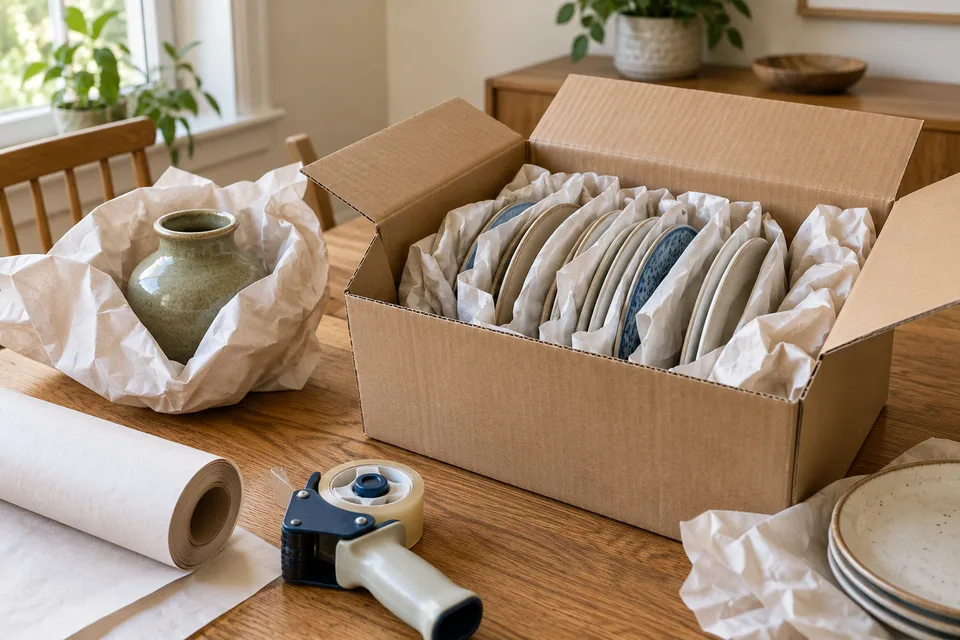
3. Packing Furniture
Furniture survives storage when it is clean, dry, taken apart where it can be, and covered with something that breathes. The two mistakes that cost people real money are shrink-wrapping a finished surface and standing a sofa on end for a year — both look tidy on day one and show up as damage on day 200.
General Furniture Rules
- Clean everything before storing to prevent stains setting
- Disassemble what you can—tables, bed frames, shelves
- Keep hardware in labeled bags taped to the furniture
- Wrap in blankets or furniture pads, not plastic
- Stand sofas on end to save floor space — for a short stay only; over many months the frame and cushions deform under their own weight
Why not plastic? Plastic traps moisture against wood and leather, causing mold, warping, and cracking. Use breathable covers.
By Furniture Type
4. Packing Electronics
Electronics fail in storage from two things: condensation and leaked batteries. Pull every battery, get the boxes off the floor, and put anything with a screen or a hard drive in climate control rather than a garage or an unconditioned unit.
Climate control recommended: Electronics are sensitive to temperature extremes and humidity. Consider climate-controlled storage for TVs, computers, and audio equipment.
- Original boxes: If you have them, use them—they're designed for protection
- No original box? Wrap in anti-static bubble wrap, use double-walled box
- Remove batteries: They can leak and corrode over time
- Photograph cable setups: Before unplugging, take photos for reassembly
- Bundle cables: Zip ties or velcro straps, store with the device
- Silica gel packets: Add to boxes to absorb moisture
5. Packing Fragile Items
Fragile items break from movement, not from impact. Paper goes on first because it grips the surface and doesn't trap moisture against glaze or finish; bubble wrap goes over the paper; then you fill every void until a shaken box makes no sound. If it rattles, it isn't packed.
Dishes & Glassware
- Wrap each item individually in packing paper
- Stack plates vertically (like records), not flat
- Glasses: stuff inside with paper, wrap outside, store rim-down
- Use dish pack boxes with dividers for best protection
- Fill all gaps—nothing should shift when you shake the box
Artwork & Frames
Framed art travels upright, like a record in a crate. Stacked flat, the weight above it cracks glass and presses the mat into the paper:
- X-tape across glass (prevents shattering spread)
- Wrap in bubble wrap, then cardboard
- Store upright, not flat
- Use picture boxes or make custom cardboard sleeves
- Never store in attic or non-climate-controlled unit
6. Packing Clothing & Fabrics
Fabric needs two things storage rarely gives it: cleanliness and air. Everything goes in washed and bone dry — body oils and food traces you can't see are what moths and stains work on — and it goes into containers that breathe rather than sealed plastic, which holds whatever humidity was in the room when you closed the lid.
- Wardrobe boxes: Best for suits, dresses, coats—keeps them hanging
- Vacuum bags: A seasonal tool, not a long-term one — fine for synthetics you'll unpack within a few months, but never for wool, down, or leather, which need air and take permanent creases under compression
- Clean everything: Stains set permanently over time; food attracts pests
- Cedar blocks: Natural moth deterrent (not mothballs—they smell)
- Breathable containers: Avoid sealed plastic for long-term storage
Never store: Wet or damp clothing—mold spreads quickly in storage
7. Loading Your Storage Unit
Load the unit in one pass, back to front, heaviest first, with a walkway down the middle. Two rules do most of the work: nothing touches the concrete (pallets or boards, 4–6 in of clearance), and nothing sits flush against a wall, so air can move behind it.
Loading Strategy
- Floor protection: Put pallets or boards down first—never items directly on concrete
- Heavy items: Go in first, along the back and bottom
- Furniture: Against walls, covered with blankets
- Boxes: Stack heavy on bottom, lighter on top
- Frequently needed items: Near the front
- Walkway: Leave a path to access back items
Final Checklist
Before you pull the door down, walk the unit once against these six checks. Every one of them is something you cannot fix later without unloading everything:
- Everything elevated off floor
- Airflow space between items and walls
- Nothing blocking vents or doors
- Fragile items on top, not bottom
- Inventory list created
- Lock secured
Browse the storage options above once you know what your space needs.
Doing the whole house?The free 12-week planner takes one room a week, with a printable checklist for each. Get the planner. No email required.
Packing for Storage FAQ
What is the best way to pack boxes for storage?+
Use sturdy, uniform-sized boxes for easy stacking. Fill boxes completely to prevent collapse — use crumpled packing paper for empty space. Keep every box under 40 lb regardless of size — that's the weight one person can carry down stairs safely. Label all sides with contents and room. Use small boxes for heavy items like books, large boxes for light items like linens.
How many boxes do I need to pack a house?+
Plan on 25–35 boxes for a studio or one-bedroom, 40–60 for a two-bedroom, and 70–100 for a three-bedroom or larger. Weight them toward small and medium sizes — roughly half smalls, a third mediums, the rest large. Standard sizes are small ~16x12x12 in, medium ~18x18x16 in, large ~24x18x18 in. Budget one 10 lb bundle of packing paper and about 3 rolls of tape per bedroom. A complete kit runs about $120–230 for a studio or one-bedroom and $150–345 for a two-bedroom — boxes are most of it.
How do I protect fragile items in storage?+
Wrap each item individually in packing paper or bubble wrap. Use dish pack boxes with dividers for dishes and glasses. Fill all empty space to prevent shifting. Mark boxes FRAGILE on all sides. Store fragile boxes on top, never on bottom. Consider climate control for antiques and artwork.
Should I use plastic bins or cardboard boxes for storage?+
Plastic bins win for anything on a floor, in a basement, or in a garage — waterproof, pest-resistant, reusable. Cardboard is fine for climate-controlled units and short durations, and it's cheaper. The one exception runs the other way: fabric, leather, and anything else that needs to breathe should go in breathable containers rather than sealed plastic for long-term storage, because a sealed bin traps whatever humidity was in the air when you closed it.
Find a storage unit near you
Compare prices and find the right size for your needs.
Find storage near you