Disclosure: As an Amazon Associate, we earn from qualifying purchases. We may earn a commission when you buy through our partner links. It doesn't affect our recommendations or what you pay. Prices and availability change frequently; editorial ranges are planning estimates, not live quotes. Check the retailer for current prices, pack sizes, and availability. Learn more
Entryway Storage Side-by-Side
Seven pieces, sized by the wall they need. Measure the wall and the walkway past it before you pick a row.
Tap a piece to shop it, or read the full comparison below.
Entryway Storage Comparison by Type
Five types, in the order most entries should buy them. These are category picks from reading the listings, not from testing units side by side.
Which Type Fits Your Entry
Most entries are one of three layouts, and the layout picks the piece before taste does.
A wall by the door, 36 to 48 inches wide
Keep at least 32 inches of clear path past whatever you add, the door-opening minimum, and 36 if you can, the standard for a walkway. If 32 holds with a 16-inch-deep piece in place, a hall tree puts the seat, hooks and shoes in one assembly. If it does not, a bench at 12 to 14 inches deep with a hook rail above it does the same work in less depth and survives a move.
A closet-less hallway under 46 inches wide
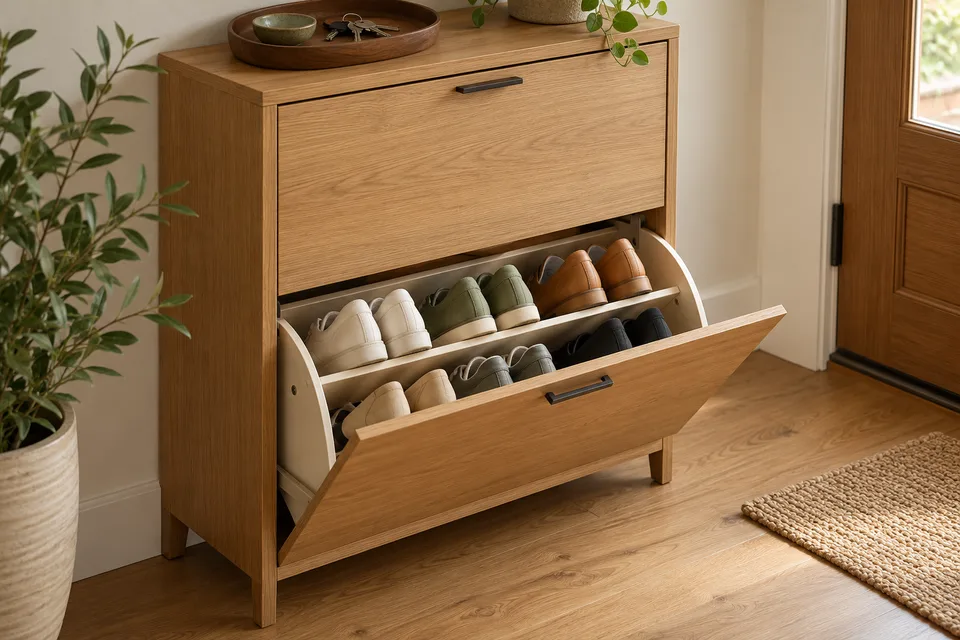
Nothing that sticks out more than 10 inches. A tilt-out shoe cabinet goes flat against the wall with a hook rail above it, and its top is the drop zone. IKEA's 4-compartment STÄLL is among the shallowest of the type at under 7 inches deep, and holds about 8 pairs. If even that blocks the path, an over-door rack takes the coats and the shoes move to a rack inside the nearest closet. The shoe storage guide covers that half.
A true mudroom or garage entry
Here the problem is people, not wall. A locker unit with one section per person ends the pile, and a boot tray at floor level keeps the wet pairs off it. With 48 inches or less of wall, a bench with two rails of hooks at adult and kid height covers a family of four. The mudroom guide has the zone-by-zone layout, and a photo of the space through the mudroom analyzer returns a plan sized to the wall you actually have.
Tips for Choosing Entryway Storage
Six checks before you buy, in the order they matter.
- Measure the walkway, not just the wall. A hall tree is 12 to 16 inches deep and the path past it needs 32 inches clear, so allow up to 48 inches of hall. Narrower halls take the cabinet route.
- Two heights of hooks. 60 inches for adults, 36 to 42 inches for kids. Kids use what they can reach and drop what they cannot.
- Daily rotation only. The entry holds two pairs per person and the rest lives in a closet.
- Wet-boot-proof the floor level. Slatted shelves or a boot tray, never bare fabric cubbies at floor height.
- One drop zone, enforced. A single tray for keys and mail beats five surfaces each holding some of it.
- Check flip-top lids for safety hinges. A lid without a soft-close hinge drops on fingers.
Entryway Storage FAQ
Prices and links for every piece are in the comparison table above.
What's the best entryway storage overall?+
A shoe-shelf storage bench with a hook rail above it, about $80 to $200 for the pair. The bench takes the daily shoes and gives you a seat, the rail takes the coats and keys, and both come with you when you move. Step up to a hall tree only when a single 40-inch wall has to carry everything.
What are the features of a well-designed mudroom storage system?+
Four zones in order of use: a seat, hooks at two heights (60 inches for adults, 36 to 42 inches for kids), open shoe storage for wet-day pairs plus closed storage for the rest, and one drop zone for keys and mail. Per-person cubbies come last. They end arguments but eat the most wall.
Hall tree or a separate bench and hooks?+
A hall tree wins when the entry has one usable wall and nothing else. Separates win when the layout is awkward, such as a corner with room for a bench but not a tall piece, or a long hall where the hooks belong opposite the seat. Separates also survive a move. A hall tree is sized to the wall it was bought for.
What works in a narrow entryway or apartment hall?+
A tilt-out shoe cabinet 7 to 10 inches deep holds 12 or more pairs on a wall a bench would block, and a hook rail with a shelf above it takes the coats and keys. Keep at least 32 inches of clear path past the cabinet, the door-opening minimum. A bench at 12 to 14 inches deep needs a hall 44 to 46 inches wide, depending on its depth, and a hall tree needs 48.
What entryway storage works for renters?+
Freestanding pieces: a hall tree, a bench or a shoe cabinet needs no holes, and an over-door hook rack at $10 to $20 gives five or six coat positions with none. If you do mount a hook rail, use one horizontal board with two anchors; two holes patch in ten minutes at move-out.
How much storage does a family entryway actually need?+
Two hooks and two daily shoe pairs per person, one seat, one drop zone. A family of four needs eight hooks and eight pairs at the door, which is a wide hall tree with six or more hooks plus an over-door rack, or a locker unit with a bench. Everything beyond the daily rotation goes to a closet.